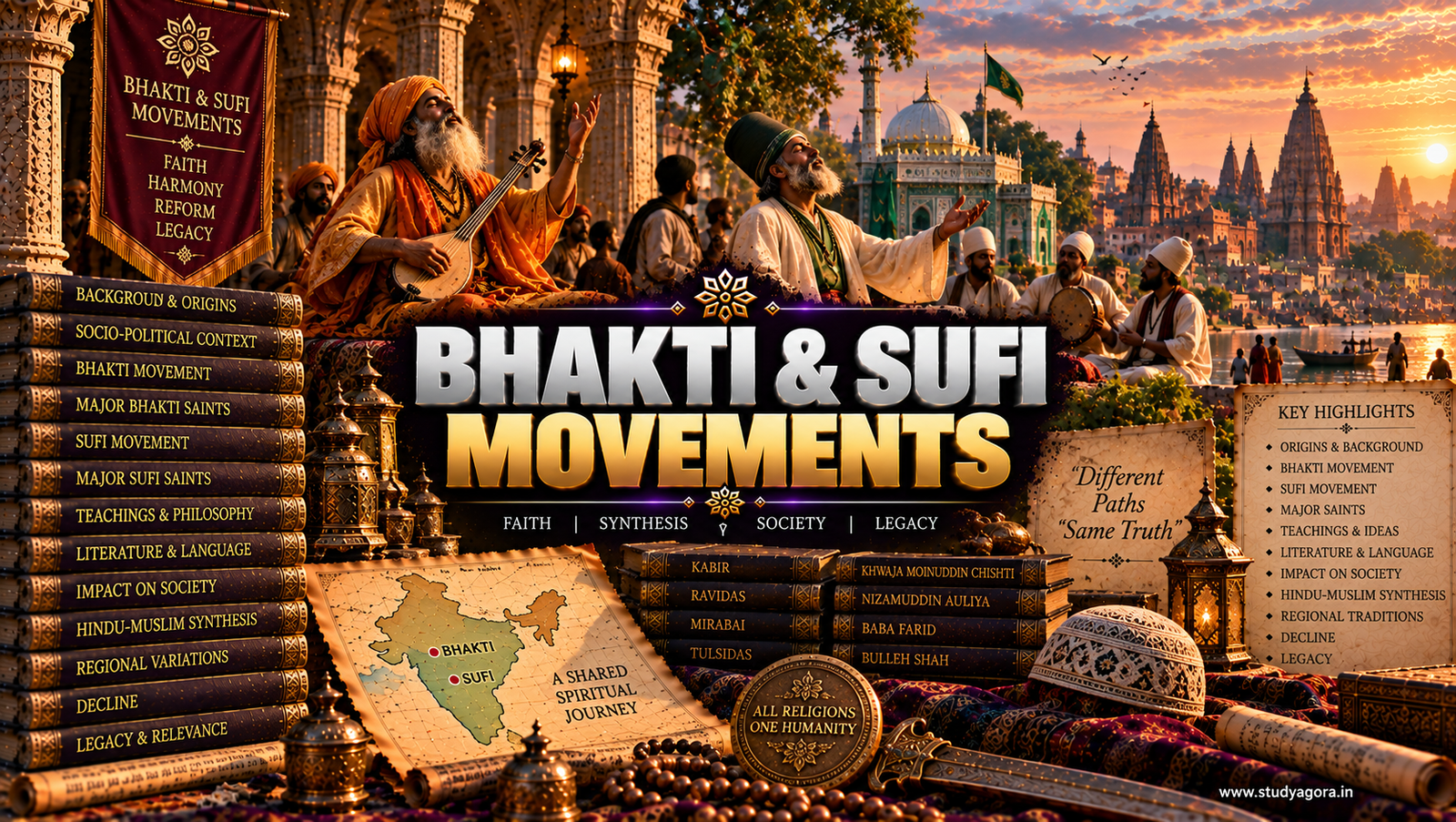
The medieval period in India witnessed parallel, transformative socio-religious movements: the Bhakti Movement within Hinduism and the Sufi Movement within Islam. Arising as reactions against rigid ritualism, priestly monopolies, and social stratifications, both traditions emphasized direct personal devotion to the Divine, spiritual equality, and universal humanism.
Together, these movements broke open orthodox barriers, spurred the growth of regional languages (vernacularization), democratized access to spiritual salvation, and laid the foundation for India’s composite culture (Ganga-Jamuni Tehzeeb).
🔥 Core Core Principles
Bhakti (Root: Bhaj - to worship/devote): Personal love and devotion to God without ritualistic intermediaries.
Sufism (Root: Suf - wool / Safa - purity): Islamic mysticism focused on spiritual union with God through divine love (Ishq).
Shared Vision: Spiritual egalitarianism, rejection of caste/class barriers, use of vernacular tongues, and promotion of communal harmony.
1. 🔱 Origin & Development of the Bhakti Movement
While foundational Bhakti concepts exist in the Shvetashvatara Upanishad and Bhagavad Gita, the movement developed as a mass popular movement in Tamil South India between the 6th and 9th centuries CE under two groups of poet-saints:
Poet-Saint Group
Affiliation & Deity
Number & Key Saints
Literary Anthologies
Alvars
Devotees of Vishnu (Vaishnavites)
12 Saints (including female saint **Andal**, Nammalvar, Kulasekhara)
Nalayira Divya Prabandham (termed the Tamil Veda).
Tevaram (compiled by Nambi Andar Nambi) and Tirumurai.
Northward Migration: In the 14th–15th centuries, saints like **Ramananda** transplanted the Bhakti movement from South India to the Gangetic plains, declaring that spiritual devotion knows no caste distinctions.
2. 🧠 Major Vedantic Schools of Philosophy
Between the 8th and 16th centuries CE, prominent acharyas formulated distinct theological interpretations of the relationship between the Individual Soul (Jiva) and the Supreme Reality (Brahman):
Philosopher & Period
School of Thought (Darshana)
Core Philosophical Concept
Shankaracharya (8th C)
Advaita Vedanta (Absolute Non-Dualism)
Brahman is the sole reality; the world is Maya (illusion). Soul and Brahman are identical ($Jiva = Brahman$). Knowledge (Jnana) is the primary path to liberation.
Ramanujacharya (11th–12th C)
Vishishtadvaita (Qualified Non-Dualism)
Brahman is qualified by attributes; souls and matter are real parts of Brahman. Devotion (Bhakti) and surrender (Prapatti) lead to salvation.
Madhvacharya (13th C)
Dvaita (Dualism)
Complete distinction between Brahman (God) and Jiva (Individual Soul). God, soul, and matter are eternally separate entities.
Nimbarkacharya (12th C)
Dvaitadvaita (Dualistic Non-Dualism)
The soul is both different from and identical to God (like a sunbeam to the sun). Promoted Krishna-Radha devotion.
Vallabhacharya (15th–16th C)
Shuddhadvaita (Pure Non-Dualism)
World is not Maya; Jiva is a non-different part of Brahman without attributes of illusion. Founded the Pushtimarga (Path of Grace).
3. ✨ Nirguna vs. Saguna Traditions & Key Saints
In Northern India, the Bhakti movement split into two primary theological traditions:
Dimension
Nirguna Bhakti (Formless Divine)
Saguna Bhakti (Divine with Attributes)
Core Concept
God is abstract, unconditioned, formless, beyond human qualities. Rejects idol worship and temples.
God manifests in personal, physical incarnations (Avataras) with distinct attributes and forms. Supports idol worship.
Prominent Saints
Kabir, Guru Nanak, Dadu Dayal, Raidas.
Tulsidas, Surdas, Mirabai, Chaitanya Mahaprabhu.
3.1 Key Saints of the Nirguna Tradition
Kabir (15th C): Weaver from Varanasi; disciple of Ramananda. Strongly condemned both Hindu and Islamic orthodoxy, ritualism, and caste barriers. Composed couplets (Dohas) collected in the Bijak (comprising Sakhi, Sabad, Ramaini). Incorporated into the Guru Granth Sahib.
Guru Nanak Dev (1469–1539 CE): Founder of Sikhism; born at Nankana Sahib. Preached Ik Onkar (One Supreme God), rejected caste hierarchy, and instituted the communal kitchen (Langar) and collective prayer (Sangat).
Raidas (Ravidas): Low-caste tanner saint from Varanasi who advocated social equality and pure spiritual devotion.
3.2 Key Saints of the Saguna Tradition
Tulsidas (16th C): Rama Bhakti saint; composed the epic Ramcharitmanas in Awadhi, making the Ramayana accessible to the masses.
Surdas (16th C): Blind disciple of Vallabhacharya; composed Sursagar in Braj Bhasha, celebrating the childhood deeds of Lord Krishna.
Mirabai (16th C): Rajput princess dedicated to Lord Krishna. Composed devotional Bhajans in Rajasthani-Braj Bhasha, defying royal patriarchal conventions.
Chaitanya Mahaprabhu (1486–1534 CE): Bengal saint; founder of Gaudiya Vaishnavism. Popularized congregational chanting and dancing (Sankirtan) of Krishna mantras. Expressed the philosophy of Achintya Bheda Abheda.
Founded in the 12th century CE by Basavanna (along with Allama Prabhu and Akka Mahadevi) in Karnataka.
Social Radicalism: Strongly rejected the caste system, Brahminical supremacy, child marriage, and rituals. Encouraged widow remarriage and post-puberty marriage.
Vachana Literature: Preached through simple Kannada prose lyrics called Vachanas.
Anubhava Mantapa: Established the "Hall of Spiritual Experience," an open forum for socio-religious discussion among all castes and women.
4.2 The Varkari Movement of Maharashtra
Centered on the shrine of Lord Vitthala/Vithoba at Pandharpur. Members undertake an annual pilgrimage (Wari).
Jnaneshwar (Dnyaneshwar): Wrote Jnaneshwari (Marathi commentary on the Bhagavad Gita).
Namdev: Tailor-saint who composed abhangas in Marathi and Hindi; some included in the Guru Granth Sahib.
Eknath & Tukaram: Tukaram was a contemporary of Chhatrapati Shivaji Maharaj, famous for his devotional Abhangas emphasizing moral purity.
5. 🕌 The Sufi Movement: Philosophy, Mysticism & Silsilas
Sufism (Tasawwuf) emerged in Central/Western Asia as an esoteric, mystical movement within Islam, emphasizing inner purification, divine love (Ishq), and union with God (Fana).
5.1 Core Sufic Concepts
Pir / Murshid: Spiritual master or guide.
Murid: Disciple or seeker.
Khanqah: Hospice or monastery where Sufi saints lived and instructed disciples.
Dargah: Tomb shrine of a Sufi saint, functioning as a pilgrimage center (Ziyarat).
Sama: Spiritual musical assemblies designed to induce ecstatic devotion.
Wahdat-ul-Wujud: Doctrine of "Unity of Being" formulated by Ibn-i-Arabi, asserting that all creation is a manifestation of the Divine.
Strictly avoided political patronage, state gifts, and court offices. Adopted musical assemblies (Sama / Qawwali), austerity, and open community kitchens.
Centered in Punjab and Sindh. Accepted state appointments, held royal titles, and accumulated wealth to maintain social influence.
Qadiri Order
Niamatullah, Miyan Mir (spiritual guide of Prince Dara Shikoh).
Moderate, orthodox sunni leanings. Strongly patronized by Dara Shikoh.
Naqshbandi Order
Khwaja Baqi Billah, Sheikh Ahmad Sirhindi (Mujaddid Alf-i-Sani).
Highly orthodox Sunni order; strongly opposed Akbar’s liberal policies, Sulh-i-Kul, and Wahdat-ul-Wujud, asserting Wahdat-ush-Shuhud.
6. ⚖️ Comparative Analysis: Bhakti vs. Sufi Traditions
Comparison Basis
Bhakti Movement
Sufi Movement
Religious Root
Reform tradition within Hinduism (Vedantic / Puranic).
Esoteric mystical branch within Islam (Quranic / Tasawwuf).
Spiritual Leader
Guru / Acharya.
Pir / Murshid / Sheikh.
Devotional Medium
Bhajans, Kirtans, Sankirtan, Abhangas.
Sama, Qawwali, Zikr (remembrance).
Shared Legacy
Rejection of hypocritical ritualism, promotion of universal brotherhood, spiritual equality for women/marginalized groups, and enrichment of local vernacular languages.
7. 🎯 UPSC / UPPCS Prelims High-Yield Fact Vault
📌 Direct Revision Points for Prelims
Nalayira Divya Prabandham: Anthology of 4,000 Tamil verses composed by the 12 Alvars.
Andal: Only female Alvar poet-saint, known as the "Meera of the South."
Advaita Vedanta: Non-dualistic philosophy formulated by Adi Shankaracharya.
Vishishtadvaita: Qualified non-dualist philosophy introduced by Ramanujacharya.
Bijak: Primary collection of Kabir’s poetic compositions (Sakhi, Sabad, Ramaini).
Anubhava Mantapa: Socio-religious Parliament established by Basavanna in Kalyani, Karnataka.
Chishti Silsila: Order introduced in India by Khwaja Moinuddin Chishti of Ajmer.
Wahdat-ul-Wujud: Concept of "Unity of Being" supported by Chishti mystics.
Sirr-i-Akbar: Persian translation of 50 Upanishads by Sufi-inclined Prince Dara Shikoh.
8. ✍️ UPSC Mains Analytical Anchor Points
💡 Structural Value Additions for GS Paper 1
Spiritual Democratization: By rejecting Sanskrit and formal Arabic script monopolies, Bhakti and Sufi saints brought theological discourses directly to the lower castes and uneducated masses.
Linguistic Vernacularization: The movement acted as the primary catalyst for the growth of modern Indian regional literature (Hindi, Marathi, Bengali, Punjabi, Kannada, Assamese).
Ganga-Jamuni Tehzeeb: The syncretic interactions between Sufi hospices (*Khanqahs*) and Bhakti centers created a shared cultural space that fostered religious harmony in medieval India.
9. ❓ FREQUENTLY ASKED QUESTIONS (FAQ)
What are the key philosophical differences between Nirguna and Saguna Bhakti traditions?
Nirguna Bhakti focuses on the worship of a formless, transcendent, unconditioned Divine Reality without anthropomorphic attributes or idol worship (e.g., Kabir, Guru Nanak). Saguna Bhakti focuses on devotion to a personal God with specific forms, qualities, and incarnations, utilizing idols and rituals (e.g., Tulsidas, Surdas, Mirabai).
What was the Chishti order's attitude toward state patronage?
The Chishti Silsila (e.g., Khwaja Moinuddin Chishti, Baba Farid, Nizamuddin Auliya) strictly maintained distance from political power, refusing state patronage, court titles, and royal gifts to preserve spiritual independence. In contrast, orders like the Suhrawardi accepted state appointments and royal wealth.
How did the Bhakti and Sufi movements foster 'spiritual democratization' and 'vernacularization'?
They bypassed Sanskrit and formal Arabic/Persian monopolies by preaching and composing literature in local spoken dialects (Awadhi, Braj Bhasha, Punjabi, Bengali, Tamil, Kannada). By opening spiritual salvation to all gender, class, and caste backgrounds without priestly intermediaries, they democratized religion.
10. 🔗 Next Medieval History Modules in Series
Continue your systematically ordered Medieval History syllabus coverage: