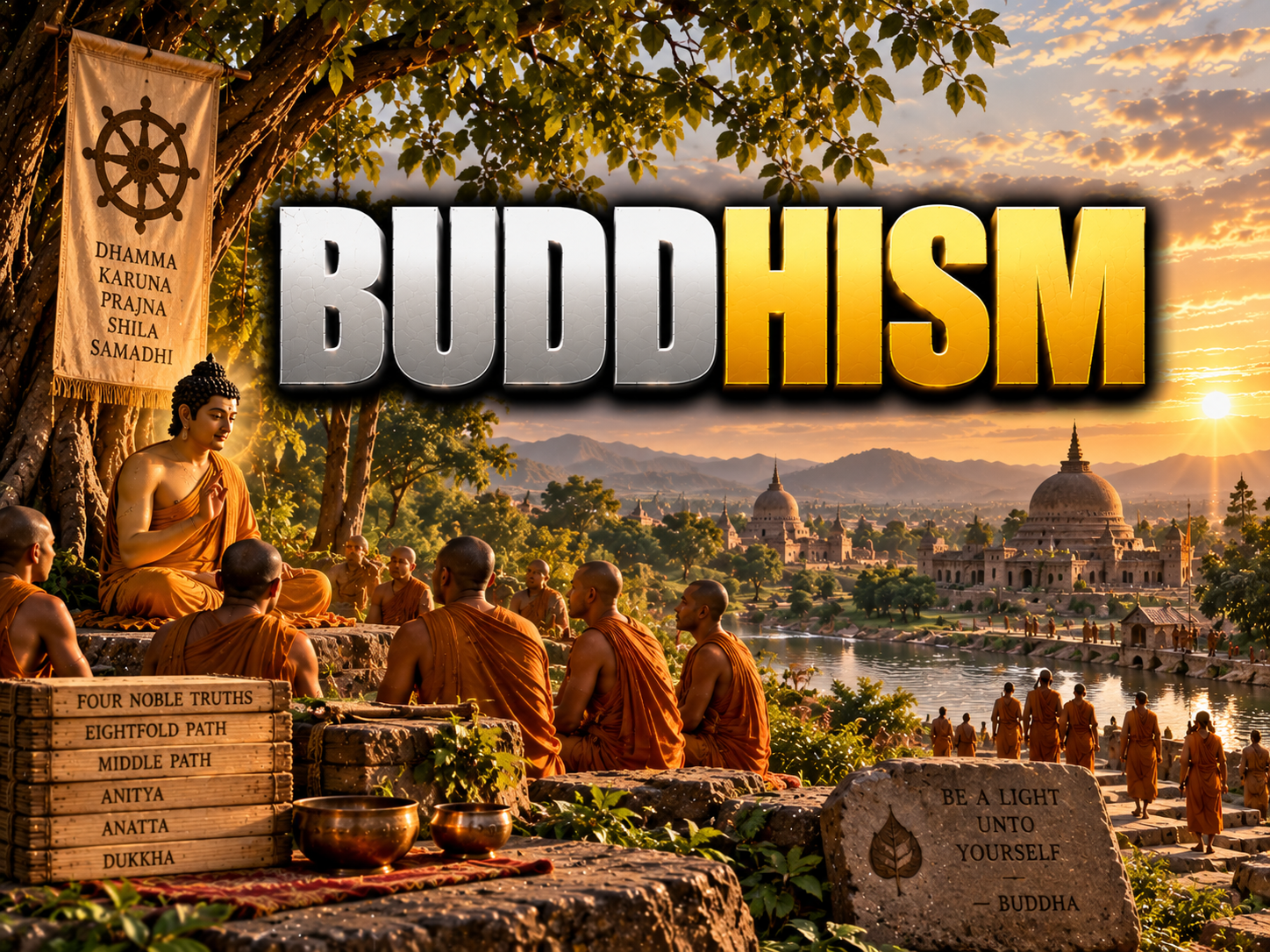
EXHAUSTIVE REVISION FOR UPSC CSE & UPPCS (MODULE 05 OF 15)
🧭 OVERVIEW & EXAM CONTEXT
Buddhism emerged in the 6th century BCE as part of the Sramana Movement—a heterodox intellectual reaction against rigid Brahmanical ritualism, expensive animal sacrifices, and the birth-based Varna hierarchy. Founded by Siddhartha Gautama (The Buddha), Buddhism offered a practical, egalitarian path to liberation (Nirvana) through the Middle Path (Madhyama Marg). It rapidly gained favor among urban merchants, artisans, and monarchs, developing into a major world religion that transformed artistic, political, and philosophical landscapes across Asia.
🔥 Three Jewels of Buddhism (Triratna)
1. Buddha: The Enlightened Teacher. 2. Dhamma: The Philosophical Doctrine / Truth. 3. Sangha: The Monastic Order / Community.
1. 🛕 Life of Siddhartha Gautama (The Buddha)
Siddhartha Gautama was born in 563 BCE (traditionally) at Lumbini (in present-day Nepal) into the Sakya Kshatriya clan. His father, Suddhodana, was the elected chief of Kapilavastu, and his mother was Queen Maya (who died 7 days after his birth, leading to his upbringing by foster mother Mahaprajapati Gautami).
1.1 Five Great Life Events & Symbols
Life Event
Pali / Sanskrit Term
Associated Symbolic Motif
Historical Context
Birth
Janma
Lotus & Bull
Born at Lumbini grove; marked by white elephant dream of Queen Maya.
Great Renunciation
Mahabhinishkramana
Horse (Kanthaka)
Left palace at age 29 accompanied by charioteer Channa after witnessing Four Sights.
Enlightenment
Sambodhi / Nirvana
Bodhi Tree (Peepal)
Attained supreme wisdom at age 35 under Bodhi tree at Uruvela (Bodh Gaya) on Niranjana River.
First Sermon
Dharmachakra Pravartana
Wheel with 8 spokes
Delivered first discourse to 5 disciples (Panchavaggiya) at Deer Park, Sarnath (Isipatana).
Final Demise
Mahaparinirvana
Stupa
Passed away at age 80 at Kusinara (capital of Malla Mahajanapada) after eating meal at Cunda's house.
1.2 The Four Great Sights (Nimitta)
An Old Man: Discovered the physical decay inherent in human aging.
A Diseased Man: Understood that sickness afflicts all physical bodies.
A Dead Body: Realized the absolute inevitability of mortality.
An Ascetic / Recluse: Saw tranquility, purpose, and the possibility of transcending worldliness.
2. ☸️ Core Philosophical Doctrine & Teachings
Buddhism rejects the divine authority of the Vedas, animal sacrifices, and the concept of an immortal, unchanging Soul (Atman). It preaches a rational, psychological approach to ending human suffering.
2.1 The Four Noble Truths (Arya Satya)
Dukkha: Worldly existence is fundamentally full of suffering and sorrow.
Dukkha Samudaya: Suffering has a cause—Desire, Attachment, and Ignorance (Tanha).
Dukkha Nirodha: Suffering can be eliminated completely by overcoming desire.
Dukkha Nirodha Gamini Pratipat: The path to end suffering is the Eightfold Path (Astangika Marga).
2.2 The Noble Eightfold Path (Astangika Marga)
The Middle Path (Madhyama Marg) avoids extreme ascetic self-mortification and extreme sensory indulgence:
Division
Eightfold Step
Pali / Sanskrit Term
Meaning & Ethical Application
Wisdom (Panna)
Right Vision
Samyak Dristi
Understanding the Four Noble Truths and law of karma.
Right Resolve
Samyak Sankalpa
Renouncing ill-will, greed, and harmful thoughts.
Ethics (Sila)
Right Speech
Samyak Vaka
Abstaining from lying, slander, gossip, and harsh speech.
Right Action
Samyak Karma
Practicing non-violence (Ahimsa) and ethical conduct.
Right Livelihood
Samyak Ajiva
Earning a living without causing harm to living beings.
Concentration (Samadhi)
Right Effort
Samyak Vyayama
Preventing unwholesome mental states and fostering positive ones.
Right Mindfulness
Samyak Smriti
Constant awareness of body, feelings, and mental states.
Right Concentration
Samyak Samadhi
Deep meditative focus culminating in Four Dhyanas.
2.3 Philosophical Pillars
Pratityasamutpada (Dependent Origination): "This arising, that arises." Everything in the universe is conditioned by cause-and-effect loops (the 12-linked Nidana chain / Bhavachakra wheel of life).
Anicca (Impermanence): All physical and mental phenomena are in a state of constant flux and impermanence.
Anatta (Non-Self): Rejection of an eternal soul. What is termed "self" is merely a temporary combination of 5 aggregates (Skandhas: Form, Feeling, Perception, Mental Formations, Consciousness).
Kamma & Rebirth: Rebirth is governed by moral action (Karma), but without an enduring soul migrating—rather, momentum of mental energy passes to a new life.
3. 📜 Buddhist Canonical & Non-Canonical Literature
Buddhist texts were preserved orally initially and written down primarily in Pali (for Theravada) and later in Sanskrit (for Mahayana and Tantric traditions).
3.1 The Three Baskets (Tripitakas)
Text Collection
Compiled At / By
Core Content & Key Sub-Divisions
Vinaya Pitaka
1st Council / Compiled by Upali
Monastic rules and discipline code. Contains Suttavibhanga (Patimokkha rules), Khandhaka, and Parivara.
Sutta Pitaka
1st Council / Compiled by Ananda
Core discourses and sermons of Buddha. Divided into 5 Nikayas: Digha, Majjhima, Samyutta, Anguttara, and Khuddaka Nikaya (containing Dhammapada, Thera-Therigatha & Jatakas).
Abhidhamma Pitaka
3rd Council / Compiled by Moggaliputta Tissa
Philosophical and psychological classification of doctrine. Includes 7 books, most notably the Kathavatthu.
3.2 Key Non-Canonical Texts
Milinda Panha (Questions of King Milinda): Dialogue in Pali between Indo-Greek King Menander I (Milinda) and sage Nagasena.
Buddhacharita, Saundarananda & Shariputra-Prakarana: Written in Sanskrit by Asvaghosha (court poet of Kanishka).
Mahavamsa & Dipavamsa: Sri Lankan Pali chronicles detailing Buddhist history, Ashoka's missions, and island lineages.
Madhyamaka Karika: Written by Nagarjuna, establishing the Sunyavada (Emptiness) philosophy.
Visuddhimagga (Path of Purification): Comprehensive Theravada doctrinal encyclopedia composed by Buddhaghosa.
King Ajatashatru (Haryanka) Presided by Mahakassapa
Compilation of Vinaya Pitaka (Upali) and Sutta Pitaka (Ananda) to preserve oral Dhamma after Buddha's death.
2nd Council
c. 383 BCE Vaishali
King Kalasoka (Shishunaga) Presided by Sabakami
First schism in the Sangha over 10 minor monastic rules (Dasa Vatthuni) into Sthaviravadins (conservatives) and Mahasanghikas (reformers).
3rd Council
c. 250 BCE Pataliputra
King Ashoka (Mauryan) Presided by Moggaliputta Tissa
Added Abhidhamma Pitaka; purged heretics; compiled Kathavatthu; dispatched global Buddhist missions (e.g., Mahinda and Sanghamitta to Sri Lanka).
4th Council
c. 72 CE Kundalavana, Kashmir
King Kanishka (Kushana) Presided by Vasumitra (VP: Asvaghosha)
Formal, permanent division into Hinayana and Mahayana; compiled the Mahavibhasha Sastra (Sanskrit encyclopedia).
5. ☸️ Major Buddhist Sects
Feature
Hinayana (Theravada)
Mahayana
Vajrayana (Tantric)
Meaning
"Lesser Vehicle" / Theravada ("School of Elders")
"Greater Vehicle"
"Diamond / Thunderbolt Vehicle"
Concept of Buddha
Historical human teacher who attained Nirvana.
Transcendent god/divinity with cosmic manifestations.
Deified master worshipped via esoteric mudras and mantras.
Ideal Goal
Arhat (Personal individual liberation/Nirvana).
Bodhisattva (Delaying self-liberation to save all beings).
Achieving rapid Buddhahood via Tantric sadhana.
Image Worship
Rejected idol worship; used symbols (Footprints, Stupa).
Central practice; elaborate statues of Buddha and Bodhisattvas.
Deity visualization, mandalas, consorts, and Yantra symbols.
Primary Language
Pali
Sanskrit
Sanskrit, Tibetan, and local dialects
Dominant Regions
Sri Lanka, Myanmar, Thailand, Cambodia, Laos.
China, Japan, Korea, Vietnam, Tibet.
Tibet, Bhutan, Mongolia, Ladakh, Sikkim.
6. 🧠 Deep Philosophical Sub-Schools
Buddhism evolved sophisticated epistemological and metaphysical schools categorized under Hinayana and Mahayana umbrellas:
6.1 Hinayana Schools
Vaibhashika (Direct Realism): Derived from the Mahavibhasha Sastra. Believes in direct perception (Pratyaksha) of both mind and external physical reality as real entities.
Sautrantika (Indirect Realism / Representationalism): Relies strictly on original Suttas. Asserts that external objects are not directly perceived, but inferred (Anumana) through mental impressions left on consciousness.
6.2 Mahayana Schools
Madhyamaka (Sunyavada / Relativity School): Founded by Nagarjuna. Proposes that all things are "empty" (Sunya) of inherent, independent existence because everything exists relative to causes and conditions (Pratityasamutpada).
Yogacara (Vijnanavada / Idealism School): Founded by brothers Asanga and Vasubandhu. Rejects external material reality, stating that everything is a projection of Consciousness (Vijnana-matra) or "Storehouse Consciousness" (Alayavijnana).
7. 🪷 Exhaustive Inventory of Key Bodhisattvas
Bodhisattva Name
Embodied Quality
Iconographic Attributes & Symbols
Key Cultural Role
Avalokiteshvara (Padmapani)
Infinite Compassion (Karuna)
Holds a Lotus flower; small image of Amitabha in crown.
Most widely worshipped; manifests as Guanyin in China.
Manjusri
Transcendent Wisdom (Prajna)
Holds a flaming Sword of Wisdom and a Lotus carrying scripture.
Cuts through ignorance; patron of scholars.
Vajrapani
Spiritual Power & Energy
Holds a Thunderbolt (Vajra); often shown in wrathful stance.
Protector of the Buddha; symbol of fierce defense.
Maitreya
Future Compassionate Savior
Shown seated with a water flask (Kumbha) or stupa in crown.
The Future Buddha currently in Tushita heaven.
Ksitigarbha
Vow to Save Hellish Beings
Holds a monk's staff and a wish-fulfilling jewel.
Savior of souls in purgatory and underworld realms.
Samantabhadra
Action, Practice & Meditation
Rides a white elephant with six tusks; holds a lotus/scroll.
Associated with the Lotus Sutra and moral practice.
Akasagarbha
Boundless Wisdom as Space
Holds a sword and sun/moon symbols.
Purifies sins and clears karmic obstructions.
Tara (Green / White)
Mother of Liberation & Protection
Green Lotus, gesture of boon-granting (Varada Mudra).
Female Bodhisattva central to Vajrayana/Tibetan traditions.
8. 🏛️ Buddhist Art, Architecture & Sculptural Schools
8.1 Architectural Typologies
Stupa: Reliquary mound built over Buddha's bodily remains or possessions. Key elements:
Anda: Hemispherical earth mound representing the dome of heaven.
Harmika: Square balcony atop Anda, symbolizing the abode of gods.
Chhatra: Triple umbrella shaft symbolizing the Triratna.
Pradakshina Patha: Circumambulatory pathway enclosed by a rail (Vedika).
Focus on narrative relief panels depicting Buddha's life and Jataka tales.
Primary Centers
Taxila, Peshawar, Jalalabad, Bamiyan.
Mathura, Sonkh, Kankali Tila.
Amaravati, Nagarjunakonda, Guntupalle.
9. 🎓 Monastic Universities & International Spread
9.1 Key Ancient Mahaviharas (Universities)
Nalanda (Bihar): Founded by Gupta King Kumaragupta I (Mahendraditya) in 5th C. CE. World-famous center for Mahayana, logic, and medicine. Visited by Xuanzang and Yijing. Destroyed by Bakhtiyar Khilji c. 1193 CE.
Vikramashila (Bihar): Founded by Pala King Dharmapala in 8th C. CE. Premier international center for Vajrayana / Tantric Buddhism; directed by Atisa Dipankara.
Odantapuri (Bihar): Established by Pala founder Gopala I; served as a model for Tibet's Samye Monastery.
Vallabhi (Gujarat): Founded under Maitraka patronage; famous center for Hinayana / Theravada studies.
Somapura (Bangladesh): Massive university built by Pala King Dharmapala at Paharpur.
Jagaddala (Bengal): Established by late Pala ruler Ramapala; specializing in Vajrayana.
9.2 International Diffusion Vectors
Sri Lanka: Missionaries Mahinda and Sanghamitta (Ashoka's children) carried Sri Maha Bodhi sapling and Theravada texts to Anuradhapura.
Central Asia & China: Silk Road monks like Kasyapa Matanga, Kumarajiva, and Bodhidharma (who founded Chan/Zen Buddhism) transmitted Mahayana texts to China.
Tibet & Himalayan Realm: Padmasambhava (Guru Rinpoche) and Atisa Dipankara introduced Vajrayana to Tibet, establishing monastic orders.
10. 🎯 UPSC / UPPCS Prelims High-Yield Fact Vault
📌 Memory Keys for Direct Prelims MCQs
First Female Disciple: Gautami Prajapati (foster mother) inducted at Vaishali after Ananda's plea.
First Two Lay Disciples: Tapassu and Bhallika (merchants from Odisha).
Early Teachers of Buddha: Alara Kalama (Sankhya philosopher) and Uddaka Ramaputta.
Place of First Sermon: Deer Park at Sarnath (Isipatana).
Language of Early Teachings: Pali (populist vernacular).
Great Schism Council: 4th Council at Kashmir under Kanishka.
Kathavatthu Author: Moggaliputta Tissa (compiled during 3rd Council at Pataliputra).
Kanaganahalli Discovery: Inscribed slab of Ranyo Asoka (King Ashoka) found in Karnataka.
UNESCO World Heritage Sites (Buddhist): Sanchi Monuments (MP), Ajanta Caves (MH), Mahabodhi Temple Complex (Bihar), Nalanda Mahavihara (Bihar).
11. ✍️ UPSC Mains Analytical Anchor Points
💡 Structural Value Additions for GS Paper 1
Socio-Economic Catalyst for Rise: Buddhism gained popularity because it catered to the rising merchant class (Setthis) who wanted a philosophy that legitimized trade, rejected costly Vedic sacrifices, and offered higher social status free from Varna constraints.
Democratic Principles in Sangha: The Buddhist Sangha was governed like a Gana-Sangha republic—using formal motions (Natti), quorums, secret ballot voting via wooden sticks (Salaka), and consensus building.
Decline Factors in India: Re-absorption by revised Brahmanical Hinduism (Buddha recognized as 9th Avatar of Vishnu), corruption within wealthy monasteries, loss of royal patronage, adoption of Sanskrit over vernacular, and destruction of monastic centers like Nalanda by Bakhtiyar Khilji (1193 CE).
12. ❓ FREQUENTLY ASKED QUESTIONS (FAQ)
What are the Four Great Events (Mahaparivartana) in the Buddha's life?
The four main events are Janma (Birth at Lumbini), Mahabhinishkramana (Great Renunciation), Sambodhi/Nirvana (Enlightenment at Bodh Gaya), and Dharmachakra Pravartana (First Sermon at Sarnath).
What is the key difference between Gandhara and Mathura schools of Buddhist art?
Gandhara art was heavily influenced by Greco-Roman styles, using blue-grey schist stone to portray Buddha with wavy hair and draped robes. Mathura art was indigenous, using spotted red sandstone, depicting Buddha with a muscular physique, shaved head or topknot, and smiling facial expressions.
What are the three canonical Pitakas of Buddhist literature?
The Tripitakas are the Vinaya Pitaka (monastic discipline rules), Sutta Pitaka (discourses and teachings of Buddha), and Abhidhamma Pitaka (philosophical and psychological analysis).
13. 🔗 Next Ancient History Modules in Series
Continue your systematically ordered Ancient History syllabus coverage: