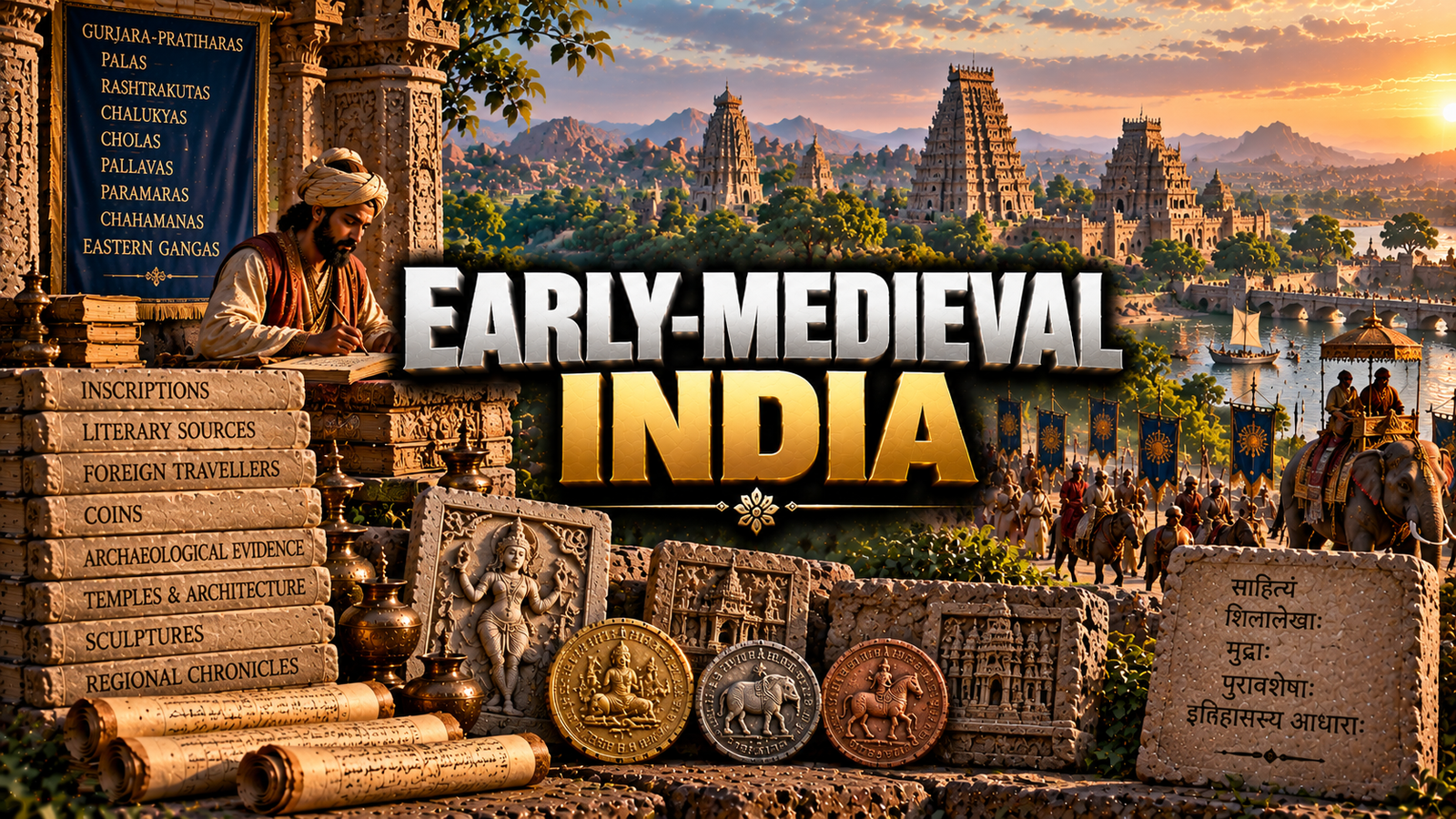
The period between c. 750 and 1200 CE bridges the collapse of ancient imperial structures (such as the Gupta and Pushyabhuti realms) and the establishment of the Delhi Sultanate. Colonial historiography initially mischaracterized this epoch as a "Dark Age" marked by political anarchy and economic decay. Modern historical analysis, however, reinterprets this era as a dynamic phase of state formation, agrarian expansion, tribal integration, and regional identity building.
🔥 Key Historical Paradigm
Early Medieval India represents a shift from centralized empire-building to decentralized regional state polities. Land grants served as the primary mechanism for agrarian expansion into peripheral forests, giving rise to localized landed elites, temple urbanism, and distinctive regional art styles.
1. 🏛️ Political Structure & The Tripartite Struggle
Following the decline of Harshavardhana's empire, political supremacy in Northern India centered on controlling Kannauj (Kanyakubja) in the fertile Gangetic Doab. Control over Kannauj symbolized imperial overlordship and guaranteed access to vital trade routes.
1.1 The Tripartite Rivalry
For over two centuries, three major regional dynasties engaged in a continuous military struggle for hegemony:
The Palas of Bengal and Bihar: Founded by Gopala I (c. 750 CE); major patrons of Mahayana and Vajrayana Buddhism. Expanded westwards under Dharmapala and Devapala.
The Gurjara-Pratiharas of Western India: Originating in Rajasthan/Malwa; acted as a defense line against Arab forces from Sindh. Mihira Bhoja established firm control over Kannauj.
The Rashtrakutas of Manyakheta: Deccan-based power founded by Dantidurga. Regularly launched northern raids across the Vindhyas under Dhruva, Govinda III, and Indra III.
Dynasty
Geographical Base
Prominent Monarchs
Key Cultural & Political Legacy
Palas
Bengal and Bihar
Gopala I, Dharmapala, Devapala
Founded Vikramashila and Somapura Mahaviharas; promoted Pala bronze art.
Gurjara-Pratiharas
Malwa, Rajasthan, Kannauj
Nagabhata I, Mihira Bhoja, Mahendrapala I
Built Maru-Gurjara style temples; patronized poet Rajashekhara.
Rashtrakutas
Deccan (Manyakheta)
Dantidurga, Krishna I, Amoghavarsha I
Commissioned Ellora Kailashnath Temple; patronized early Kannada literature.
2. ⚖️ Historiographical Debate: Indian Feudalism vs. Integrative Model
The nature of the early medieval state remains one of the most debated topics in Indian history. Three primary analytical models explain this period:
2.1 Indian Feudalism Thesis (R.S. Sharma, D.N. Jha)
Mechanism: Widespread royal land grants (Brahmadeya and Devadana) alienated sovereign rights, transferring judicial, fiscal, and administrative authority to landed intermediaries.
Consequences: Political fragmentation, rise of autonomous Samantas, decline of long-distance trade, urban decay, demonetization, and the subjugation of peasantry bound to land (serfdom-like conditions).
2.2 Segmentary State Model (Burton Stein)
Derived from South Indian Chola studies. Asserts that political sovereignty was dual: actual political control was decentralized at the local micro-region level (Nadu), while the center exercised only ritual sovereignty.
2.3 Integrative / Processual Model (B.D. Chattopadhyaya, Hermann Kulke)
Rejects the "decline" narrative of feudalism. Argues that land grants were an integrative mechanism that introduced agriculture to tribal frontiers, fostered horizontal state formation, stimulated local trade networks, and led to the organic growth of regional polities.
3. 📜 Land Grant System & Agrarian Restructuring
Land grants recorded on copper plates (Tamra-patra) served as the primary instrument of socio-economic policy during this era.
Grant Category
Primary Beneficiary
Exemptions & Rights Transferred
Brahmadeya
Individual Brahmins or groups
Tax-free land rights (Akaradaya), along with rights over water bodies and hidden treasures.
Agrahara
Brahmin settlements / Colleges
Revenue-free village clusters granted for educational and religious maintenance.
Devadana / Devagrahara
Temples and religious mathas
Revenues dedicated perpetually to maintaining temple daily rituals and festivals.
Secular Land Grants
Military and civil officers
Assigned revenue rights (Bhoga) in lieu of cash salaries, strengthening the Samanta hierarchy.
3.1 Socio-Economic Impacts of Grants
Agrarian Expansion: Virgin forests were cleared for cultivation, expanding the agricultural tax base.
Peasant Dependence: Local peasants lost direct connection to the monarch, paying rents and labor services (Vishti) directly to local intermediaries.
Tribal Assimilation: Forest tribes were brought into the agrarian economy and integrated into the lower tiers of the Varna framework as Shudras.
4. 👑 Rise of Rajputs & Origin Theories
The 9th to 12th centuries witnessed the political ascendancy of the Rajputs in Western and Central India, organized into clan-based lineages (such as Chauhans, Chandelas, Paramaras, and Solankis).
4.1 Historiographical Theories on Rajput Origin
Foreign Origin Theory (James Tod, V.A. Smith): Suggests Rajputs descended from post-Gupta Central Asian invaders (Sakas, Hunas, Kushanas) who settled in India and were integrated into the Kshatriya fold through purification rituals.
Agnikula Myth (Chand Bardai's Prithviraj Raso): States that four Rajput clans—Paramaras, Pratiharas, Chaulukyas (Solankis), and Chahamanas (Chauhans)—emerged from a sacred fire altar (Yajna-kunda) on Mount Abu performed by Sage Vashistha to destroy demons.
Social Mobility / Kshatriyazation Model (B.D. Chattopadhyaya): Views Rajputization as a process of social elevation where local tribal leaders and ruling lineages acquired Kshatriya status by patronizing Brahmins, fabricating solar/lunar genealogies (Suryavamsi/Chandravamsi), and constructing forts.
5. 🏺 Economy, Trade Dynamics & Temple Urbanism
5.1 Trade Dynamics: Debate on Monetization
Early Phase (c. 750–1000 CE): Marked by localized barter systems, cowrie shells, and limited high-value metallic coinage (such as Pratihara Adivaraha coins and Rashtrakuta Drammas).
Later Revival (c. 1000–1200 CE): Re-emergence of active trade routes, proliferation of merchant guilds (such as Manigramam, Ayyavole 500, and Anjuvannam), and vibrant maritime commerce with Southeast Asia (Srivijaya) and the Fatimid Arab world.
5.2 Temple Urbanism & Economic Hubs
Temples transcended their role as religious spaces to become central economic engines of early medieval India:
Landed Proprietors: Managed vast agricultural lands received through Devadana grants.
Major Employers: Supported priests, architects, sculptors, weavers, musicians, and dancers.
Financial Institutions: Received monetary deposits, offered loans at interest to trader guilds, and invested in irrigation infrastructure (tanks and canals).
Urban Catalysts: Temple complexes attracted pilgrimage markets, developing into major urban centers (such as Tanjore, Kanchipuram, Puri, and Khajuraho).
6. 🏹 Social Proliferation, Caste Rigidity & Gender Status
Proliferation of Jatis: Increase in sub-castes due to the assimilation of regional tribes, occupational guilds hardening into hereditary castes, and foreign ethnic absorption.
Rise of the Kayastha Community: Emerged as a distinct occupational caste responsible for drafting royal charters, maintaining land records, and managing revenue accounts.
Condition of Women: Property rights expanded for upper-class women in legal treatises like the Mitakshara (by Vijnanesvara) and Dayabhaga (by Jimutavahana). However, social restrictions increased, marked by child marriage, purdah among royalty, and the practice of Sati and Jauhar.
7. 🏰 Major Regional Powers Overview
Region
Ruling Dynasty
Capital
Key Historical Contribution
Bengal
Palas & Senas
Gauda / Bikrampur
Patronized Nalanda and Vikramashila; Jayadeva composed Gita Govinda under Lakshmana Sena.
Rajasthan & Delhi
Chahamanas (Chauhans)
Ajmer / Dhillika
Prithviraj Chauhan III resisted Ghurid invasions before falling at the 2nd Battle of Tarain (1192 CE).
Bundelkhand
Chandelas
Khajuraho / Kalinjar
Constructed the Khajuraho temple complex, featuring the Kandariya Mahadeva temple.
Gujarat
Chaulukyas (Solankis)
Anhilwara
Built the Sun Temple at Modhera and Rani ki Vav stepwell; patronized Jain scholar Hemachandra.
Malwa
Paramaras
Dhar
King Bhoja, a renowned polymath, authored works on architecture (Samarangana Sutradhara) and poetics.
Odisha
Eastern Gangas
Kalinganagara
Constructed the Jagannath Temple at Puri (Anantavarman Chodaganga) and Sun Temple at Konark (Narasimhadeva I).
8. 🎯 UPSC / UPPCS Prelims High-Yield Fact Vault
📌 Direct Revision Points for Prelims
Mitakshara Legal School: Authored by Vijnanesvara; applied throughout India except Bengal/Assam, granting inheritance rights to sons by birth.
Dayabhaga Legal School: Authored by Jimutavahana; prevailed in Bengal/Assam, where inheritance rights accrued only after the father's death.
Kayasthas: First mentioned as a distinct caste in early medieval smritis (such as Vedavyasa Smriti).
Ayyavole 500 & Manigramam: Prominent South Indian merchant guilds operating internal and trans-oceanic trade networks.
Rajashekhara: Sanskrit court poet patronized by Pratihara rulers; wrote Kavyamimamsa, Karpuramanjari, and Balaramayana.
King Bhoja of Dhar: Polymath ruler who founded the Bhojpur temple and established the Bhoj Shala learning center.
9. ✍️ UPSC Mains Analytical Anchor Points
💡 Structural Value Additions for GS Paper 1
Transition, Not Dark Age: Early Medieval India was a formative era during which regional languages (Proto-Bengali, Old Marathi, Kannada, Gujarati) and distinctive architectural styles (Nagara, Dravida, Vesara) developed fully.
Socio-Economic Integration: Land grants acted as an effective institutional mechanism for integrating tribal frontiers into agrarian society and extending Sanskrit culture across regions.
Weakness of Clan-Based Polity: The inability of Rajput kingdoms to establish a unified central command, combined with recurring internal rivalries, rendered Northern India vulnerable to Ghurid military tactics in the late 12th century.
10. ❓ FREQUENTLY ASKED QUESTIONS (FAQ)
What is the Indian Feudalism thesis proposed by R.S. Sharma?
R.S. Sharma argued that widespread land grants (Brahmadeya and Devadana) led to the fragmentation of political authority, decline of trade and urban centers, demonetization, and the subjection of peasantry to local landed intermediaries.
What was the integrative model of state formation suggested by B.D. Chattopadhyaya?
B.D. Chattopadhyaya countered the feudal decline model by arguing that land grants led to agrarian expansion, tribal integration into the caste hierarchy, and the organic growth of regional state polities and commercial networks.
What is the Agnikula origin myth of the Rajputs?
Mentioned in Chand Bardai's Prithviraj Raso, the Agnikula myth claims four major Rajput clans—Paramaras, Pratiharas, Chaulukyas (Solankis), and Chahamanas (Chauhans)—emerged from a sacrificial fire pit (Yajna) performed by Sage Vashistha at Mount Abu to protect Dharma.
11. 🔗 Next Medieval History Modules in Series
Continue your systematically ordered Medieval History syllabus coverage: