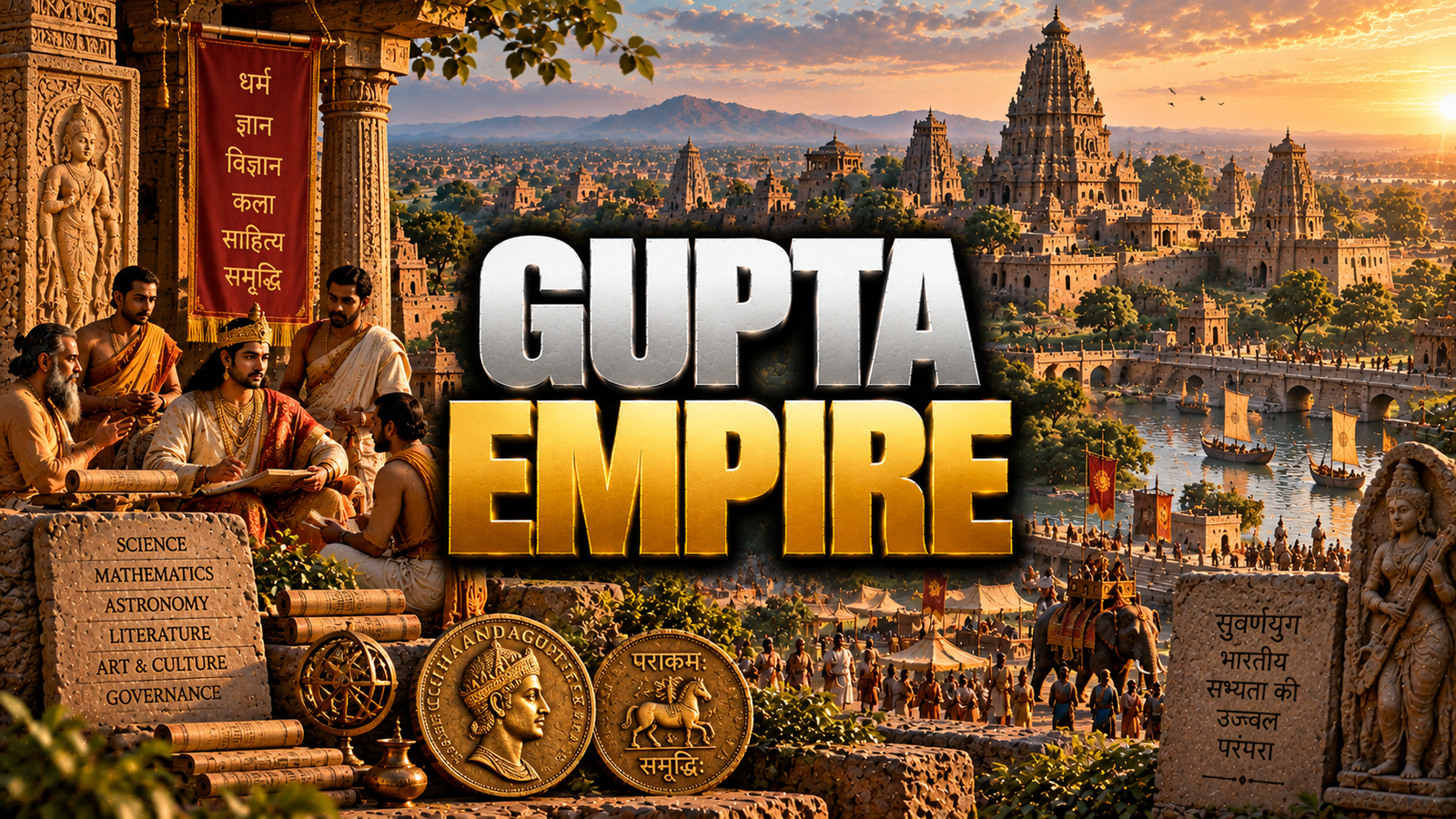
EXHAUSTIVE REVISION FOR UPSC CSE & UPPCS (MODULE 09 OF 15)
🧭 OVERVIEW & THE "GOLDEN AGE" HISTORIOGRAPHICAL DEBATE
The establishment of the Gupta Empire in the early 4th century CE ended centuries of political fragmentation following the decline of the Kushanas and Satavahanas. Traditionally characterized as the "Classical Age" or "Golden Age" of Ancient India, this period witnessed unprecedented heights in classical Sanskrit literature, mathematical and astronomical discoveries, metallurgical engineering, and the inception of structural Nagara temple architecture. However, modern historiography emphasizes that it also marked the structural emergence of Indian political feudalism, administrative decentralization, forced labor (Vishti), economic ruralization, and social rigidities such as untouchability.
🔥 KEY PARADIGM SHIFT
In sharp contrast to the centralist, direct bureaucratic machinery of the Mauryas, the Gupta state operated on a decentralized, feudal structure. The emperor ruled through autonomous vassals (Samantas), hereditary officials, and widespread royal land grants (Agraharas) transferred to religious beneficiaries.
1. 👑 Political History & Major Imperial Rulers
1.1 Early Founders
Sri Gupta & Ghatotkacha: The earliest recorded ancestors of the dynasty who held the modest title of Maharaja, suggesting they functioned as local feudatories (likely under Kushana overlordship) in the Magadha-Pataliputra region.
1.2 Chandragupta I (c. 319 – 335 CE)
Imperial Sovereign: First ruler of the dynasty to assume the paramount imperial title Maharajadhiraja ("King of Great Kings").
Gupta Era Commencement: Founded the Gupta Era in 319–320 CE to commemorate his formal imperial coronation.
Lichchhavi Matrimonial Alliance: Married Princess Kumaradevi of the prestigious Lichchhavi clan of Vaishali. This alliance elevated Gupta political prestige and expanded their territorial foothold across Bihar and Oudh. Celebrated this union by issuing gold coins (*Kumaradevi-Chandragupta type*).
1.3 Samudragupta (c. 335 – 375 CE)
Epitheted by historian V.A. Smith as the "Napoleon of India" for his expansive military campaigns that brought virtually the entire subcontinent under direct rule or tributary vassalage.
Restored imperial sovereignty through military genius; performed the Ashvamedha Yajna (issued specialized Ashvamedha-type gold coins).
An accomplished poet and musician, he assumed the title Kaviraja ("King among Poets") and was depicted playing the Veena (lute) on his gold coins.
Granted royal permission to King Meghavarman of Sri Lanka to construct a Buddhist monastery at Bodh Gaya.
1.4 Chandragupta II "Vikramaditya" (c. 380 – 415 CE)
Extended the empire to its maximum territorial extent. Annihilated the last Shaka Western Kshatrapa ruler, Rudrasimha III, annexing Malwa, Kathiawar, and Gujarat. Assumed the titles Vikramaditya and Sakari ("Conqueror of Shakas").
Gained direct access to prosperous Arabian Sea trade ports—including Barygaza (Bharuch), Cambay, and Sopara—boosting maritime commercial ties with the Mediterranean world.
Fa-Hien's Account: Chinese Buddhist monk Fa-Hien visited India during his reign (c. 399–414 CE), documenting a peaceful, prosperous society where justice was mild, physical punishments rare, and vegetarianism widely practiced.
Cultural Center: Established a secondary capital at Ujjain, which emerged as a premier intellectual hub housing the famed Navaratnas (Nine Gems).
Kumaragupta I (Shakraditya): Enjoyed a long, peaceful reign. Founded the world-renowned Nalanda Mahavihara (University). Devotee of Lord Kartikeya; performed the Ashvamedha sacrifice.
Skandagupta: The last formidable Gupta emperor. Faced a grave military crisis from the invasion of the Hunas (Central Asian White Huns led by Toramana and Mihirakula). Successfully repelmed the Hunas, a feat recorded in the Bhitari Pillar Inscription (Ghazipur, UP). Repaired the embankment of Sudarshana Lake in Gujarat through his governor Parnadatta.
Inscribed on an Ashokan sandstone pillar at Allahabad (Prayagraj), the Prayag Prashasti was composed in Sanskrit prose and verse (Champu style) by Samudragupta's court poet and minister of war, Harisena.
Geographical Region
Sanskrit Policy Term
Imperial Conquest & Governance Strategy
Aryavarta (North India)
Prasabhoddharana
"Violent extermination" and direct military annexation of 9 North Indian rulers (e.g., Nagasena, Achyuta, Ganapatinaga); incorporated directly into core Gupta territory.
Dakshinapatha (South India)
Grahana-Mokshanugraha
"Capturing, liberating, and restoring" 12 Southern monarchs (e.g., Vishnugopa of Kanchi); reinstated as autonomous tributary rulers upon payment of annual homage.
Atavika Rajya (Forest Tribes)
Paricharakikrita
Reducing forest chieftains of Central India and Chota Nagpur into hereditary "servants/vassals" of the crown.
Pratyanta (Frontier States) & Foreign Kings
Sarvakaradana / Kanyadayana
Frontier states (Samatata, Davaka, Kamarupa, Nepal, Kartripura) and foreign dynasties (Shakas, Kushanas, Ceylon) paid tribute, obeyed imperial commands, and offered daughters in marriage.
3. ⚙️ Administrative Structure & Rise of Indian Feudalism
3.1 Administrative Hierarchy
The administrative structure was organized in a tiered hierarchy, with local bodies exercising considerable authority:
Territorial Unit
Governing Officer
Administrative Advisory Council / Functions
Bhukti (Imperial Province)
Uparika (often royal princes)
Supreme provincial executive and revenue administration.
Vishaya (District)
Vishayapati
Advised by a district council comprising: Nagarasreshthi (Guild President), Sarthavaha (Chief Merchant), Prathama-Kulika (Chief Artisan), and Prathama-Kayastha (Chief Scribe).
Vithi (Sub-District)
Vithimahatara
Managed local land transactions and revenue assessments.
Grama (Village Unit)
Gramika / Gramadhyaksha
Assisted by a council of village elders called Mahattaras.
3.2 Feudal Institutions & Agrarian Taxes
Agrahara / Devagrahara Grants: Royal land grants transferred perpetually and tax-free to Brahmins and temples. Recipients received full administrative and judicial immunities (*Suryachandrakalin*), excluding royal officers from entering grant lands.
Emergence of the Samanta System: Subjugated kings and land grantees evolved into autonomous feudal lords (Samantas and Mahasamantas) who supplied military contingents to the emperor, gradually weakening central authority.
Vishti (Forced Labor): Villagers were subjected to compulsory, unpaid forced labor (Vishti) for royal troops and state projects—a tax form absent in Mauryan records.
Tax Structure: Standard land tax was Bhaga (typically 1/6th of produce). Other levies included Bhoga (periodic supplies of firewood, fruits, and flowers to the king), Kara (periodic property tax), and Udranga (tax on permanent tenants).
Numismatic Shift: Issued the highest volume of Gold Coins (Dinars) in ancient India, decorated with imperial motifs. However, late-period dinars suffered severe metallic debasement (alloy contamination). Copper coinage was extremely scarce, indicating that small local transactions relied on cowrie shells (*Kowris*).
The Gupta era represents an intellectual zenith in physical sciences, mathematics, astronomy, and metallurgy:
4.1 Astronomy & Mathematics
Aryabhatta (c. 476 – 550 CE): Authored the groundbreaking treatises Aryabhatiya and Surya Siddhanta.
Asserted that the Earth is spherical and rotates on its own axis.
Provided the scientific explanation for solar and lunar eclipses (shadows of Earth and Moon), rejecting the mythical Rahu-Ketu theory.
Calculated the exact value of Pi ($\pi \approx 3.1416$) and the solar year duration ($365.358$ days).
Formulated fundamental rules for algebra, trigonometry, and sine tables.
Varahamihira (c. 505 – 587 CE): Polymath in Chandragupta II's court. Authored Panchasiddhantika (summarizing 5 older astronomical systems: Paulisa, Romaka, Vasishtha, Saura, Paitamaha), Brihat Samhita (an encyclopedia on geography, weather, architecture, and botany), and Brihat Jataka.
Brahmagupta (c. 598 – 668 CE): Authored Brahmasphutasiddhanta. Formulated the mathematical rules governing Zero ($0$) and negative numbers; anticipated Newton's law of gravitation by stating that objects fall towards Earth due to an inherent attractive force.
4.2 Medicine & Metallurgy
Dhanvantari: Legendary patron physician of Ayurveda, associated with the court of Chandragupta II.
Vagbhata: Compiled the medical treatise Ashtanga Hridaya / Ashtanga Samgraha, condensing Sushruta and Charaka's medical knowledge.
Hastayurveda: Authored by Palakapya, focusing on veterinary medicine and elephant care.
Mehrauli Iron Pillar (Delhi): Standing over 23 feet tall, this unrustable forged iron pillar commemorates King Chandra (identified with Chandragupta II). Demonstrates advanced corrosion-resistant iron smelting technology.
5. 📜 Classical Sanskrit Literature & The Nine Gems (Navaratnas)
Sanskrit became the undisputed official court language, replacing Prakrit in administrative epigraphs and literature.
Fables / Political instruction through animal stories.
Shudraka
Mrichchhakatika ("The Little Clay Cart")
Social Drama depicting love between merchant Charudatta and courtesan Vasantasena.
Vishakhadatta
Mudrarakshasa & Devichandraguptam
Political plays detailing Mauryan coup and Chandragupta II's rise.
Amarasimha
Amarakosha
Sanskrit Lexicon and Vocabulary Thesaurus.
Bhasa
Svapnavasavadattam, Urubhanga
Sanskrit Dramas based on epic lore.
Kandaka / Kamandaka
Nitisara
Treatise on Statecraft (Gupta-era counterpart to Arthashastra).
6. 🎨 Origin of Nagara Temple Architecture & Sculptural Art
6.1 Evolution of Structural Temples
The Gupta era marks the beginning of free-standing structural stone temple construction in India, laying the foundations of the Nagara style:
Stage I: Flat-roofed, square sanctums: Simple flat roofs, low plinths, shallow portico resting on columns (e.g., Temple No. 17 at Sanchi; Kankali Devi Temple at Tigawa, MP).
Stage II: Addition of Pradakshina Patha: Covered ambulatory passageway added around the sanctum (e.g., Parvati Temple at Nachna Kuthara, MP).
Stage III: Emergence of Shikhara & Panchayatan Layout: Development of low curvilinear towers (Shikhara) atop the Garbhagriha and a 5-shrine complex layout:
Dashavatara Temple (Deogarh, UP): Oldest surviving stone temple with a Shikhara, featuring intricate reliefs of Vishnu on Sheshanaga and a Panchayatan layout.
Bhitargaon Temple (Kanpur, UP): A rare surviving Gupta temple constructed entirely of brick and terracotta, featuring a terraced Shikhara.
6.2 Sculptural Centers & Cave Paintings
Sarnath School of Sculpture: Achieved monumental perfection, characterized by spiritual calm, transparent robes without deep folds, and elaborate carved halos behind the head (e.g., *Sarnath Seated Buddha in Dharmachakra Pravartana Mudra*).
Sultanganj Copper Buddha: A colossal 7.5-foot tall metallic Buddha statue cast via lost-wax technique (currently housed in the Birmingham Museum).
Ajanta Cave Paintings (MH): Caves 16, 17, and 19 belong to the Gupta-Vakataka era. Executed using *fresco-secco* techniques, depicting Jataka stories (e.g., *Dying Princess* in Cave 16; *Masterpiece Paintings of Padmapani and Vajrapani* in Cave 1).
Bagh Caves (MP): Rock-cut cave group known for non-religious, secular mural wall paintings.
7. 📉 Causes of Imperial Decline & Huna Invasions
Huna Military Invasions: Catastrophic invasions by the Central Asian White Huns (led by Toramana and Mihirakula) during the 5th and 6th centuries CE drained the imperial treasury and broke Gupta military control over northern India.
Rise of Powerful Feudatories: Feudal lords exploited central weakness to assert independence, including the Maukharis of Kannauj, the Maitrakas of Vallabhi, Yasodharman of Malwa, and the Pushyabhutis of Thanesar.
Economic Fragmentation: Loss of western maritime trade ports in Gujarat disrupted foreign trade revenues, causing currency debasement and a shift toward localized agrarian self-sufficiency.
Succession Wars & Partition: Weak rulers following Skandagupta (Purugupta, Narasimhagupta, Bhanugupta) divided imperial territories among rival branches.
8. 🎯 UPSC / UPPCS Prelims High-Yield Fact Vault
📌 Memory Keys for Direct Prelims MCQs
Prayag Prashasti Author: Harisena (Minister of War) in Sanskrit prose and verse.
First Epigraphic Mention of Sati: Eran Stone Inscription (510 CE) under King Bhanugupta (recording the Sati of general Goparaja's wife).
Gupta Gold Coinage: Known as Dinars; silver coins were termed Rupaka.
Vishti: Compulsory forced, unpaid labor demanded by state officers.
Founder of Nalanda University: Kumaragupta I (Shakraditya).
First Brick Temple: Bhitargaon Terracotta/Brick Temple at Kanpur (UP).
Mehrauli Iron Pillar Location: Qutb Complex, Delhi (commemorates King Chandra / Chandragupta II).
Chinese Traveller during Chandragupta II: Fa-Hien (Faxian).
9. 📝 Previous Year Question (PYQ) Themes
Harisena's Prayag Prashasti as a source of Samudragupta's military campaigns and imperial policy.
Contributions of Gupta scientists (Aryabhatta, Varahamihira) to mathematics, astronomy, and metallurgy.
Evolution of early Nagara temple architecture: Sanchi Temple 17, Deogarh Dashavatara, and Bhitargaon.
Rise of Indian feudalism: Feudal lords (Samantas), land grants (Agraharas), and forced labor (Vishti).
Comparative assessment: Historiographical debate on the Gupta period as the "Golden Age" vs. a period of social rigidity and economic decline.
10. ✍️ UPSC Mains Analytical Anchor Points
💡 Structural Value Additions for GS Paper 1
Deconstruct the "Golden Age" Myth: While the Gupta era saw remarkable achievements in elite Sanskrit arts, mathematics, and temple architecture, it also marked the intensification of social stratification, the emergence of untouchability, the growth of forced labor (Vishti), and economic ruralization.
Institutional Beginnings of Feudal Decoupling: The widespread grant of tax-free land (Agraharas) with judicial immunity created pockets of private authority, laying the framework for early medieval Indian feudalism.
Legacy in Architecture and Literature: The Gupta era established standard structural templates for Indian temple architecture (Nagara style) and classic Sanskrit literary conventions that influenced regional artistic developments for over a millennium.
11. ❓ FREQUENTLY ASKED QUESTIONS (FAQ)
What are the four distinct conquest policies mentioned in Samudragupta's Prayag Prashasti?
Harisena's Prayag Prashasti outlines four policies: Prasabhoddharana (violent extermination in Aryavarta), Grahana-Mokshanugraha (capturing, releasing, and restoring in Dakshinapatha), Paricharakikrita (subjugating forest tribes), and Kanyadayana (receiving tributes and daughters in marriage from frontier rulers).
Which Gupta ruler founded Nalanda University?
Kumaragupta I (Shakraditya) founded Nalanda Mahavihara (University) in Bihar during the 5th century CE. It later grew into a world-renowned center for Buddhist learning, logic, and philosophy.
Which inscription contains the earliest explicit epigraphic reference to Sati in India?
The Eran Stone Pillar Inscription (Madhya Pradesh) dated to 510 CE during the reign of Bhanugupta contains the first direct historical reference to Sati, recording the immolation of general Goparaja's wife.
12. 🔗 Next Ancient History Modules in Series
Continue your systematically ordered Ancient History syllabus coverage: