SMART NOTES FOR UPSC CSE & UPPCS (MODULE 06 OF 15)
🧭 OVERVIEW & EXAM CONTEXT
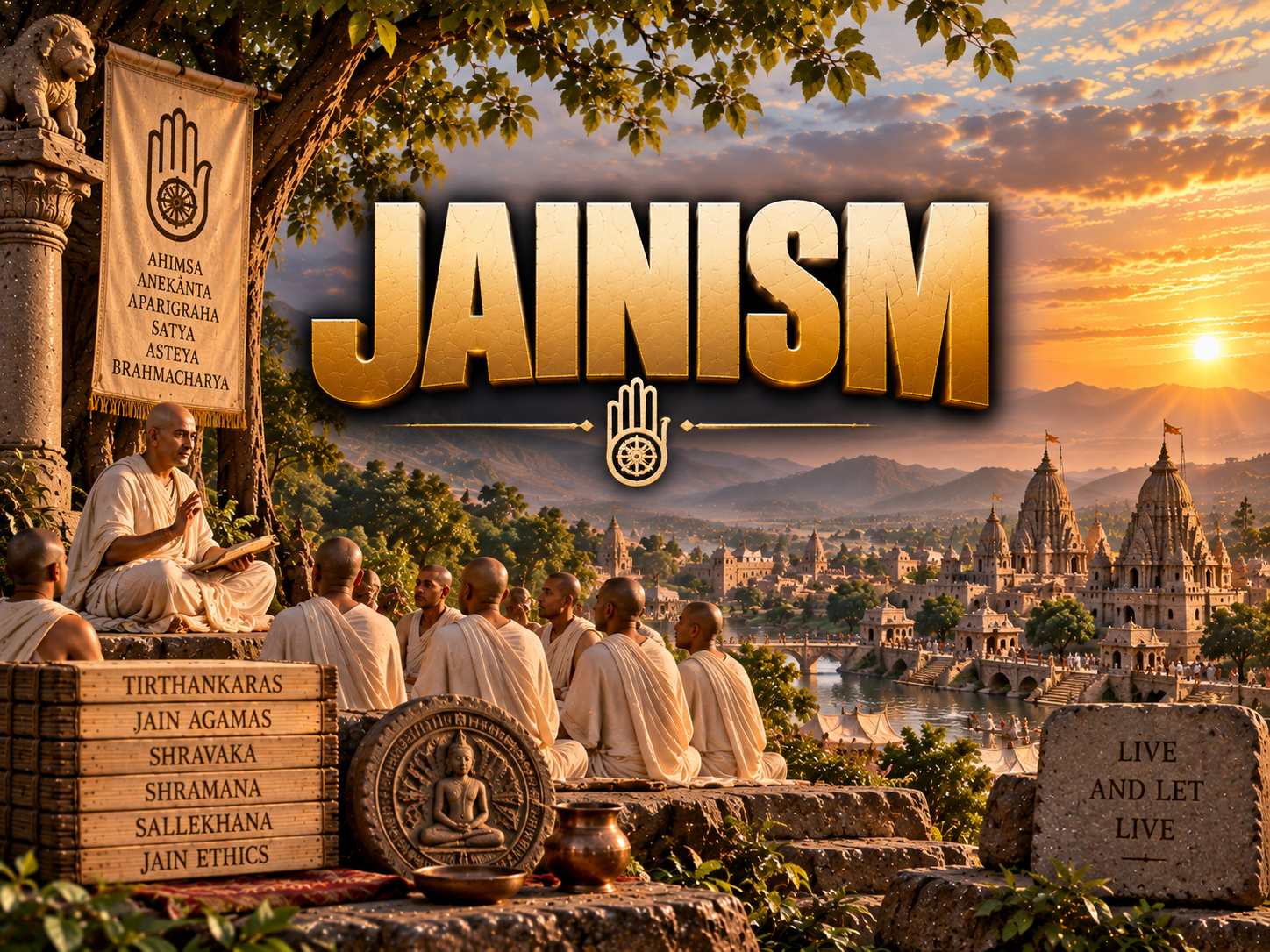
Jainism is one of the world's oldest living religious traditions, originating as an ancient Sramana tradition in India. It shares the concepts of Karma and rebirth with Buddhism, but differs sharply in its insistence on extreme asceticism, rigorous self-mortification, and an uncompromising commitment to Ahimsa (non-violence). Rather than tracing its origin to a single founder, Jainism holds that eternal truths are revealed across cyclical eons by a succession of 24 Tirthankaras ("ford-makers" who assist souls across the river of rebirth), culminating in Vardhamana Mahavira.
🔥 Three Jewels of Jainism (Triratna)
1. Samyak Darshana: Right Faith / Perception. 2. Samyak Jnana: Right Knowledge. 3. Samyak Charitra: Right Conduct.
1. 🕉️ The 24 Tirthankaras & Iconographic Cognizance
Jain tradition honors 24 Tirthankaras in the present time cycle (Avasarpini). Each Tirthankara is identified in Indian art through a specific Lanchhana (Cognizance / Symbol) carved at the base of their idols:
Tirthankara
Order
Lanchhana (Cognizance Symbol)
Historical & Scriptural Value
Rishabhanatha (Adinatha)
1st
Bull (Vrishabha)
Father of Bharata; referenced in Rigveda and Vishnu Purana; founder of civilizational arts.
Ajitanatha
2nd
Elephant (Gaja)
Mentioned in Yajurveda alongside Rishabhanatha.
Mallinatha
19th
Water Jar (Kalasha)
Believed by Svetambaras to have been female (Princess Malli of Mithila); Digambaras view Mallinatha as male.
Neminatha (Arishtanemi)
22nd
Conch (Shankha)
Tradition places him as a cousin of Krishna (Yadu clan) in Mahabharata lore.
Parshvanatha
23rd
Serpent (Sarpaphana)
Historical prince of Varanasi (c. 8th C. BCE). Taught the Chaturyama (Four Vows).
Vardhamana Mahavira
24th
Lion (Simha)
Systematizer of modern Jainism. Added the 5th Vow (Brahmacharya).
2. 🧘 Life of Vardhamana Mahavira
Vardhamana was born in 599 BCE (or 540 BCE by traditional timeline) at Kundagrama near Vaishali (Bihar) into the Jnatrika Kshatriya clan.
Lineage: Father was King Siddhartha (chief of Jnatrika clan); mother was Queen Trishala (sister of Licchavi Chief Chetaka of Vaishali). Married Yashoda and had a daughter named Anojja / Priyadarshana.
Renunciation: Left household life at age 30 following his parents' demise, discarding his clothes after 13 months to practice total nudism.
Kaivalya (Omniscience): After 12 years of severe penance, attained supreme enlightenment at age 42 under a Sal tree on the banks of the Rijupalika River near Jrimbhikagrama village.
Titles Earned: Called Jina ("Conqueror" of senses), Mahavira ("Great Hero"), Kevalin (Omniscient), and Nirgrantha ("Free from bonds"). His followers became known as Jains.
Nirvana / Moksha: Attained final liberation at age 72 at Pawapuri (near Rajgir, Bihar) in 527 BCE (or 468 BCE).
3. 📿 Core Philosophy: Epistemology & Metaphysics
Jainism does not accept a creator or ruling God—the universe is uncreated, unbeginning, and eternal. However, it holds that every living entity (and certain non-living matter) possesses a conscious soul (Jiva).
3.1 Epistemological Foundations
Anekantavada (Doctrine of Non-Absolutism): Reality is complex, multifaceted, and infinite in attributes. No single human perspective can express the total absolute truth. Illustrated by the parable of the Blind Men and the Elephant.
Syadvada (Theory of Conditioned Predication): Epistemological expression of Anekantavada. Asserts that all logical statements are relative, conditional, and hold true only from a given vantage point. Every judgment must be prefixed with "Syat" ("May be" / "In a certain sense").
Saptabhangi Naya (Seven-Fold Logic): A method of formulating conditional truth through seven propositions:
Syad-Asti (In a certain sense, it is).
Syad-Nasti (In a certain sense, it is not).
Syad-Asti-Nasti (In a certain sense, it is and is not).
Syad-Avaktavyam (In a certain sense, it is indescribable).
Syad-Asti-Avaktavyam (In a certain sense, it is and is indescribable).
Syad-Nasti-Avaktavyam (In a certain sense, it is not and is indescribable).
Syad-Asti-Nasti-Avaktavyam (In a certain sense, it is, is not, and is indescribable).
3.2 Metaphysics & Karma Mechanics
Dualism (Jiva & Ajiva): Reality consists of conscious living souls (Jiva) and non-living matter (Ajiva: divided into Pudgala/Matter, Dharma/Motion, Adharma/Rest, Akasha/Space, and Kala/Time).
Pan-Psychism (Hylozoism): Believes that even elemental matter—rocks, water, wind, and fire—contains souls (Ekindriya Jivas) capable of sensing pain.
Materiality of Karma: Karma is conceived as subtle physical matter (Karmic dust) that flows into the soul (Ashrava) and sticks to it, weighing it down.
Process of Liberation: Stopping new karma from entering is Samvara; burning off existing accumulated karma through austerity is Nirjara. Complete clearance leads to Moksha.
4. ✋ The Five Ethical Vows (Pancha Mahavratas)
Practiced rigorously by Monks (Mahavratas) and in a moderated form by Lay Householders (Anuvratas):
Ethical Vow
Pali / Sanskrit Term
Practice & Scope
Historical Origin
Non-Violence
Ahimsa
Absolute refraining from harming any living being in thought, word, or action.
Taught by Parshvanatha (23rd)
Truthfulness
Satya
Speaking wholesome, non-injurious truth.
Taught by Parshvanatha (23rd)
Non-Stealing
Asteya
Not taking anything that has not been explicitly given.
Taught by Parshvanatha (23rd)
Non-Possession
Aparigraha
Detachment from material goods, land, and possessions.
Taught by Parshvanatha (23rd)
Celibacy / Chastity
Brahmacharya
Complete abstinence from sexual activity.
Added by Mahavira (24th)
5. ⚖️ The Great Schism: Digambaras vs. Svetambaras & Sub-Sects
5.1 Primary Sectarian Differences
Point of Divergence
Digambara ("Sky-Clad")
Svetambara ("White-Clad")
Leader & Lineage
Bhadrabahu (Southern tradition)
Sthulabhadra (Northern tradition)
Attire Rules
Monks maintain absolute nudism as the ultimate expression of non-possession (Aparigraha).
Monks and nuns wear simple, unstitched white cotton garments.
Female Liberation
Women cannot attain Moksha directly; must be reborn as men first.
Women can attain Moksha directly in their present birth (19th Tirthankara Mallinatha was female).
Scriptural Canon
Reject the 12 Angas compiled at Pataliputra as lost during the famine.
Accept and preserve the 12 Angas and 12 Upangas compiled in Agamas.
Food After Kaivalya
An omniscient Kevalin does not require physical food for body sustenance.
An omniscient Kevalin requires physical food for body upkeep.
Idol Imagery
Idols depict Tirthankaras unadorned, naked, with eyes downcast in meditation.
Idols are depicted wearing white robes, adorned with marble carving and glass eyes.
5.2 Major Sub-Sects
Digambara Sub-Sects:
Bispanthi: Traditional group supporting idol worship with flowers, saffron, and incense.
Terapanthi (Digambara): Reforms that reject flower/incense offerings, worshipping with sacred rice (Akshata).
Murtipujaka (Deravasi): Perform direct idol worship in dedicated stone temples.
Sthanakvasi: Founded by Lavaji c. 1653 CE; rejects idol worship and temple buildings, praying in simple halls (Sthanaks). Wear a Muhapatti (mouth cloth) continuously.
Terapanthi (Svetambara): Founded by Acharya Bhikshu in 1760 CE; strictly non-idolatrous and organized under a single supreme Acharya.
6. 🏛️ The Two Jain Councils
Council
Date & Location
Presiding Scholar / Patron
Key Achievements & Outcomes
1st Council
c. 300 BCE Pataliputra (Bihar)
Presided by Sthulabhadra Patron: Early Mauryan era
Compilation of the 12 Angas to replace lost oral Purvas; rejected by the southern Digambara tradition.
2nd Council
c. 512 CE Vallabhi (Gujarat)
Presided by Devardhi Kshamashramana
Final written documentation of the Svetambara canon into 12 Angas and 12 Upangas using Ardhamagadhi Prakrit script.
7. 🌏 Royal Patronage & Geographical Expansion
Chandragupta Maurya: According to Jain tradition, converted to Jainism late in life, abdicated his throne, and accompanied Bhadrabahu to Shravanabelagola (Karnataka), where he performed the vow of Sallakhana / Santhara (fasting unto death).
Kharavela of Kalinga (1st C. BCE): Cheti dynasty monarch whose Hathigumpha Inscription at Udayagiri caves records his patronage, cave excavations for Jain monks, and recovery of a stolen Jina image.
Ganga Dynasty (Karnataka): Prime minister Chavundaraya commissioned the colossal monolithic Gomateshwara (Bahubali) statue at Shravanabelagola c. 981 CE.
Rashtrakutas: King Amoghavarsha I authored the Jain spiritual text Prashnottara Ratnamala and patronized Jain scholars.
Solanki / Chaulukya Dynasty (Gujarat): King Kumarapala embraced Jainism under the guidance of polymath scholar Acharya Hemachandra, prohibiting animal slaughter across his kingdom.
8. 🏯 Jain Architecture, Rock-Cut Caves & Statuary
8.1 Major Cave Temple Systems
Udayagiri & Khandagiri Caves (Odisha): 1st Century BCE rock-cut residential cells built for Jain monks by King Kharavela (e.g., Rani Gumpha, Hathi Gumpha).
Badami Cave 4 (Karnataka): Chalukyan rock-cut shrine featuring relief sculptures of Tirthankaras and Bahubali.
Sittanavasal Cave (Tamil Nadu): Famous 7th-century rock-cut Jain complex known for exquisite fresco ceiling paintings depicting lotus ponds (Samavasarana).
8.2 Structural Temples & Monolithic Statues
Dilwara Temples (Mount Abu, Rajasthan): Built between 11th and 13th centuries CE by Vastupala and Tejapala (Solanki ministers); celebrated for its white marble lattice carving (e.g., Vimal Vasahi temple).
Gomateshwara (Bahubali) Statue (Shravanabelagola): 57-foot tall monolithic granite statue carved c. 981 CE. Site of the Mahamastakabhisheka festival celebrated every 12 years.
Khajuraho Jain Temples (MP): Built under Chandela patronage (e.g., Parsvanatha and Adinatha temples).
9. 📜 Canonical Agamas & Vernacular Literature
Jain scholars wrote in vernacular languages—such as Ardhamagadhi Prakrit, Apabhramsha, Tamil, and Kannada—rather than elite Sanskrit, making their spiritual and scientific works accessible to common citizens.
Kalpa Sutra: Composed in Sanskrit by Bhadrabahu; details biographies of Tirthankaras (especially Parshvanatha and Mahavira).
Tattvartha Sutra: Written by Umasvati; accepted by both Digambaras and Svetambaras as the definitive summary of Jain philosophy.
Parishishtaparvan: Historical narrative composed by Acharya Hemachandra detailing Mauryan history and Jain lineages.
9.2 Vernacular Linguistic Contributions
Tamil Literature: The famous Tamil epic Silappadikaram was written by Jain prince Ilango Adigal. The Naladiyar ethic text was also composed by Jain monks.
Kannada Literature: Jain writers laid the bedrock of classical Kannada poetry: the "Three Gems of Kannada Literature"—Pampa (Vikramarjuna Vijaya / Adipurana), Ponna (Santipurana), and Ranna (Ajitapurana)—were all Jains.
10. ⚖️ Comparative Matrix: Jainism vs. Buddhism
Comparison Dimension
Buddhism
Jainism
Philosophical Path
Madhyama Marga (Middle Path): Avoids extreme asceticism and sensory indulgence.
Extreme Asceticism: Heavy emphasis on physical mortification and penance.
Ahimsa Application
Practiced ethically, but pragmatically applied (allowed non-injurious meat eating if not killed for oneself).
Uncompromising, extreme Ahimsa extended to plants, water, and microorganisms.
Doctrine of Soul
Anatta (Non-Self): Denies the existence of an eternal, permanent soul (Atman).
Jiva: Every entity (living and non-living) possesses a distinct, eternal soul.
Creator God Concept
Silent on a creator God; focuses on psychological liberation from suffering.
Explicitly atheistic regarding a creator deity; universe operates by natural law.
Canonical Language
Primary early texts composed in Pali.
Primary early texts composed in Ardhamagadhi Prakrit.
Geographical Expansion
Spread internationally across Asia (China, Sri Lanka, Tibet, Southeast Asia).
Remained geographically concentrated within the Indian subcontinent.
Institutional Persistence
Declined institutionally in India after 12th C. CE due to reliance on central monasteries.
Sustained continuous presence in India due to strong lay-merchant support networks.
Place of Enlightenment: Jrimbhikagrama on Rijupalika River under a Sal tree.
Place of Nirvana: Pawapuri near Rajgir.
First Chief Disciple (Gandhara): Indrabhuti Gautama.
Sallakhana / Santhara: Vow of gradual voluntary fasting unto death to achieve spiritual liberation.
Hathigumpha Inscription: Records patronage of Jainism by Cheti King Kharavela of Kalinga.
Gomateshwara Monolith: Built at Shravanabelagola by Chavundaraya (Ganga Dynasty minister) c. 981 CE.
Non-Idolatrous Sub-Sects: Sthanakvasi (Svetambara) and Taranpanthi (Digambara).
Dilwara Temples: Built of white marble at Mount Abu by Solanki ministers Vastupala and Tejapala.
12. 📝 Previous Year Question (PYQ) Themes
Core epistemological doctrines of Jainism: Anekantavada, Syadvada, and Saptabhangi Naya.
Differences between Digambara and Svetambara sects and their respective sub-sects (Sthanakvasi).
Contributions of royal patrons (Kharavela, Chandragupta Maurya, Ganga dynasty, Solankis) to Jainism.
Jain art and architecture: Dilwara, Gomateshwara, Ellora Caves 30–34, and Sittanavasal frescoes.
Comparative analysis of Buddhism and Jainism as 6th-century BCE heterodox Sramana movements.
Socio-economic reasons behind Jainism's continuous survival in India compared to Buddhism.
13. ✍️ UPSC Mains Analytical Anchor Points
💡 Analytical Templates for GS Paper 1 Answers
Anekantavada as an Ancient Framework for Democratic Pluralism: The doctrine of manifold truth offers a sophisticated philosophical precedent for intellectual tolerance, peaceful dialogue, and multi-cultural accommodation in modern democratic societies.
Socio-Economic Specialization of the Lay Community: Because strict Ahimsa prohibited agriculture (harming soil organisms) and military combat, Jain adherents gravitated toward trade, banking, and commerce, building influential merchant guilds that sustained the faith throughout Indian history.
Contributions to Regional Vernacular Development: By choosing local vernaculars (Prakrit, Apabhramsha, Kannada, Tamil) over elite Sanskrit, Jain scholars laid the foundational literature for several modern Indian languages.
14. ❓ FREQUENTLY ASKED QUESTIONS (FAQ)
Who was the 23rd Tirthankara of Jainism and what were his main teachings?
Parshvanatha was the 23rd Tirthankara. A prince of Varanasi, he taught the Chaturyama (four vows: Ahimsa, Satya, Asteya, Aparigraha). Mahavira later added the fifth vow of Brahmacharya.
What is the philosophical difference between Anekantavada and Syadvada?
Anekantavada is the metaphysical doctrine of non-absolutism asserting that reality has manifold aspects. Syadvada is the epistemological and linguistic theory of conditioned predication ("in a certain sense"), expressing truth through Seven-fold Logic (Saptabhangi Naya).
Where were the two main Jain Councils held?
The First Jain Council was held at Pataliputra (c. 3rd century BCE) under Sthulabhadra. The Second Jain Council was held at Vallabhi, Gujarat (c. 512 CE) under Devardhi Kshamashramana, where the 12 Angas and 12 Upangas were compiled in written form.
15. 🔗 Next Ancient History Modules in Series
Continue your systematically ordered Ancient History syllabus coverage: