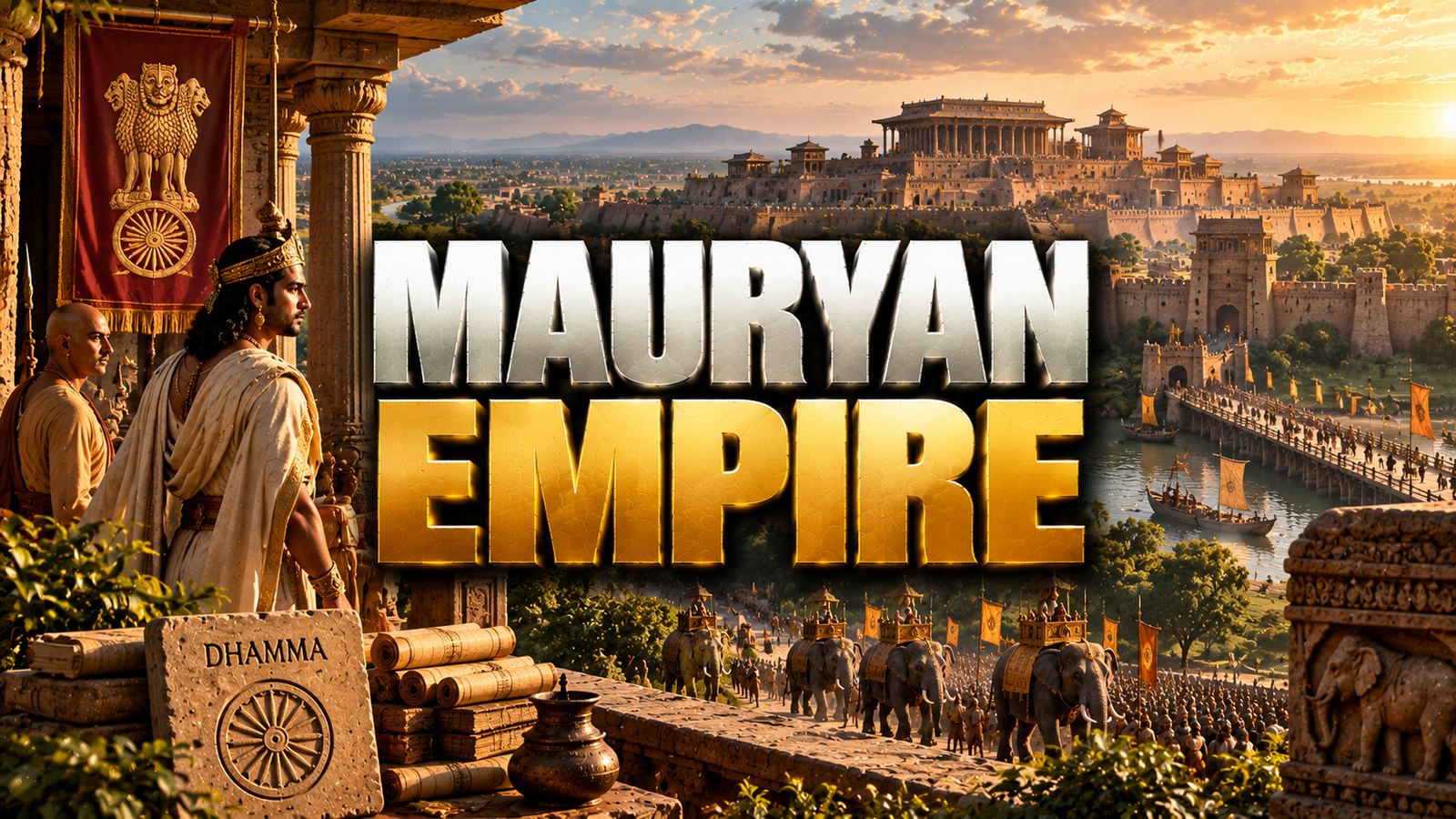
EXHAUSTIVE REVISION FOR UPSC CSE & UPPCS (MODULE 07 OF 15)
🧭 OVERVIEW & EXAM CONTEXT
The Mauryan Empire (c. 322 – 185 BCE) was the first pan-Indian empire in subcontinental history, unifying virtually the entire Indian landmass from Afghanistan to the borders of Tamilakam. Under Chandragupta Maurya, Bindusara, and Ashoka the Great, the Mauryan state constructed a highly centralized administrative machinery guided by the political realism of Kautilya's Arthashastra, the diplomatic observations of Megasthenes' Indica, and the imperial rock-and-pillar epigraphs of Ashoka. This topic merges statecraft, agrarian management, early monetization, epigraphy, and artistic monumentalism.
🔥 Why It's High-Yield
The Mauryan era provides the earliest securely dated epigraphic records in Indian history (Ashokan Brahmi script) and serves as the classical baseline for questions on state centralization, administrative bureaucracy, and moral governance (Ashoka's Dhamma).
1. 👑 Political History: The Three Imperial Monarchs
1.1 Chandragupta Maurya (c. 322 – 298 BCE)
Overthrow of the Nandas: Assisted by his prime minister and strategist Chanakya (Kautilya / Vishnugupta), Chandragupta dethroned the oppressive Nanda king Dhana Nanda at Pataliputra in 322 BCE.
Campaign against the Seleucids: Marched to the northwest to defeat the Seleucid ruler Seleucus I Nicator c. 305 BCE. Under the resulting peace treaty, Seleucus ceded the satrapies of Aria (Herat), Arachosia (Kandahar), Paropamisadae (Kabul), and Gedrosia (Balochistan) in exchange for 500 war elephants.
Diplomatic Ties: Seleucus dispatched Megasthenes as ambassador to the court at Pataliputra. Megasthenes authored Indica, providing an invaluable contemporary Greek account of Mauryan governance and urban infrastructure.
Jain Abdication & Death: Jain tradition (Parishishtaparvan) holds that during a 12-year famine, Chandragupta abdicated in favor of his son Bindusara, converted to Jainism under monk Bhadrabahu, and migrated to Shravanabelagola (Karnataka), ending his life via Sallakhana / Santhara (fasting unto death).
1.2 Bindusara (c. 298 – 273 BCE)
Epithet & Greek Titles: Referred to in Greek literature as Amitrochates (derived from Sanskrit Amitraghata — "Slayer of Enemies"). Mentioned as Simhasena in Jain texts.
Deccan Expansion: Extended Mauryan territorial control southwards across the Deccan plateau up to the borders of the Tamil country (Cholas, Pandyas, Satyaputras, and Keralaputras remained independent buffer states).
Diplomatic Correspondence: Received the Seleucid ambassador Deimachus from King Antiochus I, and ambassador Dionysius from Ptolemy II Philadelphus of Egypt. Bindusara famously requested Antiochus I to send sweet wine, dried figs, and a Greek sophist/philosopher (Antiochus sent wine and figs, replying that Greek laws forbade trading philosophers).
Religious Orientation: Patronized the Ajivika heterodox fatalist sect; his court was attended by the Ajivika fortune-teller Pingalavatsa.
1.3 Ashoka the Great (c. 273 – 232 BCE)
Accession & Coronation: Served as viceroy at Taxila and Ujjain during his father's reign. Buddhist texts (Mahavamsa, Divyavadana) mention a 4-year succession war in which he killed 99 brothers, crowning himself in 269 BCE.
The Kalinga War (c. 261 BCE): Fought in his 8th regnal year. Described vividly in Major Rock Edict XIII, which records 100,000 slain, 150,000 captured, and many times that number perishing. The immense human suffering triggered profound remorse (Anusochana), transforming his foreign policy from Bherighosha (conquest by war) to Dhammaghosha (conquest by righteousness).
Policy of Dhamma: A universal, non-sectarian moral code emphasizing social harmony, religious tolerance (MRE XII), non-violence towards animals (MRE I), filial piety, and humanitarian care for slaves and servants.
Buddhist Conversion & Patronage: Converted to Buddhism under the influence of monk Upagupta (or Nigrodha). Convened the 3rd Buddhist Council at Pataliputra (c. 250 BCE) under Moggaliputta Tissa and sent diplomatic-religious missions abroad (dispatched his son Mahendra and daughter Sanghamitra to Sri Lanka).
The Mauryan central administration was divided into 27 specialized departments headed by Adhyakshas (Superintendents), overseen by top ministers (Tirthas):
Samaharta: Chief Collector General of Revenue (managed imperial budget and tax collection).
Sannidhata: Chief Treasury Officer and Custodian of Storehouses.
Sitadhyaksha: Superintendent of Crown Agricultural Lands (Sita).
Panyadhyaksha: Superintendent of State Commerce and Trade.
Sansthadhyaksha: Superintendent of Markets and Commercial Guilds.
Lakshanadhyaksha: Superintendent of the Royal Mint (issuance of coins).
Akshapataladhyaksha: Accountant General and Keeper of Records.
Gudhapurushas: Secret Service System comprising stationary agents (Sansthana) and wandering intelligence operatives (Sanchara).
2.3 Provincial & Municipal Administration
Provincial Divisions: The empire was split into 5 core provinces ruled by royal viceroys (Kumara / Aryaputra):
District Officers: Districts were managed by Rajukas (assisted by Yuktas and Pradeshikas), who performed judicial, survey, and revenue functions.
Municipal Management of Pataliputra: Megasthenes documents that Pataliputra's administration was overseen by a Municipal Commission of 30 members split into Six Boards of 5 members each:
Board I: Industrial and Artisan Arts
Board II: Entertainment & Care of Foreigners
Board III: Registration of Births and Deaths
Board IV: Trade, Commerce, Weights & Measures
Board V: Inspection of Manufactured Goods
Board VI: Collection of 10% Sales Tax (Shulka)
3. 💰 Economic Structure, Land Revenue & Monopolies
3.1 Categories of State Taxes
Agriculture formed the mainstay of imperial finance. Land revenue was meticulously categorized:
Revenue Term
Nature & Scope of Fiscal Levy
Sita
Direct income generated from crown-owned lands cultivated under the Sitadhyaksha.
Bhaga
Standard agricultural land tax levied on private peasants (typically 1/6th to 1/4th of produce).
Bali
Religious or kingly tribute (remitted by Ashoka at Rummindei / Lumbini to 1/8th share).
Hiranya
Tax payable directly in cash/gold rather than in agricultural produce.
Kara
Periodic tax levied on orchards, gardens, and special fruit crops.
Vishti
Forced, unremunerated labor demanded for state public works (roads, canals).
3.2 State Monopolies, Trade Routes & Currency
State Monopolies: The state exercised strict state ownership over mining (Akaradhyaksha), salt production (Lavanadhyaksha), liquor manufacturing, forestry, and armaments.
Irrigation Infrastructure: State-managed irrigation was taxed via Udakabhaga (water tax). The famous Sudarshana Lake in Girnar (Gujarat) was constructed by Chandragupta's provincial governor Pushyagupta and embellished under Ashoka's governor Tushaspha.
Currency System: Silver punch-marked coins called Pana (weighing ~3.4 grams) served as legal tender alongside copper Mashaka and Kakini.
Trade Corridors: Connected via Uttarapatha (Taxila ➔ Pataliputra ➔ Tamralipti) and Dakshinapatha (Pataliputra ➔ Kausambi ➔ Ujjain ➔ Pratishthana).
4. 📜 Ashokan Epigraphy & Major Rock/Pillar Edicts
Ashokan edicts represent the earliest deciphered written documents in Indian history, deciphered by James Prinsep in 1837 in Brahmi script.
4.1 Linguistic & Script Distribution
Languages: Prakrit (majority), Greek, and Aramaic.
Scripts:
Brahmi: Used across central, eastern, and southern India (written left to right).
Kharosthi: Used in North-Western sites like Shahbazgarhi and Mansehra (written right to left).
Greek & Aramaic: Used in Afghanistan region (e.g., Shar-i-Kuna bilingual inscription at Kandahar).
4.2 Key Major Rock Edicts (MRE)
Edict Number
Core Inscriptional Subject Matter
Major Rock Edict I
Prohibits animal slaughter in capital and sacrifices; reduces royal kitchen consumption.
Major Rock Edict II
Mentions medical treatment for humans and animals; lists southern kingdoms (Chola, Pandya, Satyaputra, Keralaputra, Tamraparni).
Major Rock Edict III
Instructs Yuktas, Rajukas, and Pradeshikas to go on administrative tours (Anusamyana) every 5 years.
Major Rock Edict V
Announces the appointment of Dhamma Mahamattas in his 13th regnal year.
Major Rock Edict VIII
Replaces royal pleasure trips (Viharayatra) with spiritual journeys (Dhammayatra); records visit to Bodh Gaya.
Major Rock Edict XII
Passionate plea for religious tolerance and honor among all sects (Samavaya).
Major Rock Edict XIII
Detailed account of the Kalinga War; conquest through Dhamma (Dhammavijaya) over military war; mentions 5 Greek contemporary kings (Antiochus II, Ptolemy II, Antigonus, Magas, Alexander).
4.3 Significant Minor Rock & Pillar Edicts
Maski Edict (Karnataka): First edict where Ashoka's personal name appears directly ("Devanampiya Ashoka"). Also confirmed in Gujarra (MP), Nittur (KA), and Nettanapalle (AP).
Rummindei / Lumbini Pillar Edict: Commemorates Ashoka's visit to Buddha's birthplace; records reduction of Bali tax to zero and Bhaga to 1/8th.
Dhauli & Jaugada Separate Rock Edicts: Replaces MRE XI-XIII in Kalinga, containing the famous declaration: "All men are my children" (Save Munise Paja Mama).
Bhabru-Bairat Edict (Rajasthan): Confirms Ashoka's explicit conversion to Buddhism and faith in the Triratna.
5. 🎨 Mauryan Art, Architecture & Polish Technique
5.1 Court Art vs. Popular Art
Court Art (Imperial Patronage): Highly sophisticated, centralized stone masonry characterized by the lustrous Mauryan Glassy Polish.
Monolithic Pillars: Carved from single blocks of buff-colored Chunar sandstone. Component parts: Shaft, Bell-shaped Lotus capital, Abacus, and Animal motif (e.g., Sarnath Lion Capital, Rampurva Bull, Lauriya Nandangarh Lion).
Pataliputra Wooden Palace: Described by Megasthenes and excavated at Kumrahar; praised by Aelian as superior to Persian Susa and Ecbatana.
Stupas: Initiated the tradition of brick stupa construction (e.g., original core of Sanchi, Bharhut, and Amaravati).
Popular Art (Independent / Local): Executed by local sculptors, reflecting popular folk deity worship.
Parkham Yaksha: Colossal free-standing stone statue found near Mathura.
Barabar Hill Caves: Oldest rock-cut cave sanctuaries (Lomas Rishi, Sudama, Visvakarma caves) excavated by Ashoka and grandson Dasharatha for Ajivika monks. Featured polished granite walls and horseshoe arch facades.
6. 👥 Mauryan Society & Megasthenes' Seven Classes
Megasthenes viewed Indian society through a Greek lens, recording a 7-fold occupational classification rather than the traditional fourfold Varna system:
Megasthenes Class
Occupational Role & Social Function
1. Philosophers
Brahmins and ascetics (Sramanas); performed public sacrifices and foretold weather. Exemption from manual labor and taxation.
2. Farmers (Agrarians)
Largest numerical group; devoted exclusively to tilling land, exempted from military duty even during wartime.
3. Herdsmen & Hunters
Lived in tents/forests; cleared land of beasts and paid taxes in cattle or game.
4. Artisans & Traders
Craftsmen, armorsmiths, shipbuilders; paid direct taxes to state or received state wages.
5. Soldiers / Warriors
Second largest group; highly paid standing professional army maintained by state treasury.
6. Overseers / Inspectors
Spies (Episkopoi) who reported secret administrative intel directly to the King/Magistrates.
7. Councillors / Assessors
Elite administrative class from which ministers, judges, and high officers were recruited.
6.1 Social Realities vs Megasthenes' Accounts
Absence of Slavery Myth: Megasthenes claimed slavery did not exist in India. However, Kautilya's Arthashastra provides detailed laws regulating Dasas (slaves) and Karmakaras (hired laborers).
Position of Women: Women served as royal bodyguards (Chauri-bearers and archers), spies, and court performers. Dowry existed, and remarriage (Niyoga) was permitted under Kautilya's civil code.
7. 📉 Theories of Imperial Decline & Historical Debates
The Mauryan Empire fragmented within 50 years of Ashoka's death (c. 232 BCE). Historians advance contrasting analytical theories:
Historian
Proposed Cause of Decline
Core Historical Argument
H.P. Sastri
Brahmanical Reaction
Ashoka's ban on animal sacrifice and favor to Buddhist monks provoked a militant Vedic revival led by Pushyamitra Shunga.
H.C. Raychaudhuri
Ashoka's Pacifism
Conversion to non-violence (Dhammaghosha) destroyed the military martial spirit and readiness of the standing army.
Romila Thapar
Structural & Bureaucratic Weakness
Over-centralized state structure without representative local institutions; administrative quality depended entirely on the personal competence of the king.
D.D. Kosambi
Economic & Fiscal Crisis
Severe debasement of silver coinage in late Mauryan layers indicates extreme financial strain of maintaining vast army and bureaucracy.
N.R. Ray
Popular Alienation
Mauryan court art and administration failed to integrate with local folk cultures, causing regional disconnect.
The Final Blow: In 185 BCE, the last Mauryan king Brihadratha was assassinated during an army review by his Brahmin Commander-in-Chief, Pushyamitra Shunga, who established the Shunga Dynasty.
8. 📊 Quick Comparison Matrix: Imperial Monarchs
Metric
Chandragupta Maurya
Bindusara
Ashoka the Great
Reign Dates
c. 322 – 298 BCE
c. 298 – 273 BCE
c. 273 – 232 BCE
Key Conquests
Magadha (Nandas), NW India, Seleucid Satrapies.
Deccan plateau consolidation.
Kalinga War (c. 261 BCE).
Foreign Links
Seleucus I Nicator (Ambassador: Megasthenes).
Antiochus I (Ambassador: Deimachus).
5 Hellenistic Kings (MRE XIII).
Religious Leanings
Jainism (Sallakhana at Shravanabelagola).
Ajivika Sect.
Buddhism (Propagated Dhamma).
Key Heritage
Founded Empire & Saptanga Statecraft.
Maintained Pan-Indian Integrity.
Ashokan Edicts & Monolithic Pillars.
9. 🎯 UPSC / UPPCS Prelims High-Yield Fact Vault
📌 Memory Keys for Direct Prelims MCQs
Decipherer of Brahmi Script: James Prinsep in 1837.
Edict Mentioning Name 'Ashoka': Maski, Gujarra, Nittur, and Nettanapalle.
Only Inscription with Ashoka's Relief Image: Kanaganahalli (Karnataka) — labeled Ranyo Ashoka.
Bilingual Inscription Site: Kandahar (Shar-i-Kuna) in Greek and Aramaic.
Sudarshana Lake Construction: Built by Pushyagupta (Chandragupta's governor) in Saurashtra.
Chief Collector of Revenue: Samaharta.
Spies in Arthashastra: Gudhapurushas (Sansthana and Sanchara).
Assassination of Last Ruler: Brihadratha killed by Pushyamitra Shunga in 185 BCE.
10. ✍️ UPSC Mains Analytical Anchor Points
💡 Structural Value Additions for GS Paper 1
Dhamma as an Instrument of Imperial Integration: Ashoka's Dhamma was not a religious dogma but a sophisticated political strategy designed to provide an overarching ethical framework that could hold together a vast multi-ethnic, multi-cultural empire.
Limitations of Over-Centralization: The rapid collapse of the Mauryans highlights the fragility of imperial structures that rely entirely on central monarchical competence without strong, autonomous local self-governing institutions.
Precedent for Welfare Statecraft: The Mauryan state represents one of history's earliest examples of paternalistic welfare statecraft (state irrigation, medical care for humans/animals, roadside rest houses, and grain emergency reserves).
11. ❓ FREQUENTLY ASKED QUESTIONS (FAQ)
Which Ashokan Edict mentions the Kalinga War in detail?
Major Rock Edict XIII gives a detailed description of the Kalinga War (c. 261 BCE), recording the massive casualties and deportation that led to Ashoka's remorse and adoption of Dhamma-vijaya.
What is the difference between Sita and Bhaga land taxes in Mauryan economy?
Sita referred to revenue derived directly from crown lands cultivated under the supervision of the Sitadhyaksha. Bhaga was the standard land revenue tax (usually 1/6th) levied on private agricultural lands.
In which inscription is Ashoka directly referred to by name "Ashoka"?
Ashoka is directly mentioned by his personal name "Ashoka" in the Maski Minor Rock Edict in Karnataka, as well as in the Gujarra, Nittur, and Nettanapalle edicts.
12. 🔗 Next Ancient History Modules in Series
Continue your systematically ordered Ancient History syllabus coverage: