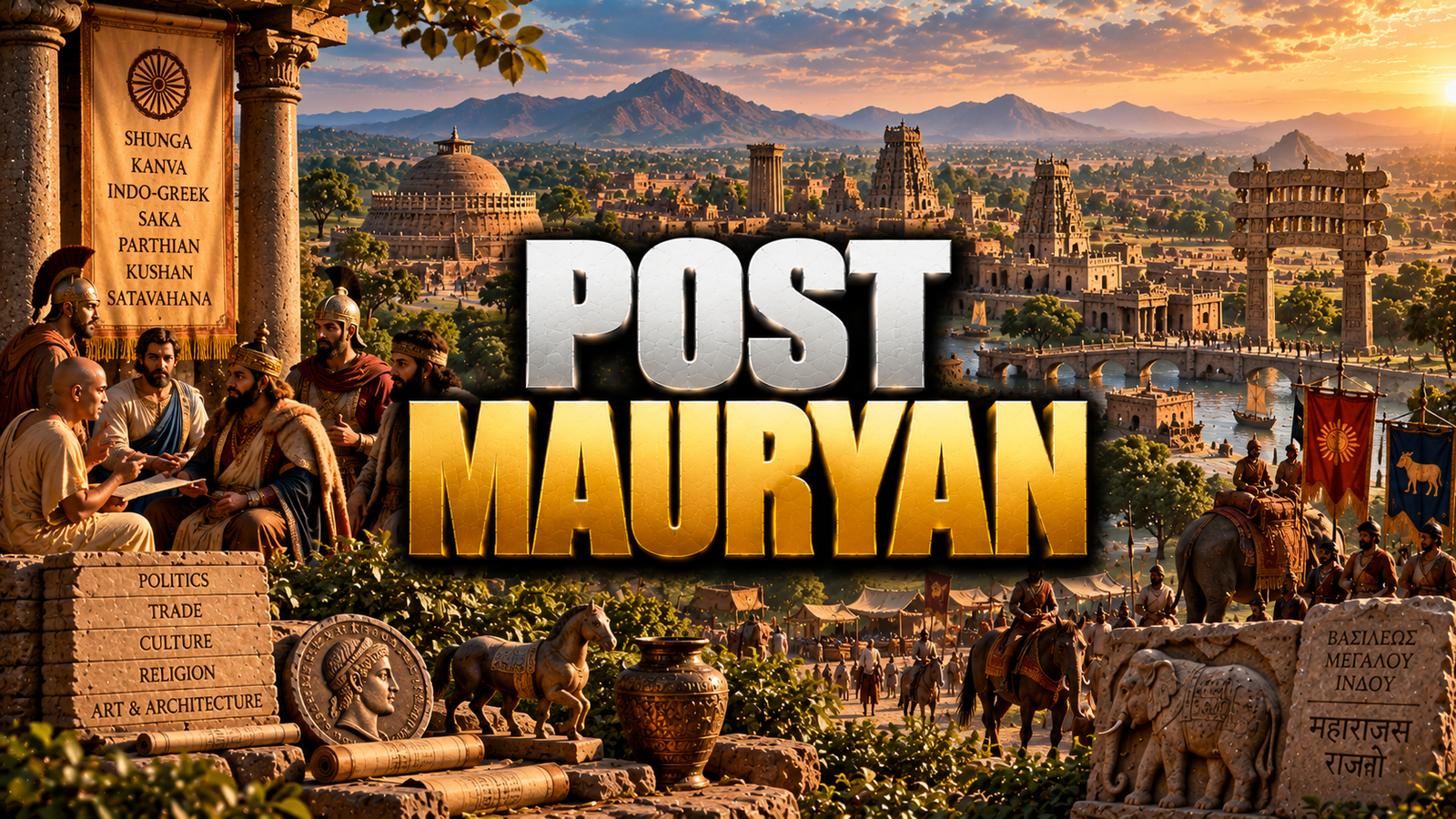
EXHAUSTIVE REVISION FOR UPSC CSE & UPPCS (MODULE 08 OF 15)
🧭 OVERVIEW & STRUCTURAL SYNTHESIS
The half-millennium following the fall of the Mauryan Empire (c. 185 BCE) was far from a "dark age" of political collapse. Instead, it was an era of intense urban expansion, commercial monetization, artistic innovation, and deep cultural assimilation. In Northern and Western India, waves of foreign invaders (Indo-Greeks, Shakas, Parthians, Kushanas) established powerful trans-continental empires, assimilating completely into Indian social structures. Meanwhile, indigenous dynasties—such as the Shungas, Kanvas, Satavahanas, Chetis, and Ikshvakus—consolidated regional power bases across Central India, Kalinga, and the Deccan. Concurrently, the Deep South witnessed the vibrant dawn of classical Tamil civilization in the Sangam Age.
🔥 KEY HISTORICAL PARADIGM
This period integrated India into the global economy via the Central Asian Silk Road and maritime Indo-Roman trade routes, leading to massive gold inflows, booming trade guilds (Shrenis), and the birth of monumental stone sculpture (Gandhara, Mathura, and Amaravati schools).
1. ⚔️ Foreign Dynasties of the North-West
Central Asian political upheavals (e.g., building of the Great Wall of China driving nomadic tribes westward) triggered successive waves of foreign incursions through the Hindukush passes:
1.1 Indo-Greeks (Bactrian Greeks)
Invasion Trajectory: First foreign wave to enter India following the Mauryan collapse. Led initially by Demetrius and Eucratides.
Menander I (Milinda) (c. 165 – 145 BCE): The most celebrated Indo-Greek monarch, ruling from Sakala (modern Sialkot, Pakistan). Extended territory up to Mathura and Magadha. Converted to Buddhism after a deep philosophical debate with monk Nagasena, recorded in the Pali classic Milinda Panha ("Questions of King Milinda").
Numismatic & Cultural Milestones: First rulers in Indian history to issue attributed coins (bearing portraits and names of kings) and the first to issue gold coinage. Introduced Hellenistic artistic conventions that catalyzed the Gandhara School of Art.
Heliodorus Pillar: Heliodorus, envoy of Indo-Greek King Antialcidas to the court of Shunga ruler Bhagabhadra, erected the famous Garuda Pillar at Besnagar (Vidisha), declaring himself a Bhagavata (devotee of Vasudeva-Krishna).
1.2 The Shakas (Scythians)
Five Regional Branches: Displaced the Indo-Greeks, establishing 5 seats of power: Afghanistan, Taxila, Mathura, Ujjain, and the Western Deccan (Western Kshatrapas).
Rudradaman I (c. 130 – 150 CE): The most prominent ruler of the Western Kshatrapas (Kardamaka dynasty). Ruled over Malwa, Kathiawar, and Gujarat.
Junagarh Rock Inscription: Issued c. 150 CE in Kathiawar. It is the first major, error-free inscription composed in classical Chaste Sanskrit. Records the repair of Sudarshana Lake (originally built under Chandragupta Maurya) using royal funds without imposing forced labor (Vishti) or emergency levies on citizens.
1.3 The Parthians (Pahlavas)
Originating from Iran, they succeeded the Shakas in northwestern India.
Gondophares (c. 20 – 46 CE): The best-known Parthian king. His reign is famous for the Takht-i-Bahi inscription and the legendary visit of St. Thomas, who arrived in India to preach Christianity.
1.4 The Kushanas (Yuezhi Clan)
Origin: A branch of the Yuezhi nomadic confederation from Central Asian steppes who united Bactria and carved out a massive trans-continental empire.
Kujula Kadphises: Founded Kushana power in the northwest; issued copper coinage imitating Roman denarii.
Vima Kadphises: Issued gold coinage on a massive scale; stamped his coins with images of Lord Shiva and the Trident, adopting the title Maheshwara.
Kanishka I (c. 78 – 105 CE): The greatest Kushana emperor.
Saka Era: Ascended the throne in 78 CE, marking the start of the Saka Era (adopted as the official Civil National Calendar of modern India).
Imperial Capitals: Dual capitals at Purushapura (Peshawar) and Mathura. Built a famous 400-foot tall wooden stupa tower at Peshawar.
4th Buddhist Council: Convened at Kundalavana, Kashmir, presided over by Vasumitra (Vice-President: Asvaghosha). Formally codified Mahayana Buddhism and compiled the Mahavibhasha Sastra.
Silk Road Monopoly: Controlled the main land corridors of the trans-Asian Silk Road, levying transit tolls that brought immense wealth to India.
Literary & Scientific Circle: Patronized Asvaghosha (Buddhacharita, Saundarananda), Nagarjuna (Madhyamaka Karika / Sunyavada), Charaka (Charaka Samhita), and Vasumitra.
2. 🏰 Indigenous Dynasties of North, Central & Deccan India
2.1 The Shunga Dynasty (c. 185 – 73 BCE)
Foundation: Established by Pushyamitra Shunga, a Brahmin commander-in-chief who assassinated Brihadratha (the last Mauryan king) during a military parade.
Vedic Revival: Performed two Ashvamedha Yajnas (horse sacrifices), officiated by the great grammarian Patanjali (author of Mahabhasya).
Monumental Works: Replaced the earlier wooden railings around the Sanchi Stupa with stone structures and constructed the stone gateways at Bharhut Stupa.
Literary Context: Formed the historical backdrop for Kalidasa's famous Sanskrit play Malavikagnimitram (focusing on Pushyamitra's son, Agnimitra).
2.2 The Kanva Dynasty (c. 73 – 28 BCE)
Founded by Vasudeva Kanva after assassinating the last Shunga ruler, Devabhuti. Ruled Magadha briefly before falling to southern powers.
2.3 The Satavahana Dynasty (The Andhras)
Dominated the Deccan for over four centuries (c. 1st Century BCE to 3rd Century CE) with capitals at Pratishthana (Paithan) and Amaravati.
Founder: Simuka.
Gautamiputra Satakarni (c. 106 – 130 CE): The greatest Satavahana monarch. The Nasik Prasasti inscription (issued by his mother Gautami Balashri) praises him as the "Destroyer of Shakas, Yavanas, and Pahlavas," the annihilator of the Kshaharata dynasty (Nahapana), and the protector of the Varna hierarchy (Eka-Brahmana).
Vashishthiputra Pulumavi & Yajna Sri Satakarni: Yajna Sri Satakarni's coins feature double-masted ships, underscoring maritime trade prowess along the Bay of Bengal.
Pioneers of Tax-Free Land Grants: First dynasty to issue royal tax-exempt land grants (Agraharas) to Brahmins and Buddhist monks, transferring judicial and administrative rights to grant recipients (a fundamental precursor to Indian feudalism).
Matronymics & Coinage: Kings bore matronymic titles (names derived from mothers like Gautamiputra and Vashishthiputra), though royal succession remained patrilineal. Issued coins in Lead, Potin, Copper, and Bronze (rather than gold).
Language & Literature: Official language was Prakrit in Brahmi script. King Hala composed the famous Prakrit romantic anthology Gatha Saptasati (Sattasai).
2.4 The Cheti Dynasty of Kalinga
Risen to prominence in the 1st Century BCE. Famous ruler Kharavela left the celebrated Hathigumpha Cave Inscription (Udayagiri, Odisha), detailing his military campaigns, public waterworks, and generous patronage to Jain monks.
3. 🎨 Comparative Matrix: Gandhara, Mathura & Amaravati Art
The Post-Mauryan era witnessed the transition from Mauryan symbolic court art to anthropomorphic images of deities across three distinct sculptural hubs:
Comparison Metric
Gandhara School
Mathura School
Amaravati School
Geographical Realm
North-West Frontier (Taxila, Peshawar, Bamiyan).
Central North India (Mathura, Sonkh, Kankali Tila).
Craftsmen and merchants organized into autonomous professional guilds (Shrenis) headed by a Shreshthin / Jetthaka:
Multi-functional Institutions: Set product quality standards, fixed market prices, trained apprentices, issued their own localized tokens/coins, and operated as commercial banks (accepting public deposits and lending money at interest).
Royal Autonomy: Guild laws (Shreni-dharma) were respected by kings as legally binding codes. Monastic land grants were often registered with local merchant guilds for long-term administrative management.
Trans-Asian Overland Silk Road: Land routes connecting Chang'an (China) through Central Asia to Antioch and Rome passed through Kushana-controlled Taxila and Peshawar, allowing Indian merchants to act as intermediaries in global silk, horse, and jade trades.
Indo-Roman Maritime Trade: Discovery of the monsoon winds by Hippalus (c. 45 CE) revolutionized direct sea navigation across the Arabian Sea.
Pliny's Lament: Roman historian Pliny the Elder in his Naturalis Historia complained that Rome was drained of over 50 million sesterces of gold annually to buy Indian luxury goods.
Yavanapriya: Indian black pepper was so prized in the Roman Empire that it was termed Yavanapriya ("Dear to the Yavanas/Greeks/Romans").
Key Ports & Trading Posts:
Western Ports: Barygaza (Bharuch), Barbaricum (Indus delta), Kalyan, and Muziris (Kerala).
Eastern Ports: Tamralipti (Bengal) and Arikamedu (Puducherry).
Arikamedu Excavations: Excavated by Sir Mortimer Wheeler; revealed a permanent Roman trading settlement containing Roman amphorae, Arretine rouletted pottery, glass beads, and Roman gold coins (Aurei).
Primary Export-Import Ledger: India exported pepper, spices, fine muslin, ivory, pearls, semi-precious stones, and exotic animals. India imported Roman gold/silver coins, wine amphorae, topaz, tin, lead, and coral.
Primary Source Text:Periplus of the Erythraean Sea (authored anonymously by a Greco-Egyptian sailor c. 1st Century CE) gives a detailed account of Indian ports, anchorage points, and trade goods.
5. 🌴 Sangam Age: The Deep South (c. 3rd C. BCE – 3rd C. CE)
The dawn of written history in Tamilakam centered around three great literary assemblies (Sangams) held at Madurai under the patronage of the Pandya monarchs.
5.1 The Three Southern Crowned Kings (Muvendar)
Kingdom
Royal Emblem
Capital & Primary Port
Notable Monarch & Key Historical Feats
Cheras
Bow & Arrow
Capital: Vanci / Karur Port: Muziris
Senguttuvan (Red Chera): Established the Pattini Cult (worship of Kannagi as the ideal virtuous wife). First South Indian king to send a diplomatic mission to China.
Karikala Chola: Constructed the famous Kallanai Dam (Grand Anicut) across the Kaveri river; defeated a coalition of 11 rulers at the historic Battle of Venni.
Nedunjeliyan: Renowned for his military victory at the Battle of Talaiyalanganam; patronized the 3rd Sangam assembly at Madurai.
5.2 Sangam Literary Works
Tolkappiyam: Authored by Tolkappiyar; the oldest surviving Tamil work, providing foundational rules on Tamil grammar, poetic conventions, and social classification.
Ettuthokai (Eight Anthologies) & Pattupattu (Ten Idylls): Form the core Melkanakku (narrative works) detailing love (Akam) and heroism/warfare (Puram).
Five Great Epics (Panchakavyas):
Silappadikaram: Authored by Jain prince Ilango Adigal; tells the tragedy of Kovalan, Kannagi, and Madhavi.
Manimekalai: Authored by Buddhist grain merchant Sattanar; sequel to Silappadikaram focusing on Kovalan's daughter Manimekalai and her conversion to Buddhism.
Sivaga Sindamani: Authored by Tirutakkatevar (Jain epic).
Tirukkural: Authored by Thiruvalluvar; revered as the "Fifth Veda" or "Tamil Veda," providing moral guidance across Aram (Virtue), Porul (Polity), and Inbam (Love).
5.3 Eco-Social Landscape (The Five Tinais)
Sangam literature categorized the physical landscape and human life into 5 distinct eco-zones (Tinais):
Tinai Eco-Zone
Landscape & Habitat
Primary Occupation
Presiding Deity
Kurinji
Hilly / Mountainous Terrain
Hunting and honey collection
Murugan (Seyon)
Mullai
Pastoral / Forest Tracts
Cattle rearing and herding
Mayon (Vishnu)
Marutam
Fertile Agricultural Valleys
Paddy farming and agriculture
Indiran
Neithal
Coastal / Littoral Belt
Fishing and salt extraction
Varunan
Palai
Arid / Parched Desert Wasteland
Robbery and highway plunder
Korravai (Durga)
6. 🎯 UPSC / UPPCS Prelims High-Yield Fact Vault
📌 Memory Keys for Direct Prelims MCQs
Milinda Panha: Pali text recording dialogue between Indo-Greek king Menander and Buddhist monk Nagasena.
Saka Era (78 CE): Commenced by Kanishka I upon his coronation; official Civil National Calendar of India.
Junagarh Rock Inscription: First long inscription in Chaste Sanskrit, issued by Shaka ruler Rudradaman I (details Sudarshana Lake repairs).
Takht-i-Bahi Inscription: Associated with Parthian ruler Gondophares and St. Thomas's visit to India.
Periplus of the Erythraean Sea: Anonymous 1st-century CE Greco-Roman text detailing Indian ports and monsoon routes.
Arikamedu: Coastal site near Puducherry excavated by Mortimer Wheeler, revealing extensive Roman trade artifacts.
First Tax-Free Land Grants: Issued by Satavahanas to Brahmins and Buddhist monasteries.
Garuda Pillar at Besnagar: Erected by Indo-Greek ambassador Heliodorus in honor of Lord Vasudeva.
Pattini Cult: Established in Tamilakam by Chera king Senguttuvan (Red Chera) to worship Kannagi.
7. 📝 Previous Year Question (PYQ) Themes
Impact of Central Asian invasions (Indo-Greeks, Shakas, Kushanas) on Indian coin minting, art, and administrative practices.
Evolution of Buddhist art: Comparative analysis of Gandhara, Mathura, and Amaravati schools.
Mechanics of Indo-Roman maritime trade: Ports, trade items, monsoon wind discovery, and monetary drain.
Institutional significance of Satavahana land grants in shaping early Indian feudalism.
Sangam socio-political organization, maritime trade, and the five eco-zones (Tinais).
8. ✍️ UPSC Mains Analytical Anchor Points
💡 Structural Value Additions for GS Paper 1
Cultural Assimilation without Forced Conversion: The Post-Mauryan era provides a striking model of cultural synthesis—foreign invaders (Greeks, Scythians, Kushanas) were completely absorbed into the Varna matrix as Vratya Kshatriyas, adopting Indian religions (Buddhism, Vaishnavism, Shaivism) without military imposition.
Origins of Feudal Decoupling: Satavahana land grants marked the beginning of administrative decentralization, as the state transferred tax collection and judicial immunity to beneficiaries, laying the groundwork for early medieval agrarian structures.
Pre-Modern Globalization: The Silk Road and Indian Ocean trade networks proved that ancient India operated not as an isolated economy, but as a central manufacturing and transit hub of the Afro-Eurasian world.
9. ❓ FREQUENTLY ASKED QUESTIONS (FAQ)
Who were the first rulers in India to issue gold coins and attributed coins?
The Indo-Greeks (Bactrian Greeks) were the first rulers in Indian history to issue coins that can be definitively attributed to specific kings, and they were also the first to introduce gold coinage in India.
What is the historical significance of the Junagarh Rock Inscription of Rudradaman I?
The Junagarh inscription of Shaka ruler Rudradaman I (c. 150 CE) is the first long, error-free inscription written in classical, chaste Sanskrit. It records the repair of Sudarshana Lake without levying forced labor (Vishti) or extra taxes.
Which ancient dynasty initiated the practice of issuing tax-free royal land grants?
The Satavahana dynasty of the Deccan was the first Indian ruling dynasty to issue tax-free land grants (Agraharas) to Brahmins and Buddhist monastic institutions, setting a major institutional precedent for Indian feudalism.
10. 🔗 Next Ancient History Modules in Series
Continue your systematically ordered Ancient History syllabus coverage: