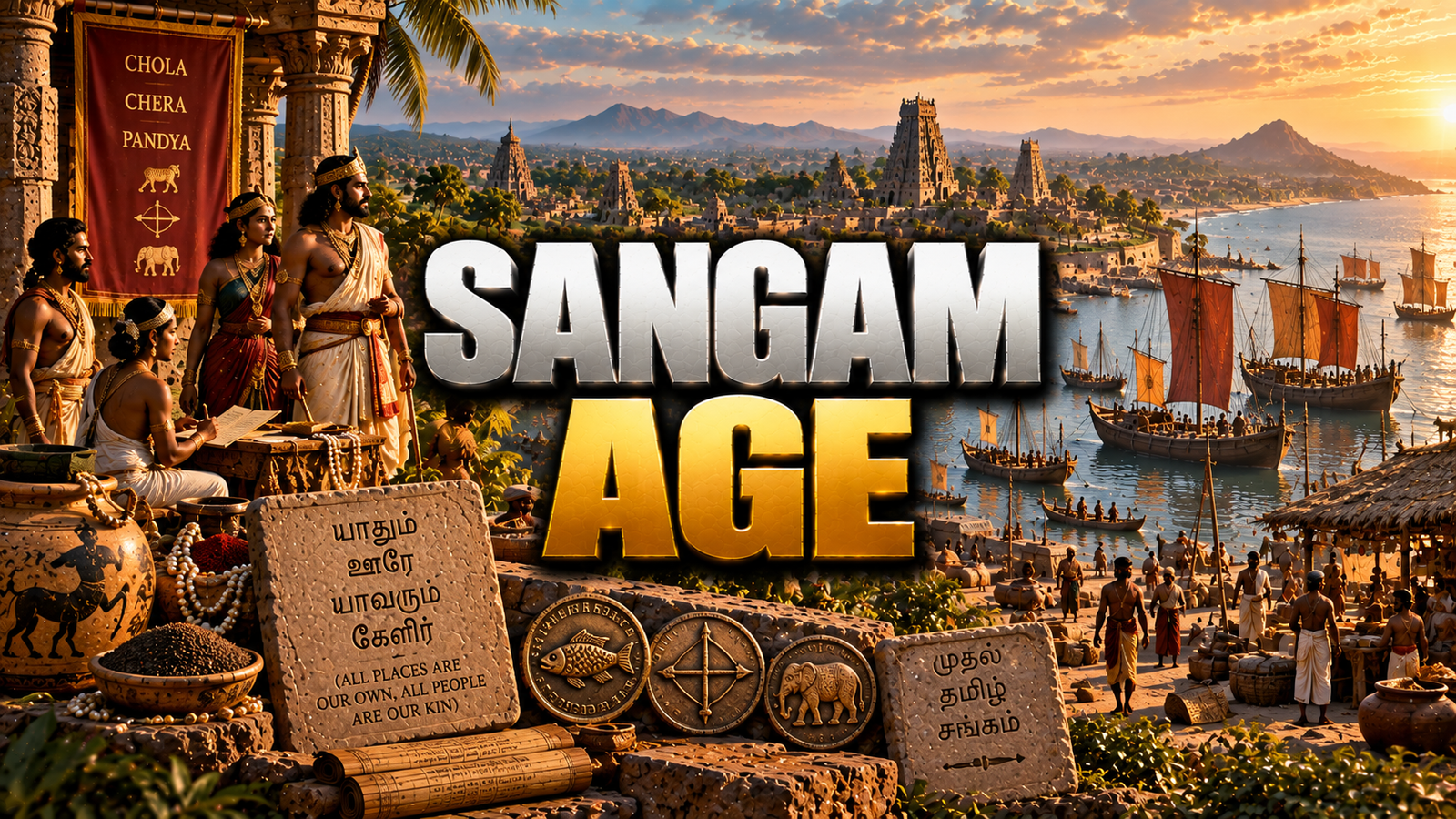
EXHAUSTIVE REVISION FOR UPSC CSE & UPPCS (MODULE 11 OF 15)
🧭 OVERVIEW & HISTORICAL LANDSCAPE OF TAMILAKAM
The Sangam Age spans roughly six centuries (c. 300 BCE to 300 CE), marking the dawn of recorded history in Southern India. The geographical domain, designated as Tamilakam, extended from Tirupati (Tiruvengadam hills) in the north to Kanyakumari in the south, flanked by the Arabian Sea and the Bay of Bengal. The era takes its name from the royal academies of Tamil poets and intellectuals (Sangams) patronized by the **Pandya kings** at Madurai. It documents the transition of tribal chieftaincies into early monarchies, guided by a realistic, non-theological literary tradition and powered by prosperous maritime commerce with the Roman Empire.
🔥 HISTORICAL PARADIGM
Unlike Northern texts heavily influenced by sacred Brahmanical rituals, Sangam literature offers a secular, empirical portrait of early South Indian life, mapping tribal eco-zones (Tinais), heroic hero-stone traditions (Nadukal), trans-oceanic trade networks, and early state formation.
1. 🏛️ The Three Sangam Academies (Sangam Assemblies)
According to the 8th-century commentary on *Irayanar Agapporul* by Nakkirar, three successive academies of poets and scholars were patronized by 199 Pandya kings across legendary eras:
Assembly Epoch
Historic Venue City
Presiding Sages / Chairs
Surviving Textual Heritage
First Sangam (Head Sangam)
Thenmadurai (legendary city submerged by sea)
Sage Agastya & Lord Shiva
No surviving texts available today.
Second Sangam (Middle Sangam)
Kapatapuram (also lost to oceanic deluge)
Sage Agastya & Tolkappiyar
Tolkappiyam (authored by Tolkappiyar).
Third Sangam (Last Sangam)
Madurai (Modern city)
Nakkirar
Entire surviving core corpus: Ettutogai, Pattupattu, and Pathinenkilkanakku.
2. 👑 The Three Crowned Kings (Muventar: Chera, Chola, Pandya)
Tamilakam was ruled by three primary ruling lineages, collectively known as the Muventar ("Three Crowned Monarchs"), alongside minor chieftaincies (Velirs):
2.1 The Chera Dynasty
Territorial Domain: Ruled over central and northern Kerala (Malabar coast) and the Kongu region of Tamil Nadu.
Royal Emblems & Ports: Royal emblem was the Bow and Arrow. Capital city was Vanchi (Karur); primary international seaport was Muziris (Kodungallur), a major spice trade hub.
Senguttuvan (Red Chera): The most celebrated Chera monarch. Instituted the Pattini Cult (worship of Kannagi as the ideal virtuous wife). Led a military expedition to the Himalayas to bring stone for Kannagi's idol and was the first South Indian ruler to send an official embassy to China.
2.2 The Chola Dynasty
Territorial Domain: Governed the fertile Kaveri delta and northern Tamil Nadu (Cholamandalam).
Royal Emblems & Ports: Royal emblem was the Tiger. Inland capital was Uraiyur (famous for fine cotton cloth); coastal port capital was Puhar (Kaveripattinam).
Karikala Chola: The most prominent early Chola ruler. Defeated a combined army of Cheras, Pandyas, and 11 Velir chieftains at the historic Battle of Venni. Built the famous Kallanai Dam (Grand Anicut) across the Kaveri river for irrigation—one of the world's oldest functional water-diversion structures.
2.3 The Pandya Dynasty
Territorial Domain: Ruled over southern Tamil Nadu (Madurai, Tirunelveli, and Kanyakumari).
Royal Emblems & Ports: Royal emblem was the Twin Fish. Inland capital was Madurai; primary seaport was Korkai (famous for pearl fisheries).
Nedunjeliyan: Renowned for his military victory at the Battle of Talaiyalanganam against a rival coalition. Famous in literary tradition for the wrongful execution of Kovalan in the epic *Silappadikaram*.
3. 📜 Corpus of Sangam Literature & Twin Epics
Sangam poetry is classified by two thematic genres: Aham (inner/private sphere of love, human emotions) and Puram (outer/public sphere of warfare, heroism, statecraft, and charity).
Tolkappiyam: Authored by Tolkappiyar; the oldest surviving Tamil work. Acts as a treatise on grammar, phonetics, and poetics, while its 3rd section (*Porulatikaram*) details social organization, marriage, and land classification.
Ettutogai (Eight Anthologies): Comprises 8 short poetic works including Purananuru (warfare, kingship) and Ahananuru (romantic poetry).
Pattupattu (Ten Idylls): Collection of 10 longer poetic songs, such as Pattinappalai (describing the trade port of Puhar) and Tirumurugatrupadai.
Pathinenkilkanakku (18 Minor Didactic Works): Later texts emphasizing ethics and moral philosophy. Contains the famous Tirukkural authored by Thiruvalluvar, categorized into three books: Aram (Virtue), Porul (Polity), and Inbam (Love).
3.2 The Twin Tamil Epics
Epic Title
Author & Background
Core Narrative & Historical Value
Silappadikaram ("The Tale of an Anklet")
Ilango Adigal (Jain prince & brother of Senguttuvan)
Narrates the story of merchant Kovalan, his devoted wife Kannagi, and courtesan Madhavi. Kovalan is executed wrongfully by the Pandya king of Madurai for stealing the queen's anklet. Kannagi proves his innocence and burns Madurai in grief. Formed the foundation of the Pattini Cult.
Manimekalai
Sithalai Sattanar (Buddhist grain merchant)
Direct sequel to *Silappadikaram*. Follows Manimekalai, daughter of Kovalan and Madhavi, who rejects worldly life to become a Buddhist nun. Provides valuable insights into early Buddhist philosophy in South India.
4. 🌾 The Five Eco-Zones (Tinais Landscape Matrix)
Sangam literature classified human activity and physical environment into five ecological micro-regions (Five Tinais), each associated with a specific landscape, occupation, and deity:
Paddy Agriculture: Rice was the primary staple crop grown in the fertile *Marudam* valleys. The Kaveri delta was so fertile that texts remarked: "The space where an elephant could lie down produced grain to feed seven people."
Craft Specialization: Spinning and weaving of fine cotton textiles were centered at Uraiyur and Madurai.
5.2 Trans-Oceanic Commerce with Rome
Monsoon Navigation: Discovery of the monsoon winds by Hippalus (c. 45 CE) allowed direct navigation across the Arabian Sea to Tamilakam ports.
Export Commodities: Black pepper (known as Yavanapriya, "Dear to Yavanas/Romans"), cardamom, ivory, pearls, beryl, and fine muslin textiles.
Import Commodities: Roman gold and silver coins, wine amphorae, coral, topaz, and glass.
Arikamedu Excavations: Sir Mortimer Wheeler excavated Arikamedu (Poduke) near Puducherry, revealing a permanent Roman trading post with Arretine pottery, amphorae jars, and Roman coin hoards.
6. 🏹 Social Stratification, Status of Women & Hero Stones (Nadukal)
6.1 Social Structure & Hero Stones
Social Classes: Rather than rigid Varna divisions, society was organized around occupational communities: Arasar (Rulers), Anthanar (Priests), Vaniyar (Traders), and Vellalar (Landowners/Cultivators).
Hero-Stone Tradition (Nadukal / Virakkal): Memorial stones erected over the graves of fallen warriors to honor bravery in battle or cattle raids. Offered regular worship and ritual offerings.
6.2 Status of Women & Religious Practices
Status of Women: Women participated actively in intellectual life. Over 30 female poets contributed to the Sangam corpus, including the celebrated Avvaiyar.
Marriage Traditions: Love marriages (Kalavu) were recognized alongside formal marriages (Karpu).
Widowhood: Sati (Tippaydal) was practiced among royal widows, and widowhood in general was subjected to strict austerity.
Deity Worship: Indigenous worship centered on Murugan (celebrated with the *Velan Veriyattam* dance) alongside early forms of Vishnu, Indra, and Korravai.
7. 🎯 UPSC / UPPCS Prelims High-Yield Fact Vault
📌 Memory Keys for Direct Prelims MCQs
Tolkappiyam Author: Tolkappiyar (Oldest Tamil work on grammar and society).
Pattini Cult Founder: Chera King Senguttuvan (Red Chera) in honor of Kannagi.
Kallanai Dam Builder: Chola King Karikala across the Kaveri River.
Muventar Dynasties: Cheras (Bow), Cholas (Tiger), and Pandyas (Fish).
Yavanas: Term used in Tamil texts for Roman and Greek traders.
Arikamedu Location: Coastal trade site near Puducherry excavated by Mortimer Wheeler.
Nadukal / Virakkal: Memorial stones erected for fallen warriors.
Tirukkural Author: Thiruvalluvar (Covers Ethics, Polity, and Love).
8. 📝 Previous Year Question (PYQ) Themes
Socio-economic insights from the Five Tinais landscape matrix in Sangam literature.
Indo-Roman maritime trade: Ports, export-import goods, and monetary impact.
Role of women and female poets (Avvaiyar) in Sangam society.
Evolution of early South Indian state formation under the Cheras, Cholas, and Pandyas.
Cultural value of the twin Tamil epics: Silappadikaram and Manimekalai.
9. ✍️ UPSC Mains Analytical Anchor Points
💡 Structural Value Additions for GS Paper 1
Ecological Determinism in Tinais: The Five Tinais system demonstrates how early Tamil society mapped human economic activity directly to natural geography before rigid caste structures emerged.
Pre-Modern Global Integration: Tamilakam served as a primary maritime bridge connecting the Roman West with Southeast Asia, evidenced by Roman amphorae and coin hoards across South India.
Secular Character of Sangam Literature: Unlike early Sanskrit religious texts, Sangam poetry provides empirical insights into daily life, warfare, romance, and statecraft.
10. ❓ FREQUENTLY ASKED QUESTIONS (FAQ)
What are the Five Tinais in Sangam socio-economic landscape?
The Five Tinais represent ecological micro-regions in Sangam literature: Kurinji (Hilly/Hunting - Murugan), Mullai (Pastoral/Herding - Mayon), Marudam (Agricultural Valleys - Vendan/Indra), Neydal (Coastal/Fishing - Varunan), and Palai (Arid/Robbery - Korravai).
Who instituted the Pattini Cult in ancient South India?
Chera King Senguttuvan (Red Chera) established the Pattini Cult, which centered on the ritualistic worship of Kannagi as the ideal virtuous wife, following the events narrated in the epic Silappadikaram.
What is the historical significance of Arikamedu in Sangam commerce?
Arikamedu (near Puducherry) was an Indo-Roman coastal trading settlement excavated by Sir Mortimer Wheeler. Findings included Roman amphorae, Arretine pottery, glass beads, and Roman gold coins, confirming intensive trans-oceanic trade.
11. 🔗 Next Ancient History Modules in Series
Continue your systematically ordered Ancient History syllabus coverage: