Comprehensive Study Notes for UPSC History
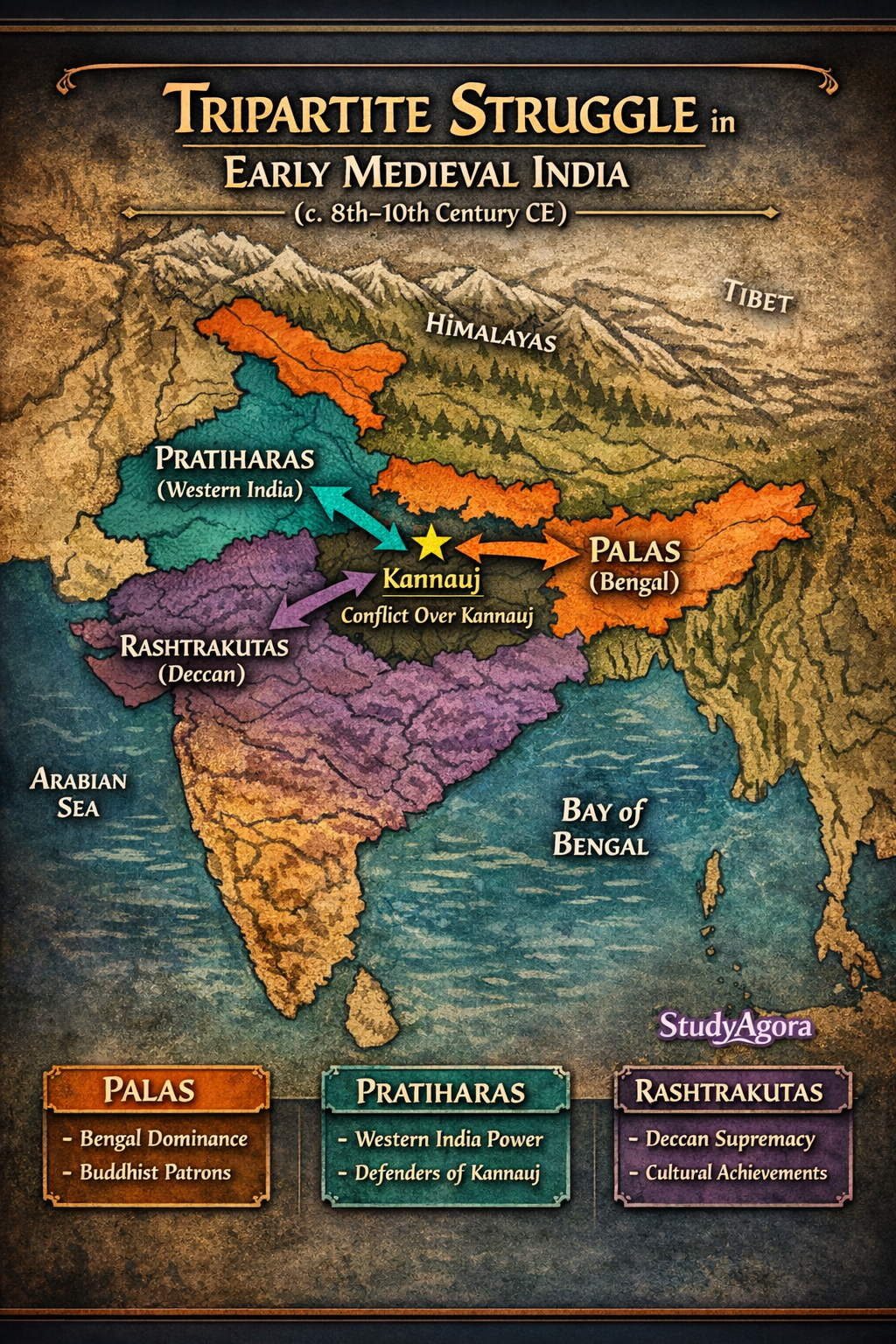
The Tripartite Struggle (c. 8th–10th century CE) refers to the prolonged political contest among three major dynasties—Palas of Bengal, Gurjara-Pratiharas of western and northern India, and Rashtrakutas of the Deccan—for control over Kannauj.
This conflict emerged in the aftermath of the decline of the Harsha Empire, which created a power vacuum in North India. In the absence of a strong centralized authority, regional powers rose and competed for political supremacy. Kannauj became the focal point of this struggle because it symbolized imperial legitimacy, controlled the fertile Ganga-Yamuna Doab, and occupied a strategic position along major trade routes.
The struggle was not a single continuous war but a series of campaigns and shifting alliances, marked by temporary victories and repeated conflicts. It reflects the broader pattern of early medieval India, characterized by decentralization, regional state formation, and the absence of long-lasting political unity.
The Pala dynasty emerged in eastern India during the mid-8th century CE in a context of political instability known as Matsyanyaya (law of the fish). In order to restore order, a local chief, Gopala, was elected as king around 750 CE. This makes the Palas unique in Indian history as one of the rare examples of an elected monarchy.
The dynasty soon grew into a major regional power controlling Bengal and Bihar and played a central role in North Indian politics, especially during the Tripartite Struggle for Kannauj.
1. Gopala (Founder)
Gopala established the Pala rule by consolidating control over Bengal and ending political chaos. His election indicates the presence of local assemblies or influential groups in early medieval polity.
2. Dharmapala ⭐
Dharmapala was the real architect of Pala imperial power. He expanded his authority beyond Bengal into North India and became a key player in the Tripartite Struggle. He captured Kannauj and installed Chakrayudha as a subordinate ruler, thereby asserting political dominance. However, his control was temporary due to challenges from the Pratiharas and Rashtrakutas.
3. Devapala ⭐
Devapala is considered the greatest ruler of the Pala dynasty. Under him, the empire reached its maximum extent, extending its influence to Assam, Odisha, and parts of Nepal. His reign represents the peak of Pala political and military power, though claims of extensive conquests are often exaggerated in inscriptions.
4. Mahipala I
Mahipala I is known for reviving the declining fortunes of the Pala dynasty. He recovered lost territories and restored some degree of stability, though the empire never regained its earlier strength.
The Pala administration was monarchical, with the king exercising supreme authority. The empire was divided into administrative units such as Bhukti (province) and Vishaya (district). Governance relied heavily on local intermediaries and feudatories, reflecting decentralization.
The economy was primarily agrarian, supported by the fertile Ganga plains. Land revenue was the main source of income, but extensive land grants to Brahmins and monasteries reduced central control and strengthened local elites.
The Palas were strong patrons of Mahayana Buddhism and played a crucial role in its revival. They supported major centers of learning such as Nalanda and Vikramshila, which attracted scholars from across Asia. Buddhist teachers like Atisha helped spread Buddhism to Tibet.
The Pala period is known for its distinctive artistic style, especially bronze sculptures and Buddhist imagery. Their art influenced Tibetan and Southeast Asian traditions.
The Palas were one of the main contenders in the Tripartite Struggle. Dharmapala initially gained control over Kannauj, but due to geographical distance and repeated invasions, the dynasty could not maintain long-term dominance.
The Pala dynasty played a crucial role in stabilizing eastern India and shaping early medieval politics. Their greatest contribution lies in the preservation and spread of Buddhism beyond India.
The Gurjara-Pratihara dynasty emerged as a major political power in western and northern India during the early medieval period. They played a decisive role in North Indian politics and were one of the principal contenders in the Tripartite Struggle for Kannauj.
The dynasty was founded by Nagabhata I, who is credited with resisting Arab invasions in western India, thereby acting as a defensive barrier against external expansion. Over time, the Pratiharas extended their control into North India and established Kannauj as their capital, symbolizing their claim to imperial authority.
1. Nagabhata I (Founder)
Nagabhata I laid the foundation of the Gurjara-Pratihara power in western India. He is particularly known for successfully resisting Arab invasions advancing from Sindh, which helped protect the interior regions of India.
2. Vatsaraja
Vatsaraja was one of the earliest rulers to actively participate in the Tripartite Struggle. He defeated the Pala ruler Dharmapala and asserted his dominance in North India. However, he was later defeated by the Rashtrakuta ruler Dhruva.
3. Nagabhata II ⭐
Nagabhata II significantly strengthened the dynasty. He defeated the Palas and successfully captured Kannauj, making it the capital of the Pratihara Empire. This marked the peak of their political assertion in North India.
4. Mihira Bhoja ⭐ (Greatest Ruler)
Mihira Bhoja is considered the greatest ruler of the Pratihara dynasty. He expanded the empire extensively and maintained control over a large part of North India. He assumed the title Adivaraha and is noted for his strong military, especially cavalry.
5. Mahendrapala I
Mahendrapala I succeeded Mihira Bhoja and maintained the stability and territorial extent of the empire. His reign marked continuity rather than expansion.
The Gurjara-Pratihara administration was largely decentralized and feudal in nature. The king was supported by a network of feudatories (samantas) who controlled local regions and provided military support.
The economy was predominantly agrarian, supported by land revenue. Trade and commerce also existed, especially in regions under their control in North India. However, the increasing practice of land grants led to decentralization.
The Gurjara-Pratiharas are particularly known for their military strength and role as defenders of India’s northwestern frontiers. Their resistance against Arab invasions helped prevent further expansion of Islamic rule into the Indian interior during this period.
The Pratiharas were the most consistent and dominant contenders in the Tripartite Struggle. They managed to capture and retain Kannauj for longer periods compared to their rivals. However, they faced repeated challenges from both the Palas and the Rashtrakutas.
The decline of the Gurjara-Pratihara dynasty began after the 10th century due to internal conflicts, the rise of regional powers, and weak successors. Eventually, their empire fragmented into smaller Rajput states.
The Gurjara-Pratiharas played a crucial role in shaping early medieval North India. They were instrumental in resisting foreign invasions, controlling Kannauj, and maintaining political stability in the region for a considerable period.
The Rashtrakuta dynasty emerged as a powerful force in the Deccan during the early medieval period and played a crucial role in shaping both southern and northern Indian politics. Founded by Dantidurga in the mid-8th century CE, the dynasty rose after overthrowing the Chalukyas of Badami.
Unlike the Palas and Pratiharas, the Rashtrakutas were primarily a Deccan power, yet they actively intervened in North Indian politics during the Tripartite Struggle for Kannauj. Their involvement added a third dimension to the conflict, making it a truly pan-Indian power contest.
1. Dantidurga (Founder)
Dantidurga established the Rashtrakuta power by defeating the Chalukyas and consolidating control over the Deccan. He laid the foundation for one of the most powerful dynasties of early medieval India.
2. Dhruva Dharavarsha ⭐
Dhruva was the first Rashtrakuta ruler to intervene in North Indian politics. He launched successful campaigns against both the Gurjara-Pratihara ruler Vatsaraja and the Pala ruler Dharmapala, thereby asserting Rashtrakuta supremacy.
3. Govinda III ⭐ (Greatest Ruler)
Govinda III was the most powerful Rashtrakuta ruler and led successful campaigns deep into North India. He defeated both the Palas and Pratiharas and reached Kannauj, demonstrating Rashtrakuta dominance.
4. Amoghavarsha I
Amoghavarsha I is known more for his cultural contributions than military expansion. His reign was relatively peaceful, and he patronized literature and religion.
The Rashtrakuta administration was decentralized in nature. The empire was divided into provinces governed by feudatories who enjoyed considerable autonomy. This reflects the broader trend of feudalism in early medieval India.
The Rashtrakuta economy was primarily agrarian, supported by land revenue. Trade also flourished due to their strategic location in the Deccan, connecting northern and southern India.
The Rashtrakutas made significant contributions to art and architecture. Their most famous achievement is the construction of the Kailasa Temple at Ellora, a remarkable example of rock-cut architecture.
The Rashtrakutas played a crucial but distinct role in the Tripartite Struggle. Unlike the Palas and Pratiharas, they did not aim to permanently control Kannauj. Instead, they sought to demonstrate their supremacy through successful military campaigns.
The Rashtrakuta Empire declined after the 10th century due to internal conflicts and the rise of new powers such as the Western Chalukyas.
The Rashtrakutas were one of the most powerful dynasties of early medieval India. They bridged North and South Indian politics and contributed significantly to art and culture. Their role in the Tripartite Struggle highlights their military strength and strategic importance.
The Tripartite Struggle was a defining political phenomenon of early medieval India, reflecting the intense competition among regional powers—Palas, Gurjara-Pratiharas, and Rashtrakutas—for supremacy in North India. While the immediate objective was control over Kannauj, the struggle symbolized a broader quest for imperial legitimacy, economic resources, and strategic dominance.
Despite repeated military successes by all three dynasties, none could establish lasting control over Kannauj. This highlights the structural limitations of early medieval polity, where decentralized administration, dependence on feudatories, and geographical constraints prevented effective political integration.
In the long run, the struggle resulted in continued political fragmentation, strengthening of feudal elements, and the rise of regional powers such as the Rajputs. It also exposed the absence of a strong centralized authority in North India, which later facilitated external invasions.
Thus, the Tripartite Struggle should not be seen merely as a series of wars, but as a reflection of the transition from centralized empires to regional state systems, marking a crucial phase in the evolution of medieval Indian polity.
Tripartite struggle = no winner, only fragmentation.
Shows shift from empire → regional states + feudalism.