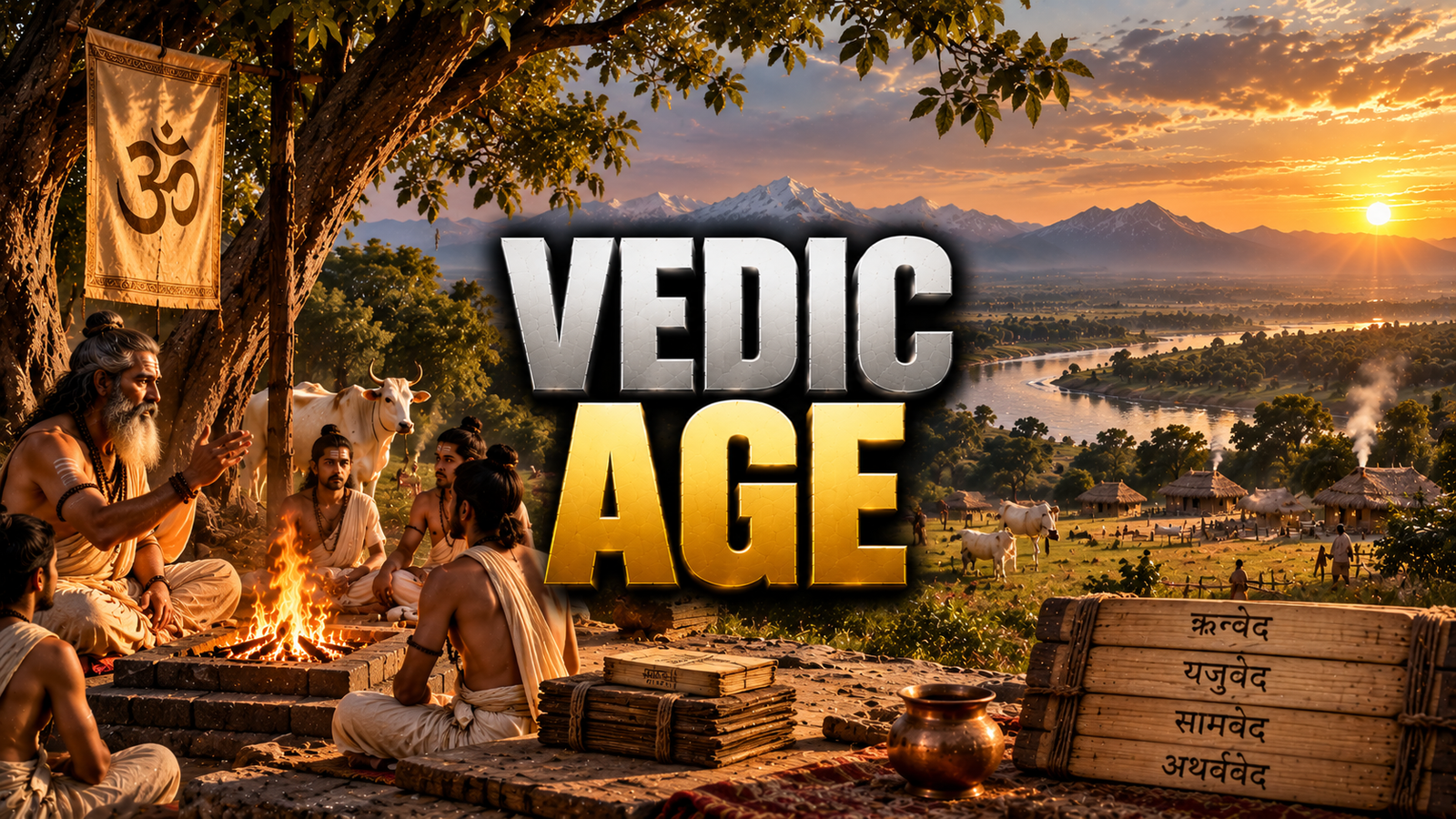
SMART NOTES FOR UPSC CSE & UPPCS (MODULE 03 OF 15)
🧭 OVERVIEW & EXAM CONTEXT
The Vedic Age (c. 1500 – 600 BCE) is the period during which the Vedas — the oldest scriptures of Hinduism — were composed, laying the religious, social, and cultural foundations of the Indian subcontinent. It is conventionally split into the Early/Rig-Vedic period (semi-nomadic, pastoral, tribal) and the Later Vedic period (settled, agrarian, increasingly hierarchical) — tracking a broader shift from a mobile cattle-herding society in the Sapta-Sindhu to territorial kingdoms in the Ganga-Yamuna Doab.
🔥 Core Historical Debate
The origin of the "Aryans" remains debated: the mainstream scholarly position (supported by comparative Indo-European linguistics, comparative mythology, and archaeogenetics) points to pastoral migrations from the Central Asian Steppes, while an alternative Out-of-India / indigenous theory is advocated by some scholars. For civil services exams, focus on the material culture, structural transition, and textual evidence.
1. 📚 Textual Sources & Vedic Corpus
Vedic literature is broadly classified into Shruti ("that which is heard" — primary divine revelations comprising Samhitas) and Smriti ("that which is remembered" — secondary supplementary texts).
1.1 The Four Vedas (Samhitas)
Rig Veda (c. 1500–1000 BCE): The oldest text. Contains 1,028 hymns (Suktas) arranged across 10 Mandalas. Mandalas 2–7 are the oldest ("Family Books," composed by specific Rishi clans like Viswamitra, Vashishta, Atri, Bharadvaja).
Mandala 3 contains the Gayatri Mantra composed by Sage Viswamitra dedicated to Savitr.
Mandala 10 contains the Purusha Sukta, providing the earliest textual reference to the origin of the four Varnas.
Mandala 7 mentions the Dasarajna Yuddha (Battle of Ten Kings) on the banks of the Parushni (Ravi) River.
Sama Veda: A book of chants consisting of 1,549 stanzas, mostly set to musical notations drawn from the Rig Veda. Regarded as the foundation of Indian classical music. Priests called Udgatri chanted it.
Yajur Veda: A ritual manual specifying sacrificial procedures. Divided into Krishna (Black) Yajur Veda (prose commentary mixed with verse) and Shukla (White) Yajur Veda (pure verse). Recited by Adhvaryu priests.
Atharva Veda: Contains spells, charms, and folk healing practices against diseases and evil spirits. Reflects popular folk beliefs and non-Aryan cultural synthesis. Associated with priest Brahma.
1.2 Secondary Vedic Literature
Brahmanas: Detailed prose treatises explaining the ritual significance and procedures of sacrifices (e.g., Shatapatha Brahmana of White Yajur Veda).
Aranyakas: "Forest books" offering mystical interpretations of sacrifices, bridging ritualism with philosophical speculation for hermits.
Upanishads (Vedanta): Philosophical discourses centered on Atman (self) and Brahman (ultimate reality). Out of 108 traditional Upanishads, 13 are principal (Mukhya) Upanishads (e.g., Brihadaranyaka, Chandogya, Mundaka).
The national motto "Satyameva Jayate" is taken from the Mundaka Upanishad.
Vedangas: Six auxiliary disciplines needed for correct Vedic study: Shiksha (phonetics), Kalpa (rituals), Vyakarana (grammar), Nirukta (etymology), Chhandas (metrics), and Jyotisha (astronomy).
2. 🐄 Early Vedic / Rig-Vedic Period (c. 1500 – 1000 BCE)
2.1 Geographical Sphere
Centred on the Sapta-Sindhu (Land of Seven Rivers) region, covering modern Punjab, Haryana, NWFP, and parts of Afghanistan. Key rivers mentioned: Sindhu (Indus - most mentioned), Saraswati (Naditarna - most sacred), Vitasta (Jhelum), Asikni (Chenab), Parushni (Ravi), Vipas (Beas), and Sutudri (Sutlej).
2.2 Tribal Polity & Assemblies
Rajan (Tribal Chief): Functioned as a tribal war leader; position was not strictly hereditary and power was checked by assemblies. Had no standing army or formal standing bureaucracy.
Tribal Assemblies:
Vidatha: Oldest assembly; performed broad socio-religious, military, and folk redistribution tasks. Women participated actively.
Sabha: Smaller council of select clan elders and elites; exercised judicial and political advisory duties.
Samiti: General assembly of the entire clan/tribe; elected and deposed the Rajan.
Administrative Helpers:Purohita (chief priest/advisor - e.g., Vasishtha and Viswamitra), Senani (head of army), and Gramani (head of village/fighting unit).
2.3 Economy & Social Life
Pastoral Economy: Cattle (Gau) formed the chief measure of wealth; conflicts were fought for cows (termed Gavisthi - search for cows). Wealthy individuals were called Gomat.
Flexible Society: Kin-based social organization (Kula ➔ Grama ➔ Vis ➔ Jana). Varna divisions were based on occupation rather than birth (flexible and mobile).
Status of Women: Position was relatively high; attended Vidatha assemblies, received education, underwent Upanayana (sacred thread) ceremonies, and composed hymns (e.g., Ghosha, Apala, Lopamudra, Vishwavara). No evidence of child marriage or Sati.
Early Vedic Religion: Anthropomorphic worship of personified natural forces. Dominant deities: Indra (Purandara - god of thunder/war, 250 hymns), Agni (fire messenger, 200 hymns), Varuna (custodian of Rita/cosmic order), and Soma (god of plants). Prayed for material boons (praja, pasu, dhana) through simple chants and fire offerings.
3. 🏹 Later Vedic Period (c. 1000 – 600 BCE)
3.1 Geographic Expansion & Metallurgy
Expansion eastward into the Ganga-Yamuna Doab (Kurukshetra, Panchala, Videha, Kashi) facilitated by the discovery of Iron technology (termed Shyama Ayas or Krishna Ayas) around 1000 BCE at sites like Atranjikhera and Hastinapur. Archaeologically associated with the Painted Grey Ware (PGW) culture.
3.2 Political Transformation & Territorial States
Rise of Janapadas: Fusion of clans into larger territorial units (e.g., Bharat + Puru = Kuru; Turvasa + Krivis = Panchala).
Hereditary Kingship: Rajan evolved into a territorial monarch with elevated titles (Samrat, Ekarat, Virat). Tribal assemblies (Sabha and Samiti) lost authority and became dominated by nobles and Brahmins, while the Vidatha disappeared entirely.
Royal Sacrifices & Officers: Kings performed elaborate rituals to validate political legitimacy:
Rajasuya: Royal consecration sacrifice conferring supreme authority.
Vajapeya: Chariot race ritual to rejuvenate the king's physical vigour.
Assisted by 12 Ratnins (royal officials like Sangrahitri - treasurer, Bhagadugha - tax collector).
3.3 Social Stratification & Agrarian Economy
Rigid Varna Hierarchy: Society stratified into four distinct, hereditary Varnas (Brahmana, Kshatriya, Vaishya, Shudra). The concept of Gotra (clan lineage exogamy) and four Ashramas (Brahmacharya, Grihastha, Vanaprastha, Sannyasa) took shape.
Declining Status of Women: Women lost the right to attend political assemblies, underwent restrictions in Upanayana rites, and female child birth was increasingly lamented (Aitareya Brahmana calls daughter a source of misery).
Agrarian Dominance & Taxation: Agriculture overtook pastoralism as the primary livelihood (rice - Vrihi, barley - Yava, wheat - Godhuma). Regular taxation emerged: Bali (mandatory tribute), Bhaga (1/6th produce share), and Shulka.
Religious Shift: Early deities (Indra, Agni) lost primacy to Prajapati (the Creator), Vishnu (the Preserver), and Rudra (the Destroyer). Sacrifices grew complex, expensive, and priest-dominated, triggering philosophical blowback in the Upanishads.
4. 📊 Quick Comparison Matrix: Early vs. Later Vedic
Structural Theme
Early Vedic Period (c. 1500–1000 BCE)
Later Vedic Period (c. 1000–600 BCE)
Geographical Base
Sapta-Sindhu (Punjab / Indus Basin)
Ganga-Yamuna Doab & Western UP
Primary Livelihood
Pastoralism (Cattle wealth / Gau)
Settled Agriculture (Rice, Wheat, Barley)
Political Organization
Tribal polity (Rajan checked by Vidatha/Sabha/Samiti)
Territorial Janapadas (Hereditary King / Samrat)
Social Structure
Flexible Varna based on occupation; high status for women
Hereditary rigid Varna, Gotra system, declined status of women
Primary Deities
Indra, Agni, Varuna, Mitra, Soma
Prajapati, Vishnu, Rudra
Metals Known
Copper / Bronze (Ayas)
Iron (Shyama Ayas) & Copper
Taxation System
Voluntary gifts (Bali)
Mandatory taxes (Bali, Bhaga, Shulka) collected by Bhagadugha
Archaeological Link
Ochre Coloured Pottery (OCP) / Late Harappan interfaces
Painted Grey Ware (PGW) culture
5. 🌱 Socio-Economic Significance & Transition
The transformation from the Early to Later Vedic Period represents a watershed transition in ancient Indian history. The introduction of iron axes enabled the clearing of dense monsoon forests in the Middle Ganga basin, generating agrarian surpluses. This economic expansion supported territorial state formation (Janapadas) and institutionalized administrative taxation.
Simultaneously, the rising burden of costly priestly rituals and rigid Varna exclusions sparked a profound intellectual rebellion in the 6th Century BCE. This gave birth to the Upanishadic philosophical inquiries (Atman-Brahman identity) and heterodox movements like Buddhism and Jainism.
6. 🎯 UPSC / UPPCS Prelims High-Yield Fact Vault
📌 Direct Exam Revision Keys
Oldest Veda: Rig Veda (1,028 hymns, 10 Mandalas).
Oldest Family Mandalas: Mandalas 2 to 7 of Rig Veda.
Battle of Ten Kings (Dasarajna): Fought on Parushni (Ravi) river between Bharata King Sudas and 10 allied tribes.
Origin of Varna System: Purusha Sukta hymn in the 10th Mandala of Rig Veda.
PGW Culture: Archaeologically linked with Later Vedic settlements (Hastinapur, Atranjikhera, Noh).
7. 📝 Previous Year Question (PYQ) Themes
Comparative analysis of Early Vedic tribal polity (Sabha, Samiti, Vidatha) vs. Later Vedic territorial monarchy.
Impact of Iron metallurgy on agricultural surplus and the emergence of Janapadas.
Socio-religious causes leading to the heterodox intellectual revolt (Buddhism/Jainism) against Later Vedic ritualism.
Evolution of the Varna hierarchy and changing status of women from Rig Vedic to Later Vedic eras.
Classification and historical value of Vedic literature (Samhitas, Brahmanas, Aranyakas, Upanishads).
8. ✍️ UPSC Mains Analytical Anchor Points
💡 Structural Value Additions for GS Paper 1
Precedents for Consultative Governance: Early Vedic tribal assemblies (Sabha and Samiti) demonstrate early traditions of collective deliberation and consensus-building in the Indian political ethos.
Material Basis of Social Stratification: The hardening of the Varna hierarchy from flexible occupational roles into closed birth-based classes illustrates how agricultural surpluses and territorial control reshape social institutions over time.
Dialectics of Ritualism vs. Philosophy: The philosophical shift from ritualistic Brahmana texts to contemplative Upanishadic discourses highlights an internal intellectual reform movement that laid the groundwork for classical Indian philosophy.
9. ❓ FREQUENTLY ASKED QUESTIONS (FAQ)
What was the oldest tribal assembly in the Early Vedic period?
The Vidatha is considered the oldest tribal assembly in the Early Vedic period. It performed broader folk, social, military, and religious functions, and included active female participation.
Where is the earliest mention of the four Varnas found?
The earliest textual reference to the four Varnas (Brahmana, Kshatriya, Vaishya, Shudra) is found in the Purusha Sukta hymn of the 10th Mandala of the Rig Veda.
What archaeological culture is associated with the Later Vedic Period?
The Later Vedic Period is archaeologically associated with the Painted Grey Ware (PGW) culture in the Ganga-Yamuna Doab.
10. 🔗 Next Ancient History Modules in Series
Continue your systematically ordered Ancient History syllabus coverage: