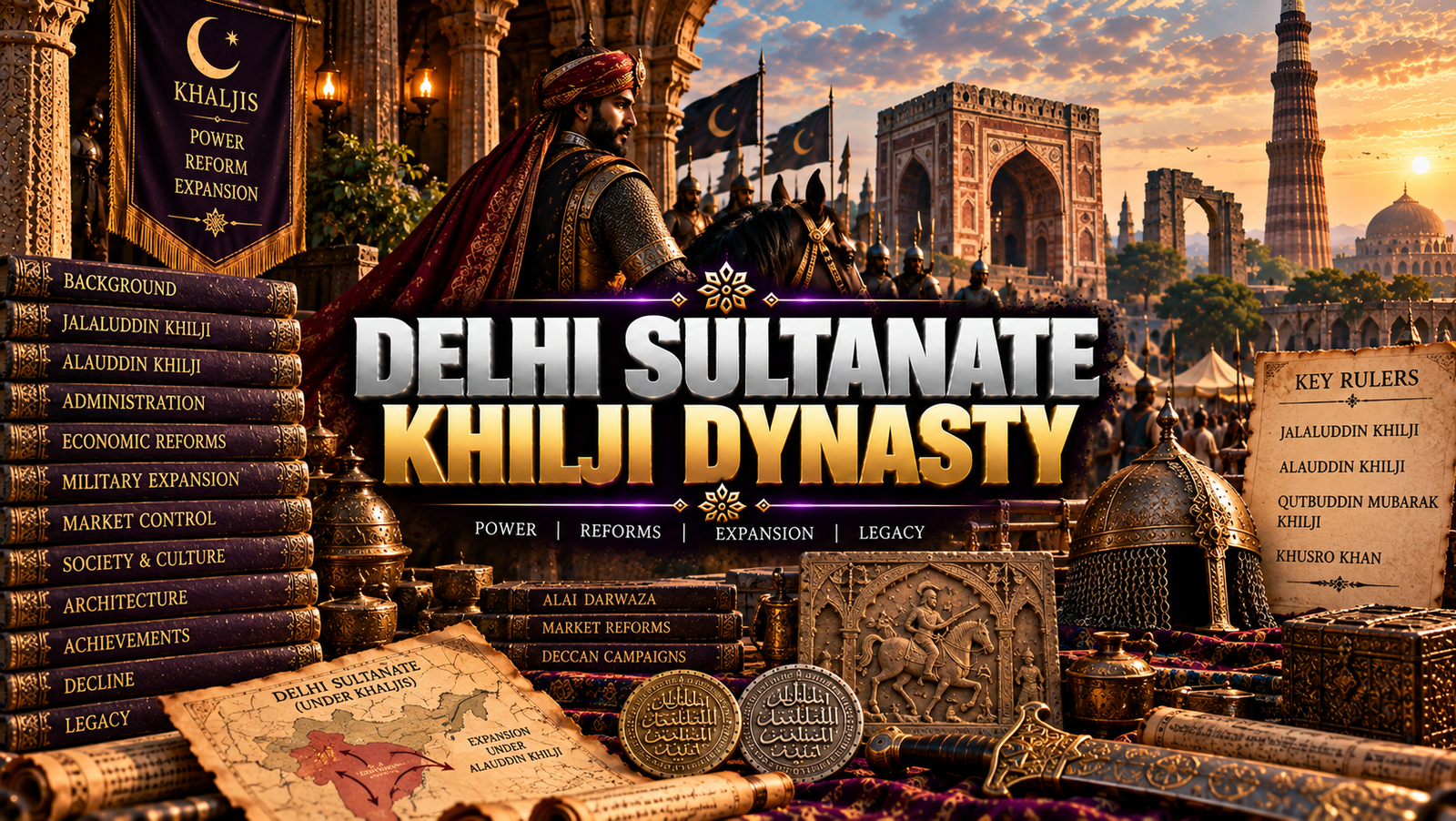
🧭 HISTORICAL PARADIGM SHIFT: THE KHALJI REVOLUTION
The overthrow of the Mamluk (Slave) dynasty in 1290 CE by Jalal-ud-din Firuz Khalji ushered in a transformative era in the history of the Delhi Sultanate. Historian Mohammad Habib famously characterized this event as the "Khalji Revolution."
This revolution shattered the long-standing monopoly of the aristocratic Ilbari Turkish nobility. The Khaljis—though of Turkic origin—had lived for centuries in the Helmand valley of Afghanistan and were treated as non-Turkish outsiders by the Delhi court elite. Their rise democratized access to state office, bringing Indian Muslims (Hindustanis), Afghans, and lower-caste converts into administrative and military power. Politically, the era shifted the Sultanate from a defensive frontier principality into an expansive, centralized, and economically regulated pan-Indian empire under Alauddin Khalji (r. 1296–1316 CE).
🔥 Core Analytical Pillars
Era: 1290–1320 CE (Shortest ruling dynasty of the Delhi Sultanate).
Key Paradigm Shift: Broadening of the ruling elite + Separation of state administration from clerical religious interference + Creation of a permanent cash-paid standing army.
Major Rulers: Jalal-ud-din Khalji (1290–1296) and Alauddin Khalji (1296–1316).
Ascended the throne at Kilokhri at the age of 70 after executing the last Mamluk puppet, Shamsh-ud-din Kayumars. His reign was marked by an unprecedented policy of political conciliation and non-violent statecraft.
Policy of Humanitarian Governance: Refused to inflict harsh retaliatory punishments on defeated rebels. When Balban’s nephew Malik Chhajju revolted at Kara, Jalal-ud-din pardoned him, stating that he was unwilling to shed the blood of fellow Muslims for a temporary throne.
Mongol Ingress & "New Muslims": Defeated a Mongol invasion force in 1292 CE led by Abdullah. A contingent of Mongols led by Ulghu Khan converted to Islam, settled in Delhi (at Mughalpura), and were designated as New Muslims.
Assassination: Assassinated in 1296 CE at Kara (Prayagraj) by his ambitious nephew and son-in-law, Ali Gurshasp (Alauddin Khalji), upon his return from an unauthorized, highly lucrative raid on Devagiri.
1.2 Alauddin Khalji (r. 1296–1316 CE) — The Imperial Autocrat
Historical Assessment: Alauddin was the primary architect of Sultanate imperialism. He combined brutal political realism with administrative innovation, transforming the state into a centralized fiscal and military apparatus.
Titles & Ambitions: Adopted the title Sikandar-i-Sani ("Alexander the Second"), which was struck on his coins. Initially harbored ambitions of establishing a new world religion and conquering the globe, but was dissuaded by his loyal scholar-advisor, Ala-ul-Mulk (Kotwal of Delhi).
Secular Theory of Kingship: Asserted that administrative law (Zawabit) and political expedience superseded traditional ecclesiastical decrees. Declared to Qazi Mughis-ud-din of Bayana that he issued commands based solely on state necessity, regardless of whether they conformed to religious canon.
1.3 Post-Alauddin Declining Phase (1316–1320 CE)
Malik Kafur's Regency: Following Alauddin’s death in 1316 CE, his powerful commander Malik Kafur seized control, blinding Prince Khizr Khan before being assassinated by royal bodyguards within 35 days.
Qutb-ud-din Mubarak Shah (r. 1316–1320 CE): Repealed Alauddin's strict market controls and land regulations. Declared himself Caliph (assuming the title Al-Wathiq Billah).
Niranjan / Khusrau Khan's Interregnum: Mubarak Shah was assassinated by his favorite general, Khusrau Khan (an Indian convert from the Baradu clan). Khusrau Khan’s brief rule ended when Ghazi Malik (Ghiyas-ud-din Tughlaq), the governor of Dipalpur, led a noble coalition, executed Khusrau Khan, and established the Tughlaq Dynasty in 1320 CE.
2. 📜 Alauddin's Royal Absolutism & Anti-Nobility Edicts
Following a series of internal rebellions early in his reign—including revolts by his nephew Akat Khan, his sister’s sons Amir Umar and Mangu Khan, and the urban uprising of Haji Maula in Delhi—Alauddin analyzed the root causes of factionalism and promulgated Four Imperial Ordinances to subjugate the nobility:
Ordinance
Administrative Action Mandated
Socio-Political Objective
Ordinance I (Resumption of Grants)
Confiscation of all tax-free land grants—including Milk (proprietary grants), Inam (charitable assignments), and Waqf (religious endowments)—converting them back into crown land (Khalisa).
Stripped nobles and religious elites of excess wealth, forcing them to focus on earning a livelihood through active state service.
Ordinance II (Espionage System)
Reorganization of the imperial intelligence network. Stationed senior spies (Barids) and secret reporting agents (Munhiyans) across noble households, offices, and markets.
Prevented nobles from conspiring against the crown. Barani noted that nobles spoke in whispers even inside their private quarters.
Ordinance III (Prohibition Policy)
Total ban on the manufacture, sale, and consumption of wine, spirits, and intoxicating drugs (Intoxicants/Gambling) within Delhi.
Eliminated festive gatherings where nobles frequently planned political coups.
Ordinance IV (Social Regulation)
Banned social gatherings, feasts, and inter-nobility matrimonial alliances without obtaining prior explicit written permission from the Sultan.
Prevented inter-family aristocratic factionalism and coalition building.
3. 💰 Market Control System & Price Fixation Mechanics
Economic Imperative: Historical chronicler Ziauddin Barani explicitly notes that Alauddin’s market control reforms were driven by military necessity. To maintain a massive permanent standing army (consisting of 475,000 cavalrymen) capable of repelling Mongol invasions without bankrupting the state treasury, Alauddin fixed low prices for essential commodities, enabling soldiers to live comfortably on modest cash salaries (234 Tankas per annum for a single-horse trooper / Yak-Aspa).
3.1 The Three Specialized Markets of Delhi
Market Category
Supervisory Bureau / Location
Commodities Controlled & Enforcement Protocols
Mandi (Grain Market)
Supervised by Shahna-i-Mandi
Prices for wheat, barley, rice, pulses, and sugar were rigidly fixed. State granaries were established in Delhi and stocked with grain collected directly as land tax from the Doab to manage bad harvests and prevent inflation.
Saray-i-Adl (Cloth & Manufactured Goods)
Located inside the Badayun Gate
Regulated high-grade textiles, silks, sugar, herbs, butter, and oil. All merchants were registered with the state department Diwan-i-Riyasat. High-value cloth required a special permit from the Rais-i-Parwana to prevent resale at higher prices outside Delhi.
Livestock & Slave Market
Regulated directly by central inspectors
Strictly fixed prices for warhorses, pack cattle, domestic slaves, and female concubines. Eliminated middleman brokers (Dallals) to prevent price manipulation.
3.2 Enforcement Machinery & Officers
Diwan-i-Riyasat: The supreme ministry of commercial control, headed by Yaqut Shahna.
Shahna-i-Mandi: Chief superintendent of the grain market; maintained registers of authorized merchants.
Munhiyans: Undercover child spies sent into markets to buy goods; if a shopkeeper shortchanged a customer on weight, an equal weight of flesh was cut from the merchant's body.
4. 🌾 Agrarian Policy, Direct Taxation & Measurement
Alauddin transformed agrarian administration across the central Gangetic plains (Doab), eliminating local intermediaries and maximizing direct revenue extraction.
4.1 Key Revenue Reforms
Measurement System (Masahat): Replaced rough crop-sharing estimates with physical land measurement based on the standard unit of Biswa. Revenue was assessed on actual cultivated area.
Revenue Rate: Fixed the state share of land revenue (Kharaj) at an unprecedented 50% (one-half) of gross agricultural produce, payable preferably in cash or grain.
Additional Direct Taxes:
Ghari: Tax assessed on residential houses.
Charai: Tax levied on pasture lands for milk-yielding livestock.
Jizya: Poll tax levied on non-Muslim subjects.
Subjugation of Village Intermediaries: Stripped local hereditary headmen—the Khuts, Muqaddams, and Chaudharis—of their traditional tax privileges (such as Haqq-i-Khoti). Forced them to pay the same land, house, and grazing taxes as ordinary peasants (Balahars). Barani remarked that local headmen could no longer afford to ride horses or wear fine clothes.
Department of Arrears (Diwan-i-Mustakhraj): Created a special audit department to recover unpaid revenue arrears from collectors and eliminate local corruption.
5. ⚔️ Army Centralization: Dagh, Huliya & Cash Salaries
Alauddin established the first permanent, standing, central army directly recruited and paid by the Sultanate state treasury.
Direct Cash Salaries: Abolished the practice of granting small land revenue assignments (Iqtas) to soldiers. Paid cavalrymen directly in cash from the imperial treasury (234 Tankas annually for a single-horse trooper / Yak-Aspa, with an additional 78 Tankas for a two-horse trooper / Do-Aspa).
Dagh System (Branding of Horses): Enforced the hot-iron branding of warhorses with an imperial seal to prevent officers from substituting high-grade warhorses with inferior pack animals during muster reviews.
Huliya / Chehra System (Descriptive Rolls): Maintained a detailed physical record (descriptive roll) of every recruited soldier to prevent substitute proxies from appearing during inspections.
Ariz-i-Mamalik: The central army department performed regular physical audits of troops and cavalry mounts.
Unlike his southern strategy, Alauddin directly annexed defeated North Indian kingdoms into the central empire:
Gujarat Expedition (1299 CE): Led by Ulugh Khan and Nusrat Khan. Defeated Baghela King Karna Dev. It was during this campaign that the general Malik Kafur (a slave known as Hazar-Dinari) was purchased at Cambay.
Ranthambore Siege (1301 CE): Defeated Chauhan King Hamir Deva after a prolonged siege, following the betrayal of Hamir's ministers.
Chittor Expedition (1303 CE): Besieged the fortress of Mewar held by Guhila King Ratnasimha. According to Malik Muhammad Jayasi’s later epic Padmavat (1540 CE), Queen Padmini performed mass Jauhar along with other Rajput women prior to the fort's fall. Chittor was renamed Khizrabad after Alauddin’s son.
Malwa & Central India (1305 CE): Subjugated Mahlak Dev of Malwa through general Ain-ul-Mulk Multani.
Strategic Pragmatism: Alauddin recognized that long supply lines made direct annexation of the Deccan impolitic. Under the command of **Malik Kafur**, the southern campaigns aimed purely at extracting immense wealth, securing annual monetary tribute, and obtaining formal political submission.
Target Dynasty & Region
Ruling Monarch
Year
Campaign Outcome & Historical Highlights
Yadavas of Devagiri
Ramachandra Deva
1307 CE
Surrendered vast gold wealth; Ramachandra was brought to Delhi, honored with the title Rai Rayan, and granted the district of Navsari.
Kakatiyas of Warangal
Prataparudra II
1309 CE
Surrendered huge monetary tribute and his famous Koh-i-Noor diamond to Malik Kafur. Agreed to remit annual tribute.
Hoysalas of Dwarasamudra
Veera Ballala III
1310 CE
Submitted after his capital was besieged, agreeing to assist the Sultanate army in their march further south.
Pandyas of Madurai
Vir & Sundara Pandya
1311 CE
Malik Kafur raided Madurai and Chidambaram, capturing hundreds of war elephants and immense temple wealth, though the Pandyan princes avoided formal capture.
7. 🎨 Art, Architecture & Literary Contributions
The reign of Alauddin marked an architectural milestone in the evolution of the Indo-Islamic style, introducing scientifically engineered domes and true arches.
7.1 Architectural Achievements
Alai Darwaza (1311 CE): The southern gateway to the Quwwat-ul-Islam mosque. Features the first true horseshoe arch, a dome engineered on squinch arches, and red sandstone inlaid with white marble lattices.
Siri Fort: Built as the second imperial city of Delhi to house the expanding standing army and protect against Mongol raids.
Hauz-i-Khas (Hauz-i-Alai): A massive artificial water reservoir constructed to supply water to the city of Siri.
Jam'at Khana Mosque: Built near the shrine of Sufi saint Nizamuddin Auliya; notable as the earliest mosque in Delhi constructed entirely according to Islamic plans.
7.2 Literary Patronage
Patronized Amir Khusrau (known as Tuti-e-Hind or "Parrot of India"), who served in the Khalji court. Khusrau authored historic poetic works including the Khazain-ul-Futuh (detailing Alauddin's military conquests), Qiran-us-Sadain, and Ashiqa. He is also credited with inventing the Sitar and popularizing Qawwali music.
8. 🎯 UPSC / UPPCS Prelims High-Yield Fact Vault
📌 Direct Revision Points for Prelims
Sikandar-i-Sani: Title assumed by Alauddin Khalji meaning "Alexander the Second."
Four Ordinances: Imperial decrees issued by Alauddin banning liquor, social gatherings, inter-nobility marriages, and confiscating tax-free land grants.
Biswa: Standard unit of land measurement introduced by Alauddin under his Masahat system.
Hazar-Dinari: Epithet given to general Malik Kafur, referring to his original purchase price at Cambay.
Ghari & Charai: Additional taxes introduced by Alauddin on residential houses and grazing lands.
Alai Darwaza: Famous gateway in Delhi built in 1311 CE, showcasing the first true horseshoe arch in India.
Diwan-i-Mustakhraj: Revenue audit department created to recover unpaid tax arrears from officials.
9. ✍️ UPSC Mains Analytical Anchor Points
💡 Structural Value Additions for GS Paper 1
Secularization of Statecraft: Alauddin's governance model demonstrated that imperial survival demanded the subordination of religious orthodoxy to practical administrative and military necessities.
State Controlled Economy: The market control system of Alauddin stands as one of the earliest historically documented experiments in price fixation, state-managed granaries, and anti-hoarding consumer protection.
Geopolitical Re-orientation: By raiding the Deccan without direct annexation, Alauddin established a lucrative tributary model that integrated South Indian wealth into the North Indian economy while avoiding administrative overreach.
10. ❓ FREQUENTLY ASKED QUESTIONS (FAQ)
Why is the accession of the Khaljis termed the 'Khalji Revolution'?
Historian Mohammad Habib termed it the 'Khalji Revolution' because it overthrew the monopoly of the elite Ilbari Turkish nobility, broadened the social base of the ruling class to include non-Turks, Indian Muslims, and Afghans, and separated state policy from clerical religious interference.
What was the economic motive behind Alauddin Khalji's Market Control Reforms?
The primary motive was military necessity. To defend the Sultanate against recurring Mongol invasions and finance northern and southern territorial conquests, Alauddin needed a massive standing army. Rather than inflating troop salaries in cash, he fixed low price ceilings on food grains, horses, and essential commodities, enabling soldiers to live comfortably on modest pay.
What were Dagh and Huliya in Alauddin Khalji's military system?
Dagh was the branding of warhorses with an imperial mark to prevent officers from substituting high-quality cavalry mounts with inferior animals. Huliya (or Chehra) was a detailed descriptive roll of every individual soldier to prevent ghost payroll fraud during military musters.
11. 🔗 Next Medieval History Modules in Series
Continue your systematically ordered Medieval History syllabus coverage: