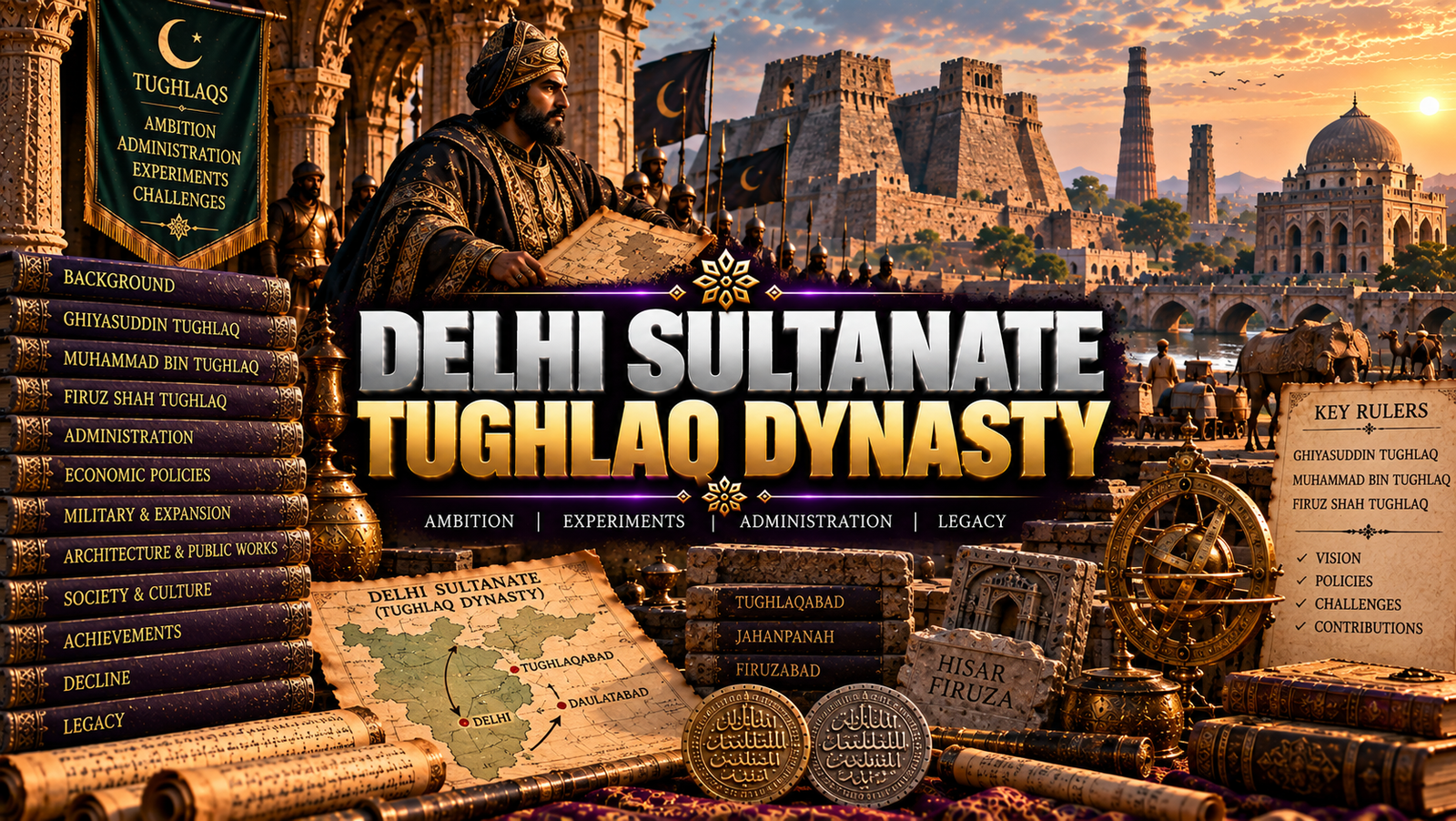
1.1 Ghiyas-ud-din Tughlaq (r. 1320–1325 CE) — The Foundational Restorer
Originally Ghazi Malik, governor of Dipalpur. He restored political stability after the assassination of Mubarak Khalji.
- Fiscal Moderation: Abandoned Alauddin Khalji's harsh land measurement system (Masahat) in favor of traditional crop-sharing (Batai). Reduced land revenue rates to 1/5th–1/10th of produce to relieve peasant distress.
- Infrastructure & Security: Built the heavily fortified third city of Delhi, Tughlaqabad. Improved postal communications (Dak Chowki) and fortified the north-western border against Mongols.
- Re-annexation of Southern Kingdoms: Sent his son Jauna Khan (later MBT) to annex Warangal (renamed Sultanpur) and Madurai. Died in 1325 CE when a wooden pavilion collapsed at Afghanpur near Delhi.
1.2 Muhammad bin Tughlaq (r. 1325–1351 CE) — The Polymath Intellectual
Historiographical Assessment: Scholar-king proficient in Arabic, Persian, mathematics, astronomy, and medicine. Modern historians argue MBT was an ideological visionary whose rational reforms failed due to poor execution, lack of institutional trust, and harsh temperament.
- Universalist Governance: Appointed officials based on merit and open talent rather than noble Turkish lineage, promoting Indian Muslims, Rajputs, Hindus, and foreign scholars (such as the Moroccan traveler Ibn Battuta, whom he appointed as Chief Qazi of Delhi).
- Territorial Fragmentation: His reign saw 34 major provincial rebellions. Excessive central overreach catalyzed the founding of independent southern states: the Vijayanagara Empire (1336 CE) by Harihara & Bukka and the Bahmani Sultanate (1347 CE) by Alauddin Hasan Bahman Shah.
1.3 Firoz Shah Tughlaq (r. 1351–1388 CE) — The Welfare Monarch
Selected by the nobility after MBT’s death in Thatta (Sindh). Shifted imperial strategy from territorial conquest to internal pacification, administrative welfare, and orthodox religious appeasement.
- Appeasement Policy: Conciliated the Ulema and nobility by making imperial grants, army commands, and administrative offices strictly hereditary.
- Humanitarian Reforms: Abolished 24 oppressive, non-Islamic taxes (Abwabs). Prohibited torture, mutilation, and public executions as standard judicial punishments.