← Back to Geography Master Library

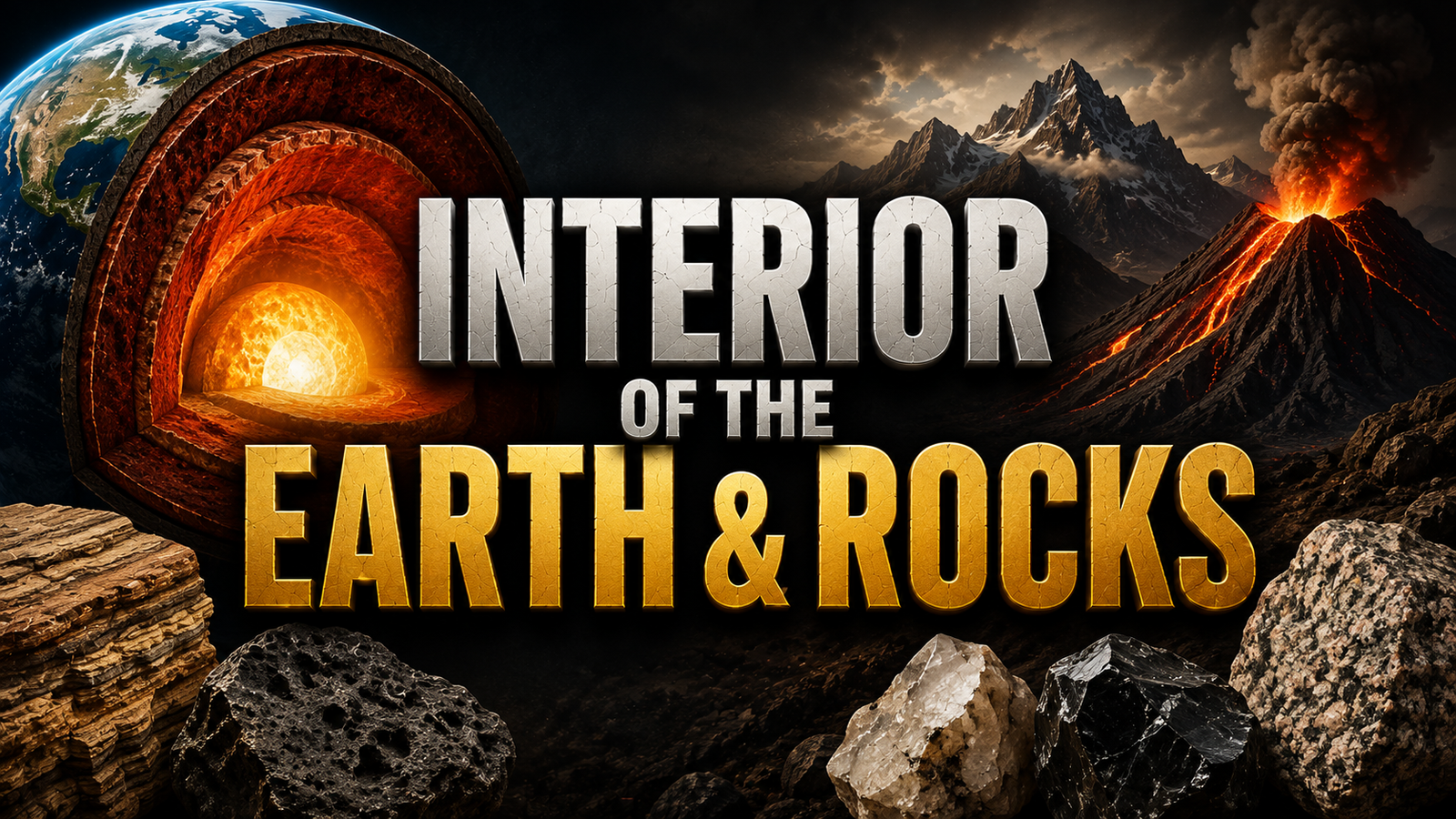
🌋 02. INTERIOR OF THE EARTH & ROCKS

SMART NOTES FOR UPSC CSE & UPPCS (MODULE 02 OF 25)

🧭 OVERVIEW & EXAM CONTEXT

Understanding the Interior of the Earth and Rock Mechanics provides the physical foundation for plate tectonics, volcanism, earthquakes, and landform development. Direct human observation of Earth's interior is limited to shallow depths (deepest borehole: Kola Superdeep Borehole, ~12.2 km). Consequently, geophysicists rely on indirect evidence—primarily seismic wave behavior—to map Earth's internal concentric layers.

🔥 Core Division of Module 02

1. Sources of Evidence: Direct sources (deep mining, volcanic ejecta) vs. Indirect sources (temperature/pressure gradients, meteors, gravity/magnetic anomalies, seismic waves).

2. Earth's Layered Structure & Discontinuities: Compositional (Crust, Mantle, Core) and mechanical (Lithosphere, Asthenosphere, Mesosphere) boundaries, plus transition zones (Conrad, Moho, Repetti, Gutenberg, Lehmann).

3. Seismic Wave Mechanics & Shadow Zones: Body waves (P and S waves) vs. Surface waves (Love and Rayleigh waves); mapping P-wave and S-wave shadow zone geometry.

4. Petrology & The Rock Cycle: Genesis, characteristics, and economic mineral distribution across Igneous, Sedimentary, and Metamorphic rock systems.
1. 🔍 Sources of Information About Earth's Interior

1.1 Direct Sources

1.2 Indirect Sources

2. 〰️ Seismic Waves & Shadow Zone Geometry

2.1 Classification of Seismic Waves

Seismic waves generated during an earthquake hypocenter are broadly split into Body Waves (travel through Earth's interior) and Surface Waves (travel along Earth's surface).

Wave TypeNature & VibrationMedium TraversedVelocity Profile
Primary Waves (P-Waves)Longitudinal / Compressional (Particles vibrate parallel to wave propagation direction).Solids, Liquids & Gases.Fastest (~6 to 13 km/s). First to arrive at seismograph stations.
Secondary Waves (S-Waves)Transverse / Shear (Particles vibrate perpendicular to wave propagation direction).Solids ONLY (cannot pass through liquid outer core).Intermediate speed (~3.5 to 7 km/s). Arrive after P-waves.
Surface Waves (L & R Waves)Complex rolling (Rayleigh) and side-to-side transverse (Love) motion along Earth's crust.Crustal surface layers.Slowest velocity, but cause maximum structural destruction.

2.2 Seismic Shadow Zones

A Shadow Zone is a specific zone on Earth's surface where seismographs fail to detect earthquake waves originating from a given focus.

📐 Geometry of Shadow Zones

P-Wave Shadow Zone: Located between 105° and 145° from the epicenter. Caused by severe refraction (bending) of P-waves as they pass through the mantle-core boundary due to drastic density change.

S-Wave Shadow Zone: Spans continuously beyond 105° to 180° (covers over 40% of Earth's surface). Proves conclusively that the Outer Core is Liquid, as S-waves cannot travel through liquids.

3. 🌐 Layered Interior: Crust, Mantle & Core

3.1 Compositional Layers

1. The Crust (Outermost Layer)

2. The Mantle (Middle Layer)

3. The Core (NIFE - Innermost Layer)

4. ⚡ Internal Boundaries (Discontinuities)

Internal discontinuities represent sharp transition boundaries where seismic wave velocity changes abruptly due to shifts in density, mineral composition, or state of matter.

Discontinuity NameLocation BoundaryDepth / Zone
Conrad DiscontinuityBetween Upper Continental Crust (SIAL) and Lower Oceanic Crust (SIMA).Within Crust (~15 km)
Mohorovičić (Moho) DiscontinuityBetween Lower Crust and Upper Mantle.Base of Crust (~35 km)
Repetti DiscontinuityBetween Upper Mantle and Lower Mantle.~700 km depth
Gutenberg DiscontinuityBetween Lower Mantle and Outer Liquid Core.~2,900 km depth
Lehmann DiscontinuityBetween Outer Liquid Core and Inner Solid Core.~5,150 km depth

5. 🪨 Petrology: Igneous, Sedimentary & Metamorphic Rocks

Petrology is the branch of geology that studies rocks. A rock is an aggregate of one or more minerals forming the Earth's solid crust.

5.1 Igneous Rocks (Primary Rocks)

Formed by the cooling, crystallization, and solidification of molten rock material (magma or lava). Completely unfossiliferous.

5.2 Sedimentary Rocks (Secondary Rocks)

Formed via weathering, erosion, transportation, deposition, lithification (compaction & cementation), and stratification of pre-existing rocks. Cover ~75% of Earth's land surface but make up only 5% of crustal volume. Contain fossils and fuel reserves.

5.3 Metamorphic Rocks

Formed when existing Igneous or Sedimentary rocks undergo physical/chemical transformation due to extreme pressure, heat, and tectonic forces (Thermal, Dynamic, or Regional Metamorphism) without melting completely.

Original Rock TypeOriginal Rock CategoryMetamorphosed Equivalent Rock
GraniteIgneous (Intrusive)Gneiss
BasaltIgneous (Extrusive)Amphibolite / Schist
SandstoneSedimentary (Mechanical)Quartzite
LimestoneSedimentary (Organic)Marble
Shale / ClaySedimentary (Mechanical)Slate ➔ Phyllite ➔ Schist
CoalSedimentary (Organic)Graphite / Diamond

6. 🔄 The Rock Cycle

The Rock Cycle is a continuous geological process through which rocks are transformed over geological time from one type to another:

  1. Magma cools and solidifies to form Igneous Rocks.
  2. Weathering and erosion break down Igneous/Metamorphic rocks into sediments, which undergo lithification to form Sedimentary Rocks.
  3. Subduction and tectonic heat/pressure transform Sedimentary/Igneous rocks into Metamorphic Rocks.
  4. Extreme heat deep within subduction zones melts Metamorphic rocks back into Magma, completing the cycle.

7. 🎯 UPSC / UPPCS Prelims High-Yield Fact Vault

📌 Memory Keys for Direct Prelims MCQs

8. ✍️ UPSC Mains Analytical Anchor Points

💡 Analytical Templates for GS Paper 1 Answers

9. ❓ FREQUENTLY ASKED QUESTIONS (FAQ)

What is the primary difference between P-waves and S-waves?

P-waves (Primary/Compressional) are longitudinal waves that travel through solids, liquids, and gases. S-waves (Secondary/Shear) are transverse waves that can only travel through solid materials.

What is the Mohorovičić Discontinuity?

The Mohorovičić (Moho) Discontinuity is the boundary separating the Earth's Crust from the underlying Mantle, marked by a sudden increase in seismic wave velocity.

What are the three main classifications of rocks?

Rocks are classified into Igneous (formed from cooling magma/lava), Sedimentary (formed from deposition and compaction of sediments), and Metamorphic (formed under heat and pressure).

Continue your systematically ordered Physical Geography syllabus coverage:

🐦 FINAL REVISION FLOW CHART

Deepest Borehole (Kola 12.2km) ➔ P-Waves (All media) / S-Waves (Solids only) ➔ P Shadow (105°-145°) / S Shadow (105°-180°) ➔ Crust (SIAL/SIMA) ➔ Moho Discontinuity ➔ Asthenosphere (Magma source) ➔ Gutenberg Discontinuity (2900km) ➔ Liquid Outer Core ➔ Solid Inner Core ➔ Igneous (Primary/Granite/Basalt) ➔ Sedimentary (Fossils/Sandstone/Coal) ➔ Metamorphic (Marble/Quartzite/Gneiss).