← Back to Medieval History Library

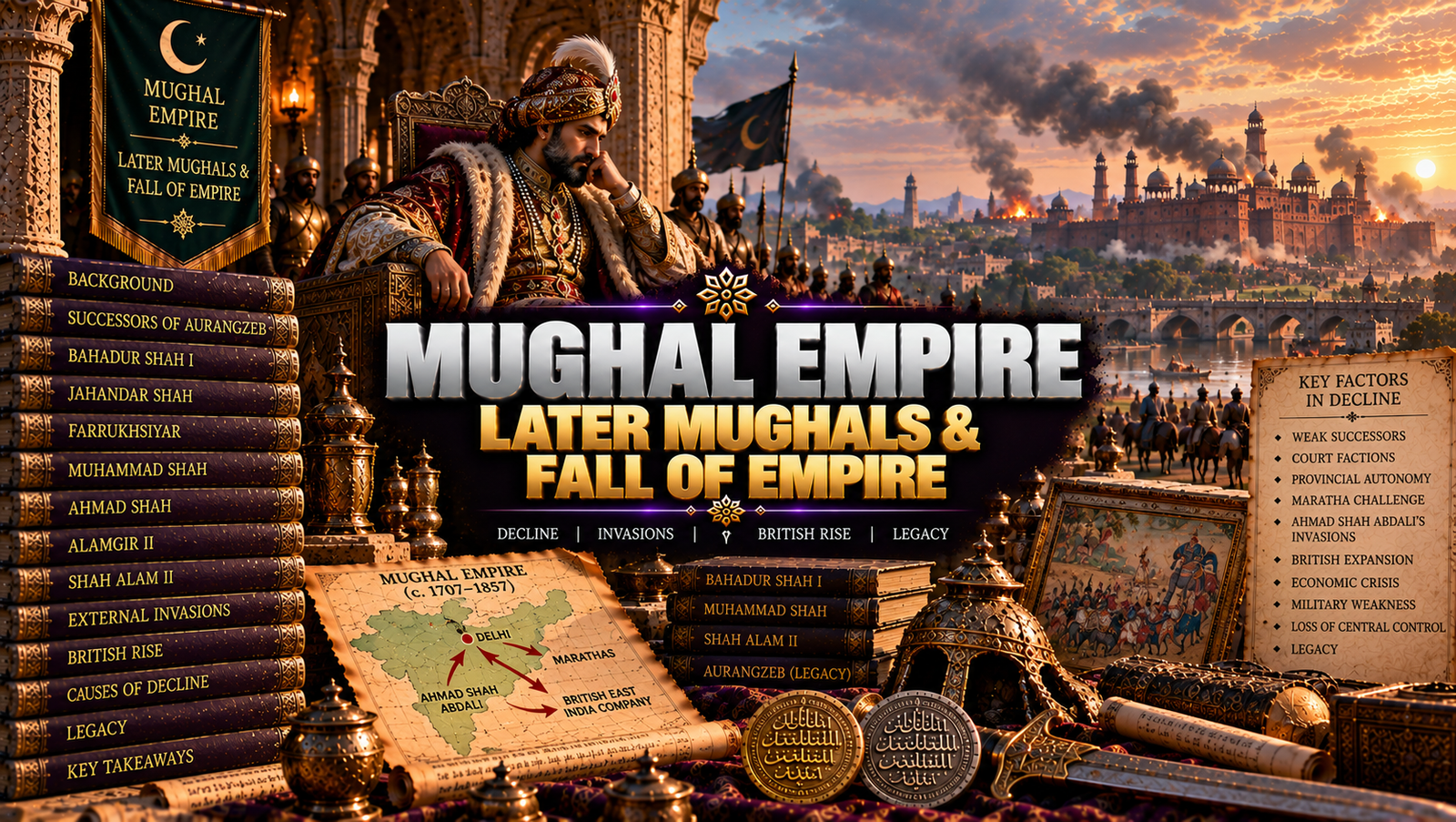
πŸ•Œ 13. MUGHAL EMPIRE - LATER MUGHALS & FALL OF EMPIRE

REVISION FOR UPSC CSE & UPPCS (MODULE 13 OF 13)

🧭 STRUCTURAL DECAY & REGIONAL FRAGMENTATION

The death of Aurangzeb in 1707 CE initiated the terminal decline of the Mughal Empire. Imperial over-expansion, severe fiscal strain caused by the 25-year Deccan Campaign, succession disputes, and factionalism among court nobles severely weakened central authority.

During the 18th century, weak "Later Mughal" monarchs lost control over distant provinces, leading to the emergence of autonomous successor states (Hyderabad, Awadh, Bengal) and regional powers (Marathas, Sikhs, Jats). Devastating foreign invasions by Nadir Shah (1739 CE) and Ahmad Shah Abdali accelerated the breakdown of Mughal hegemony.

πŸ”₯ Core Analytical Pillars

1. βš”οΈ Aurangzeb’s Deccan Policy & The "Deccan Ulcer"

Strategic Miscalculation: In 1681 CE, Aurangzeb shifted his royal court to the Deccan to crush the Maratha insurgency under Sambhaji and annex the Deccan Sultanates.

2. πŸ‘‘ Chronological Survey of Later Mughal Monarchs (1707–1857)

MonarchReignHistorical Significance & Key Events
Bahadur Shah I (Shah Alam I) 1707–1712 CE Adopted a conciliatory policy toward Marathas and Rajputs. Known as *Shah-i-Bekhabar* ("Heedless King").
Jahandar Shah 1712–1713 CE Abolished Jizya; introduced **Ijarah** (revenue farming). Dominated by vizier Zulfiqar Khan. Referred to as the *Lustful Ruler*.
Farrukhsiyar 1713–1719 CE Enthroned by the **Sayyid Brothers** (Abdullah Khan & Hussain Ali Khan - "Kingmakers"). Issued the **1717 Royal Farman** to the EIC granting duty-free trade in Bengal. Executed Sikh leader Banda Singh Bahadur (1716).
Muhammad Shah 'Rangeela' 1719–1748 CE Witnessed total fragmentation: Nizam-ul-Mulk founded autonomous **Hyderabad (1724)**, Saadat Khan established **Awadh**, and Murshid Quli Khan broke away in **Bengal**. Sustained **Nadir Shah's Invasion (1739)**.
Shah Alam II 1759–1806 CE Fought at the **Battle of Buxar (1764)** against the British; signed the **Treaty of Allahabad (1765)** granting Diwani rights of Bengal, Bihar, and Orissa to the EIC. Became a British pensioner in 1803.
Bahadur Shah II (Zafar) 1837–1857 CE Last Mughal Emperor. Symbolically declared leader of the **Revolt of 1857**. Exiled to Rangoon by the British, ending the dynasty.

3. βš”οΈ Foreign Catastrophes: Nadir Shah (1739) & Ahmad Shah Abdali

3.1 Nadir Shah’s Persian Invasion (1739 CE)

3.2 Invasions of Ahmad Shah Abdali & Third Panipat (1761)

Ahmad Shah Durrani raided Northern India eight times between 1748 and 1767. His victory over the Maratha confederacy at the **Third Battle of Panipat (1761 CE)** shattered Maratha dreams of pan-Indian empire and paved the way for British hegemony.

4. πŸ“œ Historiographical Debates on the Decline of the Empire

Modern historians offer contrasting analytical frameworks explaining the fall of the empire:

Historiographical School / HistorianCore Analytical Argument
Jagirdari Crisis (Satish Chandra) Focuses on the structural imbalance between available revenue lands (Paibaqi) and the swelling number of Mansabdars (*Be-Jagiri*), leading to economic collapse.
Agrarian Crisis (Irfan Habib) Argues that intense state revenue demands led to over-exploitation of peasants by short-term Jagirdars, sparking widespread agrarian revolts (Jats, Satnamis, Sikhs) that crushed imperial authority.
Region-Centric Model (Muzaffar Alam / C.A. Bayly) Re-evaluates decline not as dark collapse, but as a reallocation of economic prosperity from the imperial center to dynamic, commercialized regional states.

5. 🎯 UPSC / UPPCS Prelims High-Yield Fact Vault

πŸ“Œ Direct Revision Points for Prelims

6. ✍️ UPSC Mains Analytical Anchor Points

πŸ’‘ Structural Value Additions for GS Paper 1

7. ❓ FREQUENTLY ASKED QUESTIONS (FAQ)

What was Napoleon's analogy applied to Aurangzeb's 'Deccan Ulcer'?

Just as the 'Spanish Ulcer' ruined Napoleon, Aurangzeb's 25-year prolonged military campaign in the Deccan (1681–1707 CE) drained imperial financial reserves, exhausted elite army divisions, and led to total administrative neglect of Northern India.

What were the major scholarly historiographical theories explaining the decline of the Mughal Empire?

Satish Chandra emphasized the structural Jagirdari Crisis (be-jagiri and gap between Jama and Hasil). Irfan Habib argued for the Agrarian Crisis theory (excessive revenue extraction driving peasant revolts). Muzaffar Alam and C.A. Bayly proposed the Region-Centric model, viewing decline as economic reallocation to vibrant regional states.

Continue your systematically ordered Medieval History syllabus coverage:

FINAL REVISION FLOW CHART

Aurangzeb's Deccan Ulcer (1681–1707) βž” Death in 1707 βž” Bahadur Shah I βž” Jahandar Shah (Ijarah System) βž” Farrukhsiyar & Sayyid Brothers βž” 1717 EIC Farman βž” Regional secessions (Hyderabad, Awadh, Bengal) βž” Nadir Shah's 1739 Invasion & Sack of Delhi βž” Jagirdari & Agrarian Crises βž” 3rd Battle of Panipat (1761) βž” Treaty of Allahabad (1765) βž” 1857 Revolt βž” End of Empire.