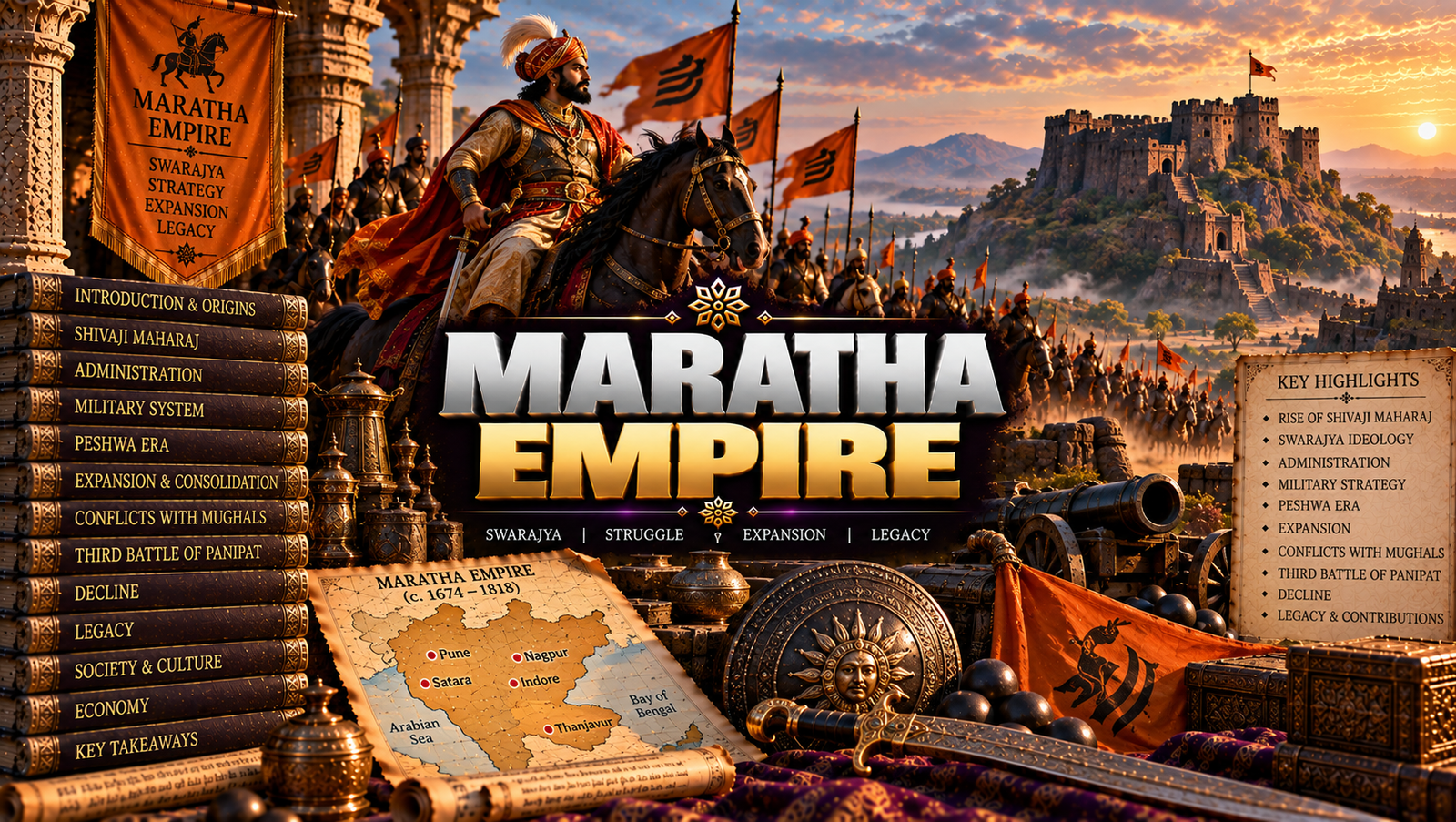
The establishment of the Maratha Empire under Chhatrapati Shivaji Maharaj (1627–1680 CE) fundamentally altered the political dynamics of 17th- and 18th-century India. Rising against the regional Deccan Sultanates (Bijapur, Golconda) and Mughal expansionism, Shivaji created an independent Hindu sovereign state (*Hindavi Swarajya*).
The Maratha polity was anchored by administrative innovations such as the Ashta Pradhan council, direct land revenue assessments, and light cavalry guerrilla tactics (Ganimi Kava). Following the post-Aurangzeb period, power shifted to the **Peshwas**, who built a confederacy extending Maratha influence from Attoch to Cuttack before experiencing a devastating setback at the **Third Battle of Panipat (1761 CE)**.
🔥 Core Analytical Pillars
Founder & Coronation: Chhatrapati Shivaji Maharaj crowned at Raigad in 1674 CE.
Executive System:Ashta Pradhan (Council of 8 Ministers); non-hereditary, cash-salaried appointments.
Fiscal Architecture:Swarajya (direct revenue) vs. Mughlai areas subjected to Chauth (25%) and Sardeshmukhi (10%).
1. 👑 Rise of Shivaji Maharaj & Military Milestones
Born at Shivneri Fort to Shahaji Bhonsle and Jijabai, Shivaji was mentored by **Dadoji Kondadev** and spiritually influenced by Saints **Samarth Ramdas** and **Tukaram**.
Year
Key Military / Political Event
Historical Significance
1659 CE
Encounter with Afzal Khan
Defeated Bijapuri commander Afzal Khan at Pratapgad using *Bagh Nakh* (tiger claws).
1663 CE
Surprise Attack on Shaista Khan
Ambushed Mughal governor Shaista Khan inside Lal Mahal, Pune, wounding him and driving out Mughal forces.
1664 CE
First Sack of Surat
Plundered the opulent Mughal port city of Surat to replenish imperial finances.
1665 CE
Treaty of Purandar
Signed with Mirza Raja Jai Singh I. Shivaji surrendered 23 out of 35 forts to the Mughals and agreed to send son Sambhaji to the Mughal court.
1674 CE
Coronation at Raigad
Conducted by Pandit Gaga Bhatt. Assumed titles **Chhatrapati**, *Haindava Dharmoddharak*, and *Kshatriya Kulavantas*.
2. ⚙️ The Ashta Pradhan Council & Executive Administration
Key Structural Feature: The Ashta Pradhan was an advisory executive body directly responsible to Shivaji. Offices were strictly non-hereditary, and ministers received direct cash salaries from the state treasury.
Minister Title
Administrative Portfolio & Functions
Peshwa (Mukhya Pradhan)
Prime Minister; overseen general administration and represented the Chhatrapati in his absence.
Amatya (Mazumdar)
Finance Minister; audited state accounts, income, and expenditure.
Mantri (Waqia-Navis)
Home Minister / Chronicler; managed daily royal court proceedings and intelligence services.
Sachiv (Shurnavis)
Royal Correspondence Secretary; drafted official edicts and verified royal land grants.
Sumant (Dabir)
Foreign Minister; managed diplomatic relations and foreign envoys.
Senapati (Sar-i-Naubat)
Commander-in-Chief; organized military recruitment, discipline, and field campaigns.
Pandit Rao (Sadr)
High Priest / Minister of Religious Matters; directed state charities and religious grants.
Nyayadhish
Chief Justice; handled civil and criminal judicial appeals according to Hindu law.
Note: All ministers except Pandit Rao and Nyayadhish were required to command military divisions during wartime.
Shiivaji abolished the oppressive **Jagirdari system** within Swarajya territories, replacing it with direct state revenue collection through state officers (Karkuns).
Land was surveyed using a standard measuring rod called the **Kathhi**. State revenue demand was initially set at 33% of gross produce, later raised to 40% after abolishing custom cesses.
Extracted from neighbouring non-Maratha territories in exchange for protection against Maratha plundering raids.
Sardeshmukhi
10% (1/10th) additional levy
Claimed by Shivaji based on his hereditary claim as the paramount head (Sardeshmukh) of the Maratha country.
4. ⚔️ Military Organization & Maratha Naval Supremacy
4.1 Cavalry Division Structure
Bargirs: Regular state-supported cavalrymen provided with warhorses and arms directly by the state.
Silahdars: Mercenary cavalrymen who maintained their own private horses and equipment.
4.2 Fort Fortifications & Naval Vision
Shivaji recognized hill forts (such as Raigad, Rajgad, Pratapgad, Torna) as the primary pillars of sovereignty. He also established a formidable **Maratha Navy** commanded by Admirals **Kanhoji Angre** and Maynak Bhandari, headquartered at sea forts like **Sindhudurg** and **Vijaydurg**, to check Portuguese power and the Siddis of Janjira.
5. 🏇 The Peshwa Era & Imperial Confederation (1713–1761)
Following Chhatrapati Shahu’s release from Mughal captivity, executive authority shifted from the Chhatrapati to hereditary Peshwas centered at **Pune** (Shaniwar Wada).
Peshwa Ruler
Reign
Key Historical Achievements
Balaji Vishwanath
1713–1720 CE
Engineered the 1719 pact with the Sayyid Brothers, securing Mughal recognition of Maratha *Swarajya* and rights to collect *Chauth* and *Sardeshmukhi* across 6 Deccan Subahs.
Baji Rao I
1720–1740 CE
Brilliant military strategist who advocated expansion into Northern India ("Strike at the trunk of the decaying tree"). Won the **Battle of Palkhed (1728)** against Nizam-ul-Mulk and established the Maratha Confederacy.
Balaji Baji Rao (Nana Saheb)
1740–1761 CE
Under the Sangola Agreement (1750), became the supreme chief executive of the empire. Maratha power reached its territorial zenith, capturing Delhi and Attock.
5.1 The Maratha Confederacy Chiefs
Peshwas: Pune
Gaekwads: Baroda
Holkars: Indore
Scindias (Shindes): Gwalior
Bhonsles: Nagpur
6. 💥 The Third Battle of Panipat (1761) & Fall of the Empire
Historical Turning Point: Fought on January 14, 1761 CE, between the Maratha army under **Sadashivrao Bhau** (along with Vishwasrao) and the invading Afghan forces of **Ahmad Shah Abdali**.
💡 Causes for Maratha Defeat at Panipat
Alienation of Regional Powers: Indiscriminate Maratha collection of Chauth alienated potential allies like the Rajputs, Jats (Suraj Mal), and Awadh Nawab (Shuja-ud-Daula, who sided with Abdali).
Abandonment of Guerrilla Warfare: Marathas under Sadashivrao Bhau shifted from rapid *Ganimi Kava* mobility to heavy European-style conventional pitched battles without adequate logistical lines.
Overburdened Camp Logistics: The presence of thousands of non-combatant pilgrims in the Maratha camp strained food supply lines during the siege at Panipat.
Consequences: Decimated an entire generation of Maratha leaders. While the Peshwa authority was briefly revived under **Madhavrao I**, internal conflicts and the three **Anglo-Maratha Wars (1775–1818)** ultimately led to the annexation of Maratha territories by the British East India Company in 1818.
7. 🎯 UPSC / UPPCS Prelims High-Yield Fact Vault
📌 Direct Revision Points for Prelims
Purandar Treaty (1665): Signed between Shivaji and Mirza Raja Jai Singh I.
Ashta Pradhan: Executive 8-minister advisory council appointed by Shivaji; positions were non-hereditary.
Chauth & Sardeshmukhi: Taxes levied on non-Maratha territories at rates of 25% and 10% respectively.
Bargirs & Silahdars: Bargirs were state-equipped cavalry; Silahdars were self-equipped horsemen.
Kanhoji Angre: Celebrated Grand Admiral of the Maratha Navy.
Battle of Palkhed (1728): Brilliant tactical victory of Baji Rao I over Nizam-ul-Mulk using rapid movement.
Sangola Agreement (1750): Transfer of central executive power from the Chhatrapati to the Peshwa at Pune.
8. ✍️ UPSC Mains Analytical Anchor Points
💡 Structural Value Additions for GS Paper 1
State Building vs. Fiscal Extraction: While Shivaji built a coherent state structure rooted in local governance, the later Peshwa era relied heavily on predatory revenue extraction (*Chauth*), which prevented the formation of a stable pan-Indian empire.
Geopolitical Power Vacuum: The Third Battle of Panipat did not decide who would rule India, but rather who would *not* rule India, clearing the geopolitical field for the rise of the British East India Company.
9. ❓ FREQUENTLY ASKED QUESTIONS (FAQ)
What was the difference between Chauth and Sardeshmukhi levies?
Chauth was a 25% (one-fourth) tax levied on neighbouring non-Maratha territories as protection money against Maratha raids. Sardeshmukhi was an additional 10% levy claimed by Shivaji based on his legal claim as the hereditary Supreme Head (Sardeshmukh) of the Maratha country.
What was the role of the Ashta Pradhan council in Shivaji's administration?
The Ashta Pradhan was an advisory council of eight ministers created by Shivaji to head different departments of state. Unlike a modern cabinet, these officers were directly accountable to the King, held non-hereditary positions, and were paid cash salaries. All ministers except the Pandit Rao and Nyayadhish were required to command military forces.
10. 🔗 Complete Medieval History Library Index
Access the complete, systematically ordered 16-module Medieval History syllabus library: