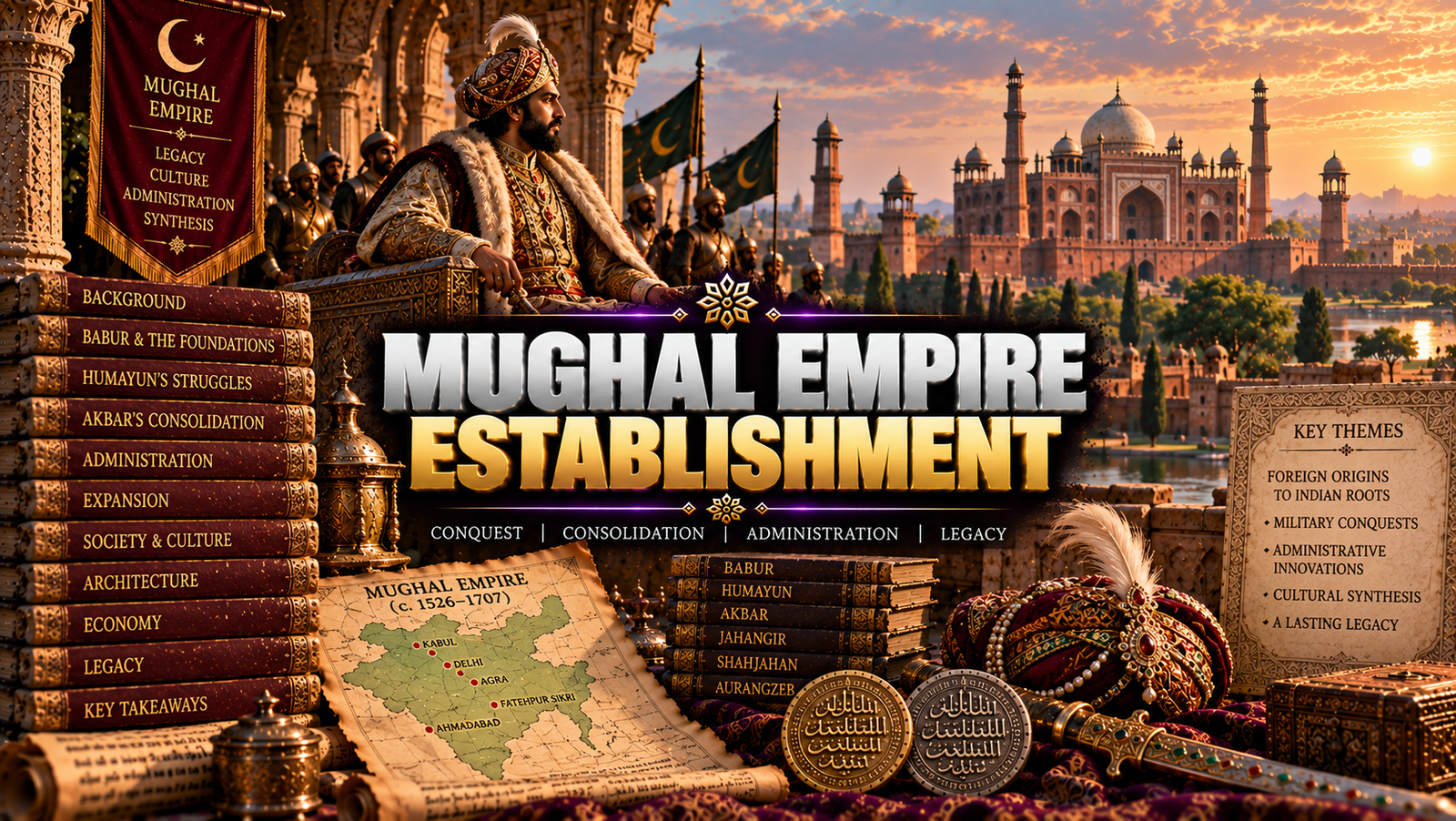
The establishment of the Mughal Empire in 1526 CE by Zahir-ud-din Muhammad Babur marked a major geopolitical transition in Northern India. Replacing the fragmented Delhi Sultanate, the early Mughals combined Central Asian Chagatai Turkic traditions, Mongol lineage, and gunpowder military technology.
However, early Mughal rule faced instability under Humayun, leading to a temporary revival of Pashtun Afghan sovereignty under Sher Shah Suri (1540–1545 CE). The Sur Empire interregnum established crucial administrative, fiscal, and infrastructure foundations—including land measurement, currency standardization, and network highways—that paved the way for imperial consolidation under Akbar (r. 1556–1605 CE).
🔥 Core Analytical Pillars
Era: 1526–1605 CE (Foundation, Sur Interregnum, and Early Consolidation).
Military Paradigm: Adoption of gunpowder field artillery, matchlocks, and Tulughma tactics.
Administrative Transition: Evolution from feudal Afghan assignments to Sher Shah's Sarkar-Pargana centralization and Akbar's early provincial integration.
1. 👑 Babur's Conquests & Military Innovations (1526–1530)
A descendant of Timur (paternal) and Chengiz Khan (maternal), Babur migrated from Fergana and Kabul to establish control over Northern India.
Battle
Year
Opponent
Tactical Significance & Result
First Battle of Panipat
1526 CE
Ibrahim Lodi
Deployed Tulughma (flanking maneuver) and Arba (cart defense) with artillery under Ustad Ali and Mustafa. Ended the Delhi Sultanate.
Battle of Khanwa
1527 CE
Rana Sanga of Mewar
Babur declared Jihad and assumed the title Ghazi. Secured Mughal dominance over Northern Rajputana.
Battle of Chanderi
1528 CE
Medini Rai
Subjugated Malwa Rajputs and captured the strategic fortress of Chanderi.
Battle of Ghagra
1529 CE
Mahmud Lodi & Afghan Chiefs
Fought on land and river; neutralized remaining Afghan opposition in Bihar and Bengal.
Autobiographical Legacy: Babur authored the Tuzuk-i-Baburi (Baburnama) in Chagatai Turkic, providing detailed observations on Indian geography, flora, fauna, and political conditions.
Humayun inherited an unconsolidated empire. His division of territories among his brothers (Kamran, Askari, Hindal) weakened imperial unity.
Conflict with Bahadur Shah of Gujarat: Humayun campaigned in Malwa and Gujarat but lost control due to administrative neglect.
Defeats by Sher Shah Suri:
Battle of Chausa (1539 CE): Sher Shah ambushed Humayun's forces on the banks of the Ganges.
Battle of Kannauj / Bilgram (1540 CE): Complete defeat of Humayun, forcing him into a 15-year exile.
Safavid Exile & Restoration: Humayun sought refuge at the court of Safavid Shah Tahmasp in Persia. With Persian military assistance, he recaptured Kabul, Kandahar, and eventually Delhi/Lahore in 1555 CE, before dying from a fall in his library (Sher Mandal) in 1556 CE.
3. 🏛️ The Sur Empire Interregnum: Administrative Legacy of Sher Shah Suri
Historiographical Significance: Sher Shah Suri (r. 1540–1545 CE) established a centralized administrative model that served as a direct prototype for Akbar’s later reforms.
3.1 Administrative Units
Sarkar (District): Managed by a Shiqdar-i-Shiqdaran (executive officer/law and order) and a Munsif-i-Munsifan (civil judicial/revenue officer).
Pargana (Sub-district): Managed by a Shiqdar, a Amil (revenue collector), a Fotedar (treasurer), and Karkuns (record keepers).
3.2 Agrarian & Fiscal System
Land Survey & Ray System: Measured cultivated land using a standard Sikandari Gaz. Created a schedule of crop rates (Rai) based on land productivity (Good, Middle, Bad).
Patta & Qabuliyat: Issued a title deed (Patta) to farmers stating tax obligations, and obtained a written agreement (Qabuliyat) from peasants. Direct tax collected was 1/3rd of produce.
Currency Standardization: Discontinued debased coins and introduced pure standard currency: the silver Rupaya (178 grains) and copper Dam.
3.3 Infrastructure & Communication
Constructed major highways with shaded trees, rest houses (Sarais), and horse-courier stations (Dak Chowkis):
4. 👑 Akbar's Accession, Regency & Early Territorial Expansion
Akbar ascended the throne at Kalanaur (Punjab) at age 13 in 1556 CE under the regency of Bairam Khan (Khan-i-Khanan).
Second Battle of Panipat (1556 CE): Bairam Khan defeated Hemu (Hemchandra Vikramaditya), chief minister of the Sur ruler Adil Shah, re-establishing Mughal rule over Delhi and Agra.
End of Regency (1560 CE): Akbar dismissed Bairam Khan, overcame the "Petticoat Government" period (1560–1562 CE) led by Maham Anaga, and asserted direct sovereign authority.
Mewar (1567–1568 CE): Besieged Chittor defended by Jaimal and Patta. Udai Singh established Udaipur.
Gujarat (1572–1573 CE): Captured Gujarat, securing maritime trade access. Built the Buland Darwaza at Fatehpur Sikri to commemorate this victory.
Bengal & Bihar (1574–1576 CE): Defeated Daud Khan Karrani at the Battle of Rajmahal.
5. 🎯 UPSC / UPPCS Prelims High-Yield Fact Vault
📌 Direct Revision Points for Prelims
Tulughma & Arba: Ottoman military tactics used by Babur at Panipat (1526).
Baburnama / Tuzuk-i-Baburi: Autobiography written by Babur in Chagatai Turkic.
Battle of Bilgram (1540): Decisive battle where Sher Shah Suri expelled Humayun from India.
Rupaya & Dam: Currency system introduced by Sher Shah Suri; standard silver Rupaya weighed 178 grains.
Patta & Qabuliyat: Legal land revenue documents formalized under Sher Shah Suri.
Kalanaur: Site in Punjab where Akbar was crowned Sultan in 1556 CE.
Buland Darwaza: Victory arch constructed at Fatehpur Sikri after Akbar's conquest of Gujarat.
6. ✍️ UPSC Mains Analytical Anchor Points
💡 Structural Value Additions for GS Paper 1
Continuity of Administration: Sher Shah Suri’s revenue and administrative divisions served as an essential bridge between Sultanate practices and the mature Mughal Mansabdari/Dahsala system under Akbar.
Geopolitical Re-orientation: Mughal expansion under Babur and Akbar reconnected India to Central Asian overland trade routes and Arabian Sea maritime networks, shifting fiscal policy toward monetary monetization.
7. ❓ FREQUENTLY ASKED QUESTIONS (FAQ)
Why is Sher Shah Suri considered a forerunner of Akbar's administrative system?
Sher Shah Suri established a centralized administrative network dividing the empire into Sarkars and Parganas, introduced a standardized silver Rupaya and copper Dam currency, measured agricultural land to fix state revenue demand, and instituted direct communication networks like the Sadak-i-Azam (Grand Trunk Road). Akbar later built his Dahsala revenue and administrative system directly upon Sur foundations.
What military tactics enabled Babur to defeat numerically superior armies in India?
Babur employed the Ottoman Tulughma flanking tactic, dividing his army into rapid mounted archer wings that encircled the enemy flanks, combined with the Arba/Rumi method of chaining baggage carts together to provide cover for matchlock musketeers and field artillery managed by Ustad Ali and Mustafa.
8. 🔗 Next Medieval History Modules in Series
Continue your systematically ordered Medieval History syllabus coverage: