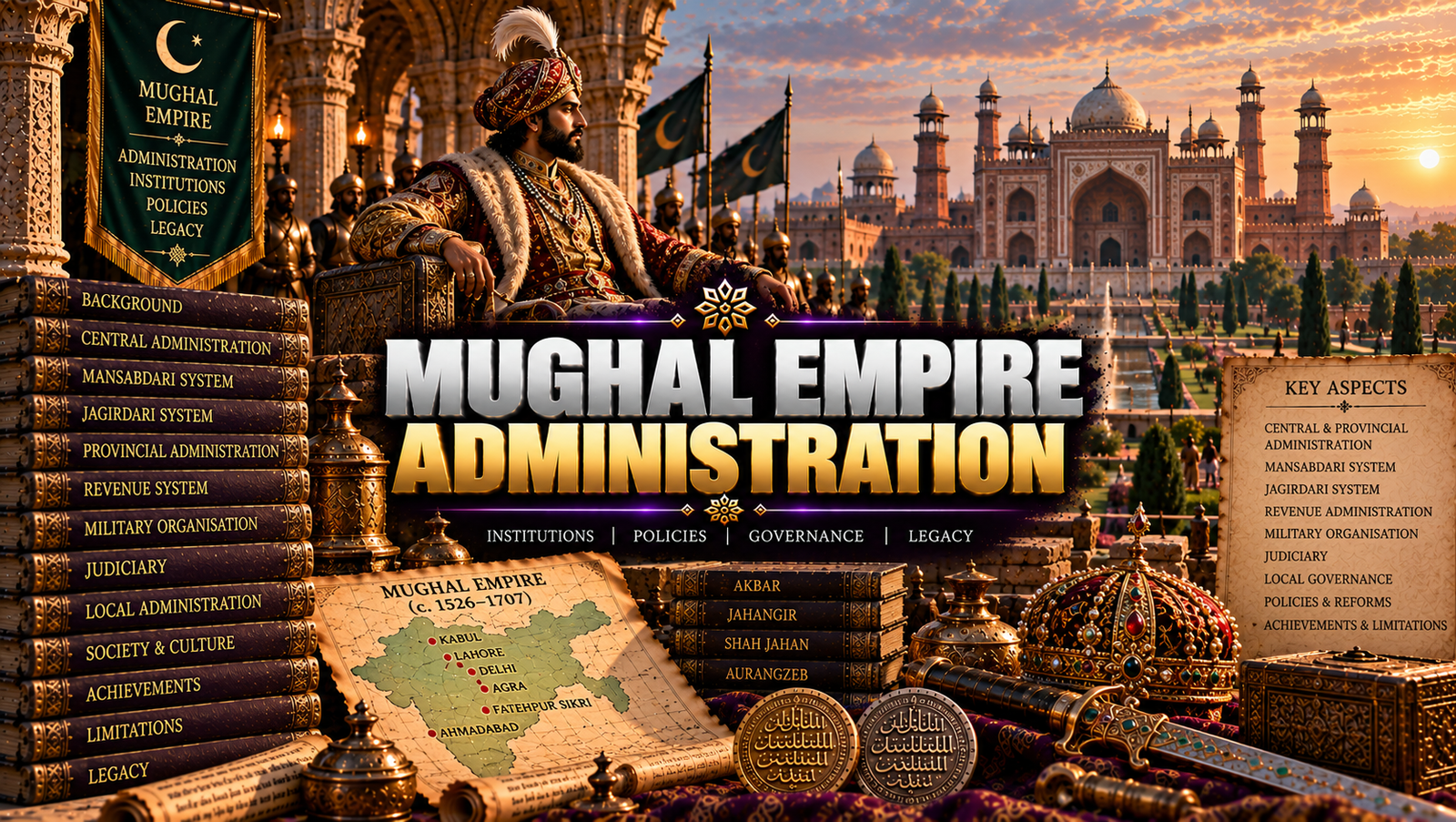
🕌 11. MUGHAL EMPIRE - ADMINISTRATION & FISCAL SYSTEMS
REVISION FOR UPSC CSE & UPPCS (MODULE 11 OF 13)
🧭 THE IMPERIAL STATE MACHINE
The Mughal Empire created one of the most sophisticated administrative and fiscal apparatuses in pre-modern world history. Formalized primarily under Akbar, the state combined centralized bureaucratic controls with decentralized revenue collection mechanisms.
The backbone of this system was the Mansabdari System—a unified civil-military ranking structure—and the Dahsala Land Revenue System, engineered by Raja Todar Mal. Understanding these dual pillars, along with provincial administration and the later Jagirdari Crisis, is critical for analyzing the rise and eventual decline of Mughal imperial authority.
🔥 Core Administrative Pillars
Mansabdari System: Imperial hierarchy based on dual numerical ranks (Zat and Sawar).
Dahsala System (1580 CE): Land revenue assessment based on a 10-year rolling average of yields and market prices.
The Mughal central government functioned through four primary ministries, operating under checks and balances without a single prime minister controlling all branches.
Minister / Office
Primary Administrative Responsibilities
Diwan / Wazir (Diwan-i-Ala)
Head of the Finance Department. Managed imperial revenues, treasury expenditures, land assessments, and revenue assignments (Jagirs).
Mir Bakshi
Head of the Military Department and Mansabdari administration. Issued imperial appointment letters (Sanaad), managed military reviews, branded warhorses (Dagh), and supervised intelligence networks (News Writers / Waqainavis).
Mir Saman (Khan-i-Saman)
Minister of the Imperial Household and Royal Karkhanas (factories). Overseen court provisions, stores, royal ceremonies, and manufacturing units.
Sadr-us-Sudur
Head of Religious Affairs, Judicial Administration, and Charitable Endowments (Madad-i-Ma'ash or Suyurghal grants). Acted as Chief Qazi.
2. ⚔️ The Mansabdari System: Mechanics, Zat, Sawar & Modifications
Introduced by Akbar in 1575 CE, the Mansabdari system was a single, unified hierarchy integrating every imperial officer—civil and military—into a single service framework.
2.1 Mechanics of Rank: Zat vs. Sawar
Zat Rank: Stated the personal rank, social precedence, and basic cash salary of the officer (Mansabdar).
Sawar Rank: Stated the precise number of fully equipped cavalrymen (troopers) and warhorses the officer was required to maintain for state service.
Mansabdar Category
Mathematical Relationship Between Ranks
First Class
Sawar rank equal to Zat rank (e.g., 5,000 Zat / 5,000 Sawar).
Second Class
Sawar rank equal to half or more than half of Zat rank (e.g., 5,000 Zat / 3,000 Sawar).
Third Class
Sawar rank less than half of Zat rank (e.g., 5,000 Zat / 1,500 Sawar).
2.2 Later Structural Modifications
Du-Aspa Sih-Aspa (Jahangir): Allowed a favored Mansabdar’s Sawar contingent to be doubled without raising his personal Zat rank or base salary, requiring double horses per trooper.
Month-Scale System (Shah Jahan): Introduced due to widening gaps between nominal revenue estimates (Jama) and actual collections (Hasil). Salaries were paid on a fraction scale (6-month, 4-month ranks).
3. 🌾 Agrarian Administration & The Dahsala Revenue System
Historical Context: In 1580 CE, Akbar introduced the **Dahsala System** (also known as the *Ain-i-Dahsala*), designed by Finance Minister **Raja Todar Mal** and Muzaffar Khan Turbati.
3.1 Assessment Mechanism
The state calculated average agricultural yields and market prices over a 10-year period (1570–1579 CE). One-third of the average produce was fixed as the state’s demand, converted into cash schedules called Dastur-ul-Amal for different regional revenue circles.
3.2 Land Classifications Under Dahsala
Land Category
Cultivation Frequency & Revenue Status
Polaj
Annually cultivated land; never left fallow. Assessed at full rates.
Parauti
Left fallow temporarily (1–2 years) to recover soil fertility.
Chachar
Left fallow for 3 to 4 years due to soil exhaustion.
Banjar
Uncultivated land left fallow for 5 years or more. Assessed at concessional rates to encourage reclamation.
4. 🏛️ Provincial & Local Governance Hierarchy
Akbar divided the empire into 12 Subahs (provinces) in 1580 CE, which grew to 15 by the end of his reign and 21 under Aurangzeb.
Administrative Tier
Executive / Military Head
Financial / Revenue Head
Judicial / Intelligence Officers
Subah (Province)
Subahdar / Nizam
Diwan-i-Subah
Bakshi, Qazi, Sadr
Sarkar (District)
Faujdar
Amalguzar (Kori)
Kotwal (Executive Police)
Pargana (Sub-District)
Shiqdar
Amil / Qanungo
Fotedar (Treasurer)
Village
Muqaddam / Headman
Patwari (Accountant)
Panchayat
5. 📉 The Jagirdari System & Structural Crisis
Mansabdars were paid either in cash (Naqdi) or through land revenue assignments called Jagirs (Jagirdars). Jagirs were strictly non-hereditary and transferred every 3–4 years to prevent local power bases.
💡 Satish Chandra Thesis: The Jagirdari Crisis
Jama vs. Hasil Gap: Over time, the estimated revenue (Jama) recorded on paper far exceeded actual revenue collected (Hasil) due to agrarian distress and local resistance.
Be-Jagiri (Shortage of Lands): During Aurangzeb’s reign, expansion into the Deccan increased the number of Mansabdars, but available high-yielding Jagir lands ran out.
Agrarian Exploitation: Facing frequent transfers, Jagirdars extracted excessive taxes from peasants, triggering peasant rebellions (Jats, Satnamis, Sikhs) that destabilized the empire.
6. 🎯 UPSC / UPPCS Prelims High-Yield Fact Vault
📌 Direct Revision Points for Prelims
Zat and Sawar: Dual numerical ranks in the Mansabdari system determining personal status and troop requirements.
Dahsala System (1580): Revenue assessment based on a 10-year rolling average, designed by Todar Mal.
Du-Aspa Sih-Aspa: Modification by Jahangir requiring double warhorses per trooper without altering Zat rank.
Polaj: Most fertile category of land under Mughal administration, cultivated annually.
Amalguzar: Chief land revenue assessment officer at the Sarkar (district) level.
Madad-i-Ma'ash: Tax-free land grants issued to religious scholars and charities, overseen by the Sadr-us-Sudur.
7. ✍️ UPSC Mains Analytical Anchor Points
💡 Structural Value Additions for GS Paper 1
Bureaucratic Centralization: The separation of executive power (Subahdar) and financial control (Diwan) at the provincial level ensured that local governors could not secede easily during the peak Mughal era.
Fiscal Liquidity & Monetization: The demand for land revenue in cash under the Dahsala system forced peasants to integrate into regional market networks, encouraging cash-crop cultivation (cotton, indigo, sugarcane).
8. ❓ FREQUENTLY ASKED QUESTIONS (FAQ)
What was the difference between Zat and Sawar ranks in the Mansabdari system?
Zat indicated the personal rank, social status, and base salary of the officer (Mansabdar) within the imperial hierarchy. Sawar indicated the specific number of fully equipped cavalrymen and warhorses the officer was required to maintain for imperial military service.
How did Todar Mal's Dahsala System (1580 CE) work?
The Dahsala system calculated state revenue demand based on the average yield of different crops over the preceding ten years (1570-1579 CE) along with average market prices. One-third of the average produce was fixed as state demand, converted into cash rates (Dastur) for different revenue circles.
9. 🔗 Next Medieval History Modules in Series
Continue your systematically ordered Medieval History syllabus coverage: