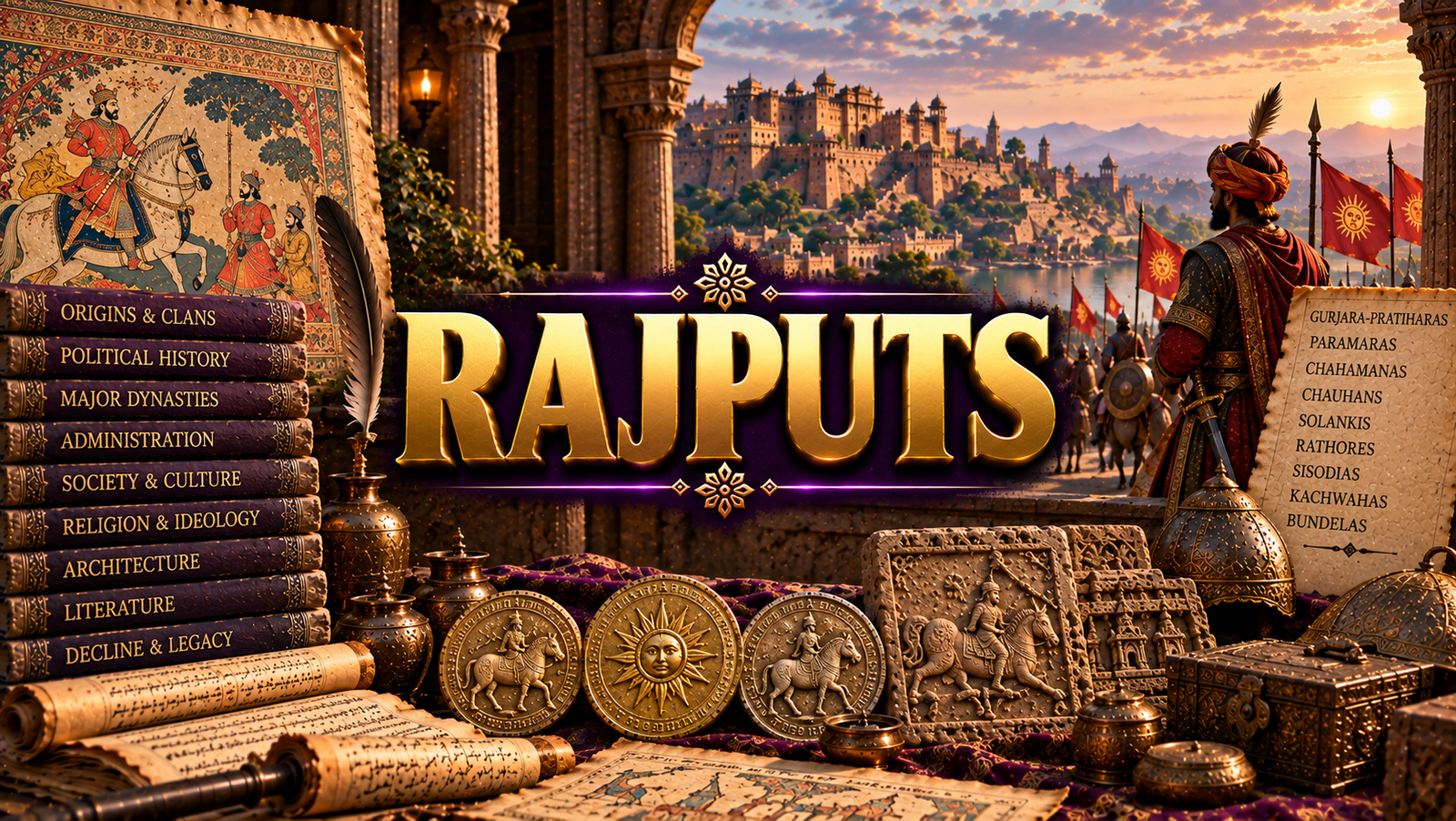
The period between the 7th and 12th centuries CE in Northern and Western India is broadly recognized as the Rajput Era. Following the collapse of Harshavardhana’s centralized empire and the eventual weakening of the Gurjara-Pratihara power, Northern India fragmented into regional states dominated by competitive warrior clans.
Derived from the Sanskrit Rajaputra ("son of a king"), the term originally denoted royal kin or military officers in ancient records. By the 10th century, it evolved into a cohesive social identity for landed warrior lineages claiming elite Kshatriya status. Their political structure was uniquely organized around kinship networks, clan lineages, and feudal obligations.
🔥 Core Polity Framework
Era: Early Medieval Period (c. 700–1200 CE).
Core Regions: Rajasthan, Malwa, Bundelkhand, Gangetic Valley, and Gujarat.
Structural Nature: Clan-based, decentralized feudal polity featuring shared land rights among kinship lineages.
1. 🧬 Historiographical Debate: Theories of Rajput Origin
The origin of the Rajputs is a major subject of historiographical analysis, representing the complex process of social assimilation and state formation in early medieval India.
1.1 Foreign Ingress Theory (Colonial View)
Pioneered by James Tod (Annals and Antiquities of Rajasthan) and V.A. Smith. Proposes that Rajputs descended from post-Gupta Central Asian invaders—such as the Sakas, Hunas, and Kushanas—who settled in India. Through fire purification rituals (Yajna), they were absorbed into the Varna system as ruling Kshatriyas.
1.2 Indigenous / Vedic Descent Theory
Advocated by scholars like G.H. Ojha and C.V. Vaidya. Asserts that Rajputs were direct, unbroken descendants of ancient Vedic Kshatriyas belonging to the Suryavamsi (Solar Lineage) and Chandravamsi (Lunar Lineage) dynasties.
1.3 The Agnikula Origin Myth
First popularized in Chand Bardai’s epic poem Prithviraj Raso (later expanded in 16th-century bardic lore). States that four major Rajput clans emerged from a sacred fire altar (Yajna-kunda) on Mount Abu performed by Sage Vashistha to destroy demonic forces protecting Dharma.
🔥 The Four Agnikula Clans
Chahamanas (Chauhans): Region of Shakambhari / Ajmer / Delhi.
Chaulukyas (Solankis): Region of Gujarat / Anhilwara.
Paramaras (Parmars): Region of Malwa / Dhar.
Pratiharas (Parihars): Region of Western Rajasthan / Kannauj.
1.4 Modern Integrative / Processual Model (B.D. Chattopadhyaya)
Historical Consensus: Modern historians like B.D. Chattopadhyaya frame "Rajputization" as a process of social mobility and state formation. ruling tribal leaders (Gonds, Bhils, Kolis) and elite lineages acquired Kshatriya status by patronizing Brahmins, manufacturing solar/lunar genealogies, building forts, and transitioning from pastoralism to settled agriculture.
2. 🏰 Survey of Major Rajput Dynasties
2.1 Chahamanas (Chauhans) of Ajmer & Delhi
Initially feudatories of the Gurjara-Pratiharas, they established an independent realm around Sambhar (Shakambhari) under Simharaja.
Ajayaraja II: Founded the city of Ajayameru (modern Ajmer) in the early 12th century and built the Taragarh Fort.
Vigraharaja IV (Visaladeva): Captured Delhi (Dhillika) from the Tomaras. Polymath author of the Sanskrit play Harakeli Nataka. Constructed the Sanskrit college at Ajmer (later converted into Adhai Din Ka Jhonpra).
Prithviraj III (Prithviraj Chauhan, r. 1177–1192 CE): Fought the Chandela ruler Paramardi (Battle of Mahoba, where legend states heroic generals Alha and Udal died). Defeated Muhammad Ghori at the First Battle of Tarain (1191 CE), but was defeated and captured at the Second Battle of Tarain (1192 CE).
2.2 Chandelas of Jejakabhukti (Bundelkhand)
Emerged in the Bundelkhand region with their traditional religious center at Khajuraho and strategic military forts at Kalinjar and Ajaygarh.
Yashovarman: Built the Lakshmana Temple at Khajuraho after asserting independence from the Pratiharas.
Dhanga: Extended the kingdom to the Narmada and built the Vishvanatha Temple at Khajuraho.
Vidyadhara: The most powerful Chandela ruler; successfully organized a coalition of kings to oppose the raids of Mahmud of Ghazni and built the grand Kandariya Mahadeva Temple.
2.3 Paramaras of Malwa
Ruled the Malwa plateau with their capital at Dhar (near Ujjain).
Raja Bhoja (r. 1010–1055 CE): Famous polymath king of early medieval India. Authored major treatises across disciplines: architecture (Samarangana Sutradhara), poetics (Sarasvatikanthabharana), astronomy, and medicine. Constructed the Bhojpur Temple (housing a giant monolithic Shiva Lingam) and established the Bhoj Shala center of learning.
2.4 Chaulukyas (Solankis) of Gujarat
Controlled Gujarat and Kathiawar with their capital at Anhilwara (Patan).
Bhimadeva I: Ruled during Mahmud of Ghazni’s raid on the Somnath Temple (1026 CE). Rebuilt Somnath in stone. His queen Udayamati constructed the subterranean stepwell Rani ki Vav.
Jayasimha Siddharaja & Kumarapala: Patronized the renowned Jain scholar Hemachandra, who composed grammar works like Siddha-Hema-Shabdanushasana. Kumarapala banned animal slaughter across Gujarat.
2.5 Gahadavalas of Rathore Lineage (Kannauj)
Established dominance over the central Gangetic plains (Kannauj and Varanasi) after the fall of the Pratiharas.
Govindachandra: Re-established control over trade routes; his minister Lakshmidhara authored the legal treatise Krutya-Kalpataru.
Jayachandra: Final prominent ruler. Defeated by Muhammad Ghori at the Battle of Chandawar (1194 CE).
Rajput polity was structured around brotherhood (Bhaichara) and clan ties. State territory was not considered the exclusive property of the king, but of the entire ruling clan lineage.
Chaurasi System: Administrative units were divided into groups of villages (typically 84 villages called Chaurasi, further divided into sub-units of 42 or 12 villages called Dhabara) distributed among clan kinsmen.
King’s Position: The monarch was treated as primus inter pares (first among equals) rather than an absolute autocrat. Feudatories expected consultation in governance.
3.2 Feudal Hierarchy
Feudal Tier
Title / Holder
Rights & Responsibilities Attached
Central Monarch
Maharajadhiraja / Parambhattaraka
Supreme commander; collected tribute and ritual allegiance.
Major Feudatories
Mahasamanta / Ranaka
Governed large provinces; maintained standing troop contingents for royal service.
Landed Chiefs
Samanta / Thakura
Held hereditary revenue assignments (Bhoga or Patta) over village clusters.
Village Officers
Gramani / Pattakila
Collected agricultural revenue at the local village level.
4. 🏹 Social Order, Status of Women & Cultural Patronage
4.1 Social Rigidities & Caste Dynamics
Varna Hardening: Proliferation of sub-castes (Jatis). Martial values were prioritized, elevating Kshatriya identity as the cultural ideal.
Hypergamy (Anuloma): Social mobility for rising elites was achieved through alliance marriages with recognized upper-clan lineages.
4.2 Code of Chivalry & Status of Women
Rajput culture prioritized martial honor, self-sacrifice, and defense of land.
Jauhar: Mass self-immolation practiced by women inside fortresses to prevent capture and dishonor during imminent military defeat.
Saka: Final battle ritual performed by male warriors who dressed in saffron robes and fought to the death.
Social Restrictions: Increasing restriction of women’s public roles among elite families, marked by purdah, child marriage, and the spread of Sati. However, noble women occasionally held administrative power or funded architectural works (e.g., Queen Udayamati’s Rani ki Vav).
5. 🎨 Architectural & Literary Achievements
The Rajput era represented a golden age of Nagara-style temple building and fort construction across Central and Western India.
Architectural Site
Patron Dynasty
Key Features & Structural Style
Khajuraho Group
Chandelas
Nagara style with elaborate multi-tiered Urushringas (subsidiary spires); includes Kandariya Mahadeva temple.
Sun Temple, Modhera
Solankis
Features an ornate stepped reservoir (Surya Kunda) and carved pillars in the Maru-Gurjara style.
Intricately carved white marble ceilings at Mount Abu (Luna Vasahi & Vimala Vasahi temples).
Fortress Architecture
Multiple Clans
Massive hill forts engineered for defense (Chittorgarh, Gwalior, Kumbhalgarh, Ranthambore).
5.1 High-Yield Literary Works
Prithviraj Raso: Epic poem composed by Chand Bardai detailing the reign and battles of Prithviraj Chauhan.
Gita Govinda: Composed by Jayadeva (court poet of Lakshmana Sena of Bengal).
Kavyamimamsa & Karpuramanjari: Written by Rajashekhara in the Pratihara court.
Samarangana Sutradhara: Architectural and engineering treatise authored by Raja Bhoja.
6. 📉 Causes of Military Failure against Turkish Invasions
Despite individual valor, the Rajput kingdoms succumbed to the Turkish forces of Muhammad Ghori and Qutb-ud-din Aibak between 1192 and 1206 CE due to structural vulnerabilities.
💡 Analytical Breakdown of Military Collapse
Political Fragmentation: Absence of a centralized command structure. Intense inter-clan feuds (e.g., rivalry between Prithviraj Chauhan and Jayachandra of Kannauj) prevented the formation of lasting military coalitions.
Feudal Army Reliance: Kings relied on feudatory levies (Samanta contingents) rather than a unified standing central army. These units lacked standardized training and unified tactical coordination.
Outdated Military Tactics: Adherence to traditional open-field dueling and chivalric rules of engagement, contrasting with the fluid, highly mobile cavalry tactics and mounted archers deployed by the Ghurids.
Strategic Blindness: Failure to establish joint defense systems at the North-Western mountain passes after the fall of the Hindu Shahi rulers, leaving the Gangetic plains open to direct attacks.
7. 🎯 UPSC / UPPCS Prelims High-Yield Fact Vault
📌 Direct Revision Points for Prelims
Chaurasi: Administrative division of 84 villages used in Rajput clan territorial allocation.
Battle of Mahoba (1182 CE): Conflict between Prithviraj Chauhan III and Chandela King Paramardi; noted for the defense led by warrior brothers Alha and Udal.
First Battle of Tarain (1191 CE): Prithviraj Chauhan III defeated Muhammad Ghori near Karnal.
Second Battle of Tarain (1192 CE): Muhammad Ghori defeated Prithviraj Chauhan III, marking a major turning point that led to Turkish rule in Northern India.
Battle of Chandawar (1194 CE): Muhammad Ghori defeated Jayachandra of Kannauj near the Yamuna river.
Rani ki Vav: UNESCO World Heritage stepwell built by Queen Udayamati for her husband Bhimadeva I in Patan, Gujarat.
Harakeli Nataka: Sanskrit drama composed by Chauhan King Vigraharaja IV, carved directly onto stone slabs in Ajmer.
8. ✍️ UPSC Mains Analytical Anchor Points
💡 Structural Value Additions for GS Paper 1
Lineage State Model: Unlike centralized bureaucratic empires, the Rajput polity operated as a corporate lineage system where land was held by the extended clan, making political authority fluid and decentralized.
Socio-Political Role of Forts: Rajput hill forts were not merely military outposts, but self-sustaining urban centers housing royal courts, temples, craft workshops, and rainwater harvesting infrastructure.
Cultural Synthesis: Despite political fragmentation, the Rajput period fostered vibrant regional artistic traditions, establishing the foundations of Nagara architecture, classical Rajput miniature painting styles, and early vernacular literature.
9. ❓ FREQUENTLY ASKED QUESTIONS (FAQ)
What is the Kshatriyazation model of Rajput origin proposed by B.D. Chattopadhyaya?
B.D. Chattopadhyaya framed Rajputization as a process of social mobility in early medieval India, where ruling tribal leaders and elite lineages acquired Kshatriya status by patronizing Brahmins, fabricating solar and lunar genealogies, constructing forts, and integrating into regional agrarian polities.
Which four Rajput clans are associated with the Agnikula Myth?
According to Chand Bardai's Prithviraj Raso, the four Agnikula clans that emerged from Sage Vashistha's sacrificial fire altar on Mount Abu are the Paramaras of Malwa, the Pariharas (Pratiharas), the Chaulukyas (Solankis) of Gujarat, and the Chahamanas (Chauhans) of Shakambhari/Ajmer.
Why did the Rajput states fail against Ghurid Turkish invasions in the late 12th century?
The collapse was driven by structural political fragmentation, inter-clan rivalries, reliance on feudal levies over standing central armies, rigid adherence to traditional open-field chivalric warfare, and inferior tactical mobility compared to Turkish mounted archers.
10. 🔗 Next Medieval History Modules in Series
Continue your systematically ordered Medieval History syllabus coverage: