โ† Back to Notes Library

๐Ÿ‡ฎ๐Ÿ‡ณ FUNDAMENTAL DUTIES (ARTICLE 51A)

SMART NOTES FOR UPSC & UPPCS (PART IV-A - GS PAPER 2)

๐Ÿงญ INTRODUCTION

Rights and duties are correlative and inseparable. While the original Constitution of 1950 contained Fundamental Rights (Part III) and Directive Principles (Part IV), it did not contain a dedicated section on Fundamental Duties for citizens. Recognizing that the enjoyment of rights requires a corresponding sense of civic responsibility, Parliament enacted Part IV-A (Article 51A) through the 42nd Constitutional Amendment Act of 1976 based on the recommendations of the Swaran Singh Committee. Inspired by the Constitution of the former USSR, India became one of the few democratic nations in the world (alongside Japan) to explicitly codify citizens' duties within its constitutional text.

๐Ÿ”ฅ Core Philosophical Precedent

Mahatma Gandhi famously emphasized that "the true source of rights is duty. If we all discharge our duties, rights will not be far to seek."

Fundamental Duties serve as a constant reminder to every citizen that while exercising constitutional rights, they must remain mindful of their civic obligations toward the nation and fellow citizens.

1. ๐Ÿ›๏ธ Genesis: Swaran Singh Committee Recommendations (1976)

In 1976, the Congress Party government set up the Sardar Swaran Singh Committee to make recommendations about fundamental duties, the necessity of which was strongly felt during the operation of the internal emergency (1975โ€“1977).

Accepted Recommendations:

Rejected Recommendations (Crucial for UPSC Prelims):

The Swaran Singh Committee recommended 8 duties, including several stringent measures that were NOT accepted by Parliament:

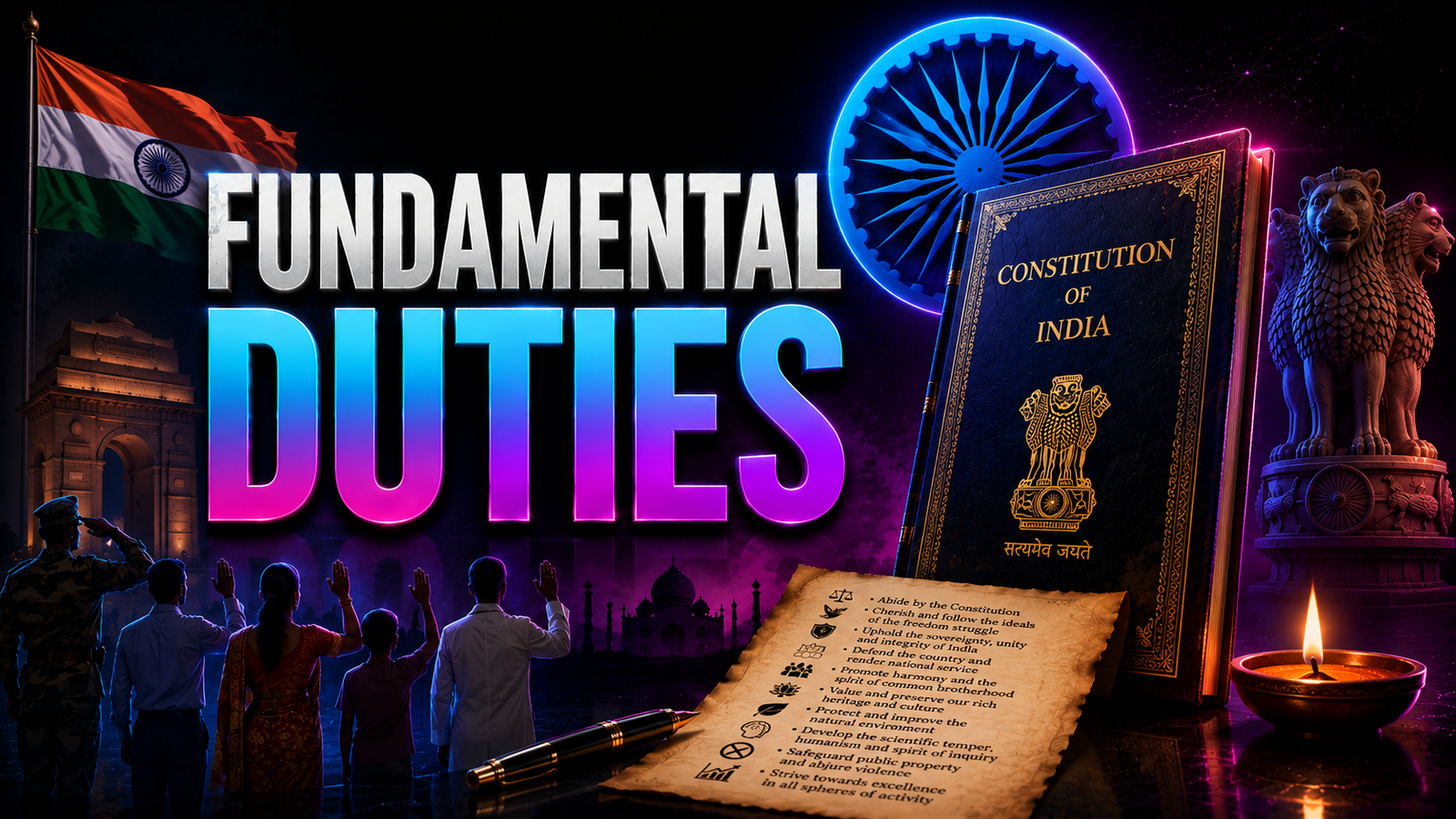
2. ๐Ÿ“œ List of All 11 Fundamental Duties [Art. 51A (a) to (k)]

Article 51A states: "It shall be the duty of every citizen of Indiaโ€”"

ClauseOfficial Text of the Fundamental DutyKey Keyword / Focus
Art. 51A(a) To abide by the Constitution and respect its ideals and institutions, the National Flag and the National Anthem; Constitution, Flag & Anthem
Art. 51A(b) To cherish and follow the noble ideals which inspired our national struggle for freedom; Noble Freedom Struggle Ideals
Art. 51A(c) To uphold and protect the sovereignty, unity, and integrity of India; Sovereignty, Unity & Integrity
Art. 51A(d) To defend the country and render national service when called upon to do so; Defend Country & National Service
Art. 51A(e) To promote harmony and the spirit of common brotherhood amongst all the people of India transcending religious, linguistic, and regional or sectional diversities; to renounce practices derogatory to the dignity of women; Brotherhood & Dignity of Women
Art. 51A(f) To value and preserve the rich heritage of our composite culture; Composite Culture & Heritage
Art. 51A(g) To protect and improve the natural environment including forests, lakes, rivers, and wildlife, and to have compassion for living creatures; Natural Environment & Wildlife
Art. 51A(h) To develop the scientific temper, humanism, and the spirit of inquiry and reform; Scientific Temper & Inquiry
Art. 51A(i) To safeguard public property and to abjure violence; Safeguard Public Property
Art. 51A(j) To strive towards excellence in all spheres of individual and collective activity so that the nation constantly rises to higher levels of endeavor and achievement; Excellence & National Endeavor
Art. 51A(k) Who is a parent or guardian to provide opportunities for education to his child or, as the case may be, ward between the age of six and fourteen years. (Added by 86th Amend 2002) Education for Children (Ages 6โ€“14)

3. ๐Ÿงฉ Key Features & Categorization

1. Dual Nature of Duties (Moral vs. Civic)

2. Rooted in Indian Ethos

They codify tasks that have traditionally been part of Indian tradition, mythology, religion, and practice (such as harmony, non-violence, environmental reverence, and respect for learning).

3. Applicable Exclusively to Citizens

๐Ÿ”ฅ Critical Distinction

Unlike certain Fundamental Rights (e.g., Articles 14, 20, 21) which extend to all persons regardless of nationality, Fundamental Duties extend ONLY to Indian citizens and do not apply to foreign nationals residing in India.

4. Non-Justiciable Nature

Like the Directive Principles of State Policy (Part IV), Fundamental Duties are non-justiciable and non-enforceable directly by courts. There is no automatic legal penalty provided in the Constitution for their violation.

4. โš–๏ธ Legal Status, Non-Justiciability & Verma Committee (1999)

Although Article 51A is non-justiciable in itself, Parliament has enacted several statutory laws over time to enforce specific Fundamental Duties indirectly:

Verma Committee on Fundamental Duties (1999)

The Justice J.S. Verma Committee was appointed to plan a strategy for teaching Fundamental Duties in educational institutions. It identified existing legal provisions for the enforcement of several fundamental duties:

Enacted LegislationCorresponding Fundamental Duty Enforced
Prevention of Insults to National Honour Act (1971) Prevents disrespect to the Indian National Flag, Constitution, and National Anthem [Art. 51A(a)].
Emblems and Names (Prevention of Improper Use) Act (1950) Prevents unauthorized use of national symbols and emblems.
Protection of Civil Rights Act (1955) / SC & ST Act (1989) Enforces abolition of untouchability and prevents offenses against social equality [Art. 51A(e)].
Indian Penal Code (IPC / Bharatiya Nyaya Sanhita) Punishes offenses threatening national integration, communal harmony, or incitement to violence [Arts. 51A(c), (e), (i)].
Representation of the People Act (1951) Disqualifies members of Parliament/State Legislatures for corrupt practices like promoting hatred on grounds of religion or caste.
Wildlife Protection Act (1972) & Forest Conservation Act (1980) Protects endangered species, forests, and natural ecosystems [Art. 51A(g)].

5. โœ๏ธ Constitutional Amendments Impacting Fundamental Duties

Amendment ActKey Impact & Modification
42nd Constitutional Amendment Act, 1976 Inserted Part IV-A and Article 51A into the Constitution, establishing 10 Fundamental Duties [Arts. 51A(a) to (j)].
86th Constitutional Amendment Act, 2002 Added the 11th Fundamental Duty under clause (k): "duty of a parent or guardian to provide educational opportunities to his child/ward between 6 and 14 years." Simultaneously enacted Article 21A (FR) and modified Article 45 (DPSP).

6. โš–๏ธ Judicial Interpretations & Landmark SC Judgments

The Supreme Court of India has held that although duties are non-justiciable, they play a crucial role in constitutional interpretation:

1. Interpretative Value in Determining Constitutional Validity

2. Bijoe Emmanuel v. State of Kerala (1986) โ€” National Anthem Case

3. M.C. Mehta v. Union of India (1988)

4. AIIMS Students Union v. AIIMS (2002)

7. ๐Ÿ—ฃ๏ธ Critical Assessment & Practical Significance

Major Criticisms:

Practical Significance:

8. ๐ŸŽฏ UPSC PRELIMS FACTS

๐Ÿ“Œ High-Yield Facts

9. โœ๏ธ UPSC MAINS VALUE ADDITION

๐Ÿ’ก Analytical Anchor Points

10. โ“ FREQUENTLY ASKED QUESTIONS (FAQ)

Which committee recommended the inclusion of Fundamental Duties in the Indian Constitution?

The Swaran Singh Committee (1976) appointed by the Congress government recommended the inclusion of a separate chapter on Fundamental Duties in the Constitution during the internal emergency.

Were Fundamental Duties present in the original Constitution of 1950?

No. The original Constitution of 1950 contained Fundamental Rights and Directive Principles, but no Fundamental Duties. They were incorporated via Part IV-A by the 42nd Constitutional Amendment Act of 1976.

How many Fundamental Duties are currently listed under Article 51A?

There are currently 11 Fundamental Duties listed under Article 51A. Originally 10 duties were added by the 42nd Amendment Act in 1976, and the 11th duty was added by the 86th Amendment Act in 2002.

Are Fundamental Duties legally enforceable in a court of law?

Fundamental Duties are non-justiciable and non-enforceable directly by courts. However, Parliament has enacted various statutory laws (like the Prevention of Insults to National Honour Act and Wildlife Protection Act) that make non-compliance with specific duties punishable.

Continue your Indian Polity syllabus coverage with these core cluster notes:

โ† Explore Complete UPSC & UPPCS Notes Hub

๐Ÿฆ FINAL REVISION FLOW

Part IV-A (Art 51A) โž” USSR Influence โž” Swaran Singh Committee (1976) โž” 42nd Amendment (10 Duties) โž” 86th Amendment (11th Duty: Education 6-14 yrs) โž” Applies to Citizens Only โž” Non-Justiciable โž” Statutory Enforcement via Verma Committee Laws.