← Back to Notes Library

⚖️ FUNDAMENTAL RIGHTS (ARTICLES 12–35)

SMART NOTES FOR UPSC & UPPCS (PART III - GS PAPER 2)

🧭 INTRODUCTION

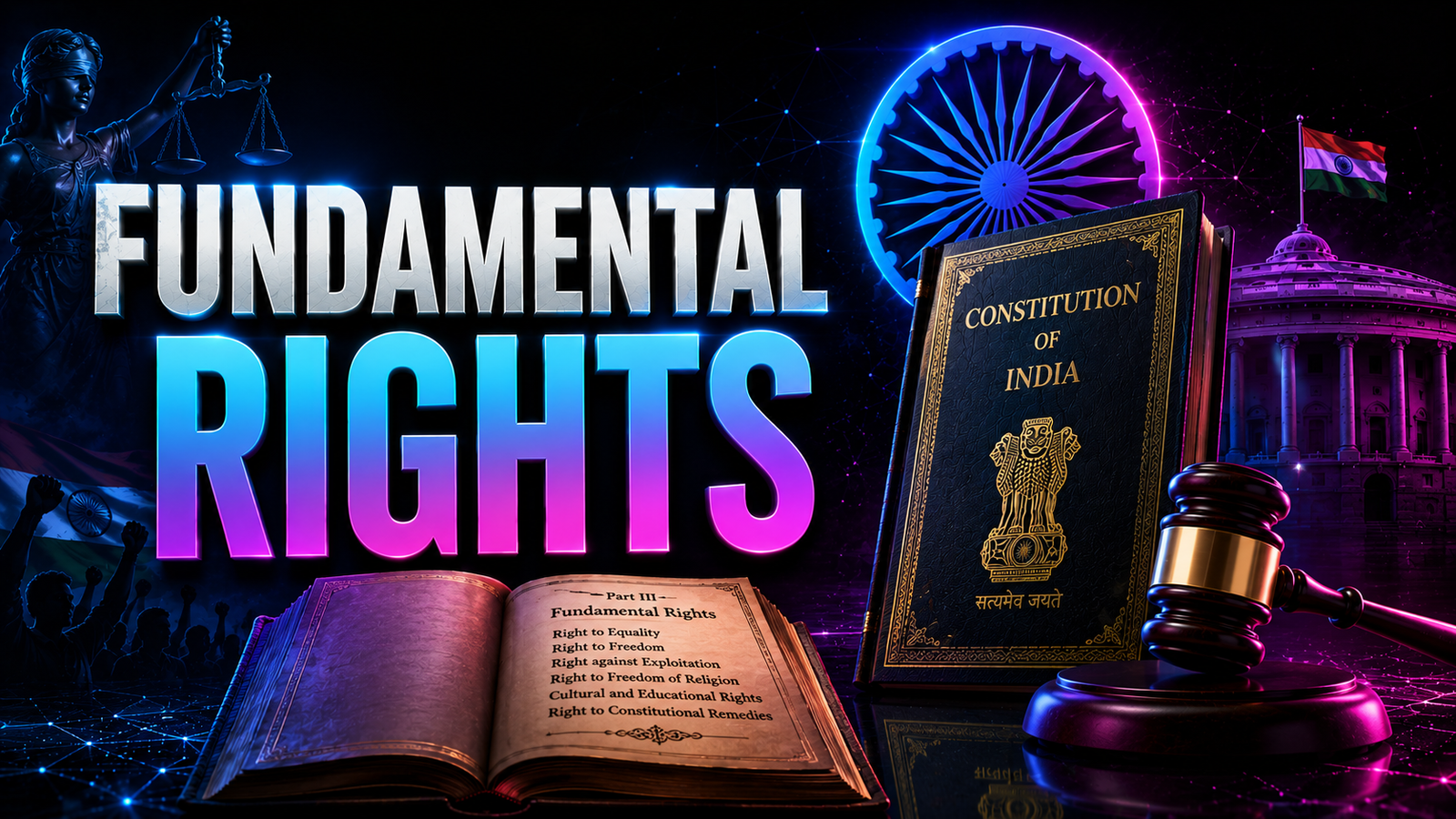
Part III of the Indian Constitution (Articles 12 to 35) guarantees Fundamental Rights to all individuals. Often described as the Magna Carta of India, these rights are designed to promote the ideal of political democracy, prevent the establishment of authoritarian rule, and protect individual liberties against executive and legislative tyranny. Borrowed primarily from the Bill of Rights in the US Constitution, Fundamental Rights are justiciable and protected directly by the Supreme Court of India under Article 32.

🔥 Core Precedent & Evolution

Originally, the Constitution provided for 7 Fundamental Rights. However, the Right to Property (Article 31) was deleted from Part III by the 44th Amendment Act of 1978 and made a legal/constitutional right under Article 300-A in Part XII.

Currently, there are 6 categories of Fundamental Rights guaranteed to Indian citizens.

1. 🏛️ General Articles: Definition of State & Laws Inconsistent (Arts. 12–13)

Article 12: Definition of 'State'

Article 12 defines the term 'State' for the purpose of Part III. Fundamental Rights are primarily claims against the actions of the State. The definition includes:

Article 13: Laws Inconsistent with Fundamental Rights

Article 13 provides the structural bedrock for the doctrine of Judicial Review. It declares that all laws inconsistent with or in derogation of any Fundamental Rights shall be void to the extent of inconsistency.

ClauseProvision & Key Legal Doctrine
Art. 13(1) [Pre-Constitutional Laws] Pre-constitutional laws remain valid except to the extent of inconsistency with FRs. Governed by Doctrine of Eclipse (the law is not dead, but remains dormant under the shadow of FRs) and Doctrine of Severability (only inconsistent parts are struck down, not the whole act).
Art. 13(2) [Post-Constitutional Laws] The State shall not make any law that takes away or abridges Part III rights. Any law made in contravention shall be void (ab initio).
Art. 13(3) [Definition of 'Law'] Includes permanent laws (Acts of Parliament/State Legislatures), temporary laws (Ordinances), delegated legislation (orders, bye-laws, rules, regulations, notifications), and non-legislative sources (custom or usage having force of law).
Art. 13(4) [Constitutional Amendments] Added by 24th Amend 1971. SC ruled in Kesavananda Bharati (1973) that a Constitutional Amendment is NOT a law under Art. 13, but CAN be challenged if it violates the Basic Structure.

2. 📋 Exhaustive Breakdown of the 6 Categories of Rights

CATEGORY 1: RIGHT TO EQUALITY (Articles 14–18)

CATEGORY 2: RIGHT TO FREEDOM (Articles 19–22)

CATEGORY 3: RIGHT AGAINST EXPLOITATION (Articles 23–24)

CATEGORY 4: RIGHT TO FREEDOM OF RELIGION (Articles 25–28)

CATEGORY 5: CULTURAL AND EDUCATIONAL RIGHTS (Articles 29–30)

CATEGORY 6: RIGHT TO CONSTITUTIONAL REMEDIES (Article 32)

3. 🔍 Deep Dive: Article 19 Freedoms & Reasonable Restrictions

Article 19 guarantees 6 democratic freedoms to citizens only. These freedoms are not absolute; each is subject to specific reasonable restrictions listed in the Constitution:

Freedom [Art. 19(1)]Permissible Grounds of Reasonable Restriction [Art. 19(2)-(6)]
19(1)(a): Freedom of Speech & Expression Sovereignty & integrity of India, security of the State, friendly relations with foreign states, public order, decency, morality, contempt of court, defamation, incitement to an offense.
19(1)(b): Freedom to Assemble Peaceably & Without Arms Sovereignty & integrity of India, public order (includes traffic management under Sec 144 CrPC).
19(1)(c): Freedom to Form Associations / Unions / Co-operatives Sovereignty & integrity of India, public order, morality. (Co-operatives added by 97th Amend 2011).
19(1)(d): Freedom of Movement Throughout India Interests of general public, protection of interests of any Scheduled Tribe (prevents exploitation of tribal culture & entry).
19(1)(e): Freedom to Reside and Settle in Any Part of India Interests of general public, protection of interests of any Scheduled Tribe.
[19(1)(f): Right to Acquire, Hold & Dispose Property] DELETED by 44th Constitutional Amendment Act, 1978.
19(1)(g): Freedom of Trade, Occupation, Profession, Business Interests of general public, professional/technical qualifications required, State monopoly creation. Prohibits illegal/immoral trades (e.g. trafficking, explosives without license).

4. 🌟 Deep Dive: Article 21 & Expansive Judicial Interpretation

Article 21 states: "No person shall be deprived of his life or personal liberty except according to procedure established by law."

The Paradigm Shift: Gopalan to Maneka Gandhi

Implied Rights Derived Under Article 21 by Supreme Court

Through expansive judicial activism, the SC has declared dozens of rights as integral to Article 21:

5. 📜 Article 32 & The 5 Constitutional Writs

To enforce Fundamental Rights, Article 32 empowers the Supreme Court (and Article 226 empowers High Courts) to issue orders or Writs derived from English Common Law ('Prerogative Writs'):

Writ NameLiteral MeaningPurpose & Target
1. Habeas Corpus "To have the body of" Order issued to produce a detained person before court. Protects against arbitrary illegal detention. Issued against both State and Private individuals.
2. Mandamus "We Command" Command issued to a public official/authority to perform a mandatory statutory duty they failed or refused to perform. Cannot be issued against private individuals, President, or Governors.
3. Prohibition "To forbid" Issued by a higher court to a lower court or tribunal to prevent it from exceeding its jurisdiction or usurping jurisdiction. Issued only against Judicial & Quasi-Judicial authorities. Preventive in nature.
4. Certiorari "To be certified" Issued by a higher court to a lower court/tribunal to quash an order already passed in excess of jurisdiction. Both Preventive and Curative. Issued against Judicial, Quasi-Judicial, and Administrative bodies.
5. Quo-Warranto "By what authority?" Issued to inquire into the legality of a person's claim to a public office, preventing illegal usurpation of public office. Can be sought by any interested person (not strictly the aggrieved party).

Article 32 (Supreme Court) vs. Article 226 (High Court) Comparison

6. 🇮🇳 Rights Available to Citizens Only vs. All Persons

Rights Available ONLY to Indian CitizensRights Available to ALL Persons (Citizens & Foreigners, except Enemy Aliens)
Article 15: Prohibition of discrimination on grounds of religion, race, caste, sex, place of birth.Article 14: Equality before law and equal protection of laws.
Article 16: Equality of opportunity in matters of public employment.Article 20: Protection in respect of conviction for offenses.
Article 19: Protection of 6 basic freedoms (speech, assembly, association, movement, residence, profession).Article 21: Protection of life and personal liberty.
Article 29: Protection of language, script, and culture of minorities.Article 21-A: Right to elementary education.
Article 30: Right of minorities to establish and administer educational institutions.Article 22: Protection against arrest and detention.
Articles 23 & 24: Prohibition of forced labor and child labor.
Articles 25, 26, 27 & 28: Freedom of religion provisions.

7. 🛡️ Articles 33–35: Armed Forces, Martial Law & Exceptions

8. ⚖️ Landmark Supreme Court Judgments Master Table

Landmark CaseYearKey Legal Ratio / Ruling
A.K. Gopalan v. State of Madras1950Narrow reading of Art. 21; procedure established by law means procedure enacted by statute.
Shankari Prasad v. Union of India1951Parliament can amend any part of the Constitution including FRs under Art. 368.
Golak Nath v. State of Punjab1967FRs are sacrosanct and transcendental; Parliament CANNOT amend Part III rights.
Kesavananda Bharati v. State of Kerala1973Overruled Golak Nath; Parliament can amend FRs under Art. 368, but CANNOT alter the Basic Structure of the Constitution.
Maneka Gandhi v. Union of India1978Expanded Art. 21; Procedure must be Just, Fair, and Reasonable ('Due Process of Law').
Minerva Mills v. Union of India1980Harmonious balance between FRs and DPSPs is part of the Basic Structure.
I.R. Coelho v. State of Tamil Nadu1992 / 2007Laws placed in 9th Schedule after April 24, 1973 are open to Judicial Review if they violate FRs/Basic Structure.
Indra Sawhney v. Union of India1992Upheld 50% OBC quota limit; excluded 'Creamy Layer'; ruled no reservation in promotions.
K.S. Puttaswamy v. Union of India2017Unanimously declared Right to Privacy as an intrinsic part of Art. 21 life & liberty.

9. 🎯 UPSC PRELIMS FACTS

📌 High-Yield Facts

10. ✍️ UPSC MAINS VALUE ADDITION

💡 Analytical Anchor Points

11. ❓ FREQUENTLY ASKED QUESTIONS (FAQ)

Why is Part III of the Indian Constitution described as the Magna Carta of India?

Part III (Articles 12 to 35) contains a comprehensive and justiciable list of Fundamental Rights that guarantee civil liberties and protect individuals against arbitrary state action, making it the Magna Carta of India.

Which Fundamental Rights can NEVER be suspended during a National Emergency?

Under the 44th Amendment Act of 1978, the Fundamental Rights guaranteed under Article 20 (Protection in respect of conviction for offenses) and Article 21 (Protection of life and personal liberty) CANNOT be suspended even during a National Emergency under Article 352.

What is the difference between Article 32 and Article 226 writ jurisdiction?

Article 32 is itself a Fundamental Right and can be invoked ONLY for the enforcement of Fundamental Rights before the Supreme Court. Article 226 is a constitutional right empowering High Courts to issue writs for both Fundamental Rights and ordinary legal rights, giving High Courts a wider territorial and subject scope for writs.

Which Fundamental Rights are available ONLY to Indian citizens?

The Fundamental Rights under Articles 15, 16, 19, 29, and 30 are exclusive to Indian citizens and are not available to foreign nationals.

Continue your Indian Polity syllabus coverage with these core cluster notes:

← Explore Complete UPSC & UPPCS Notes Hub

🐦 FINAL REVISION FLOW

Part III (Arts 12–35) ➔ Art 12 (State) + Art 13 (Judicial Review) ➔ 6 Categories (Equality 14–18, Freedom 19–22, Exploitation 23–24, Religion 25–28, Culture/Education 29–30, Remedies 32) ➔ Citizens-only (15,16,19,29,30) ➔ Emergency Protected (20 & 21) ➔ 5 Writs under Art 32.