🧭 INTRODUCTION
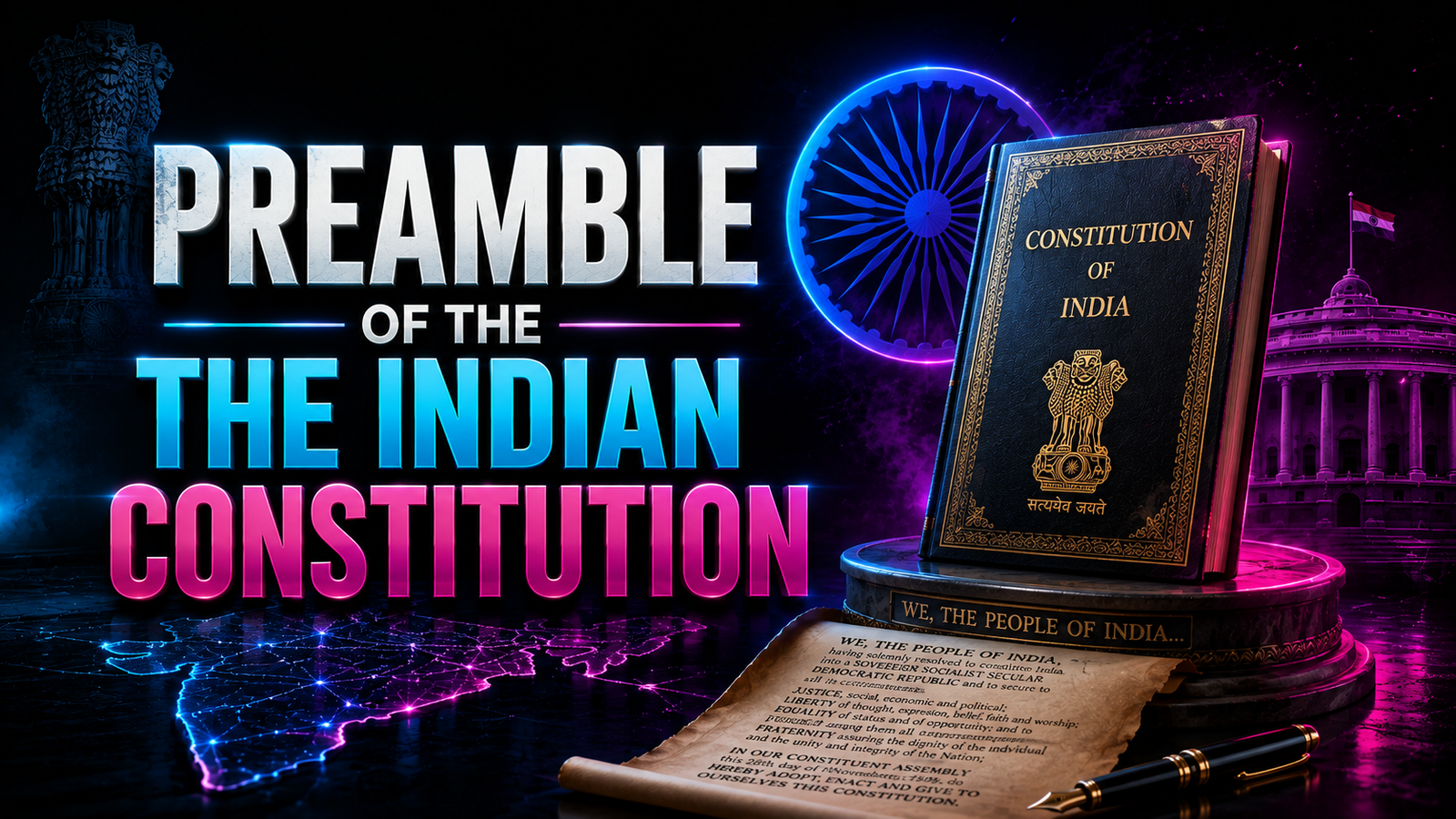
The Preamble of the Indian Constitution serves as the preface, introduction, or key to the entire constitutional text. It embodies the basic philosophy, core values, grand vision, and fundamental commitments upon which the Indian Republic is founded. Based on the historic Objectives Resolution drafted and moved by Jawaharlal Nehru on December 13, 1946 (and adopted on January 22, 1947), N.A. Palkhivala famously termed the Preamble the "Identity Card of the Constitution."
🔥 Core Precedent
The American Constitution was the first in the world to begin with a Preamble. India adopted this practice, expanding it into a comprehensive normative framework.
1. Sovereign
India is an independent state—neither a dominion nor a dependency of any external power. It possesses absolute power to acquire foreign territory or cede a part of its territory in favor of a foreign state.
2. Socialist
Added by the 42nd Amendment Act (1976). India adheres to Democratic Socialism (a mix of Marxism and Gandhian socialism heavily leaning towards Gandhian socialism) aimed at ending poverty, ignorance, disease, and inequality of opportunity. It stands in contrast to State/Communist Socialism (which involves nationalization of all means of production).
3. Secular
Added by the 42nd Amendment Act (1976). India practices Positive Secularism, meaning all religions in India (regardless of size) have the same status, support, and respect from the State. Articles 25 to 28 guarantee this as a Fundamental Right.
4. Democratic
Refers to representative parliamentary democracy based on universal adult franchise, periodic elections, rule of law, independence of the judiciary, and absence of discrimination. In the Preamble, democracy embraces not just political democracy, but also social and economic democracy (as highlighted by Dr. B.R. Ambedkar).
5. Republic
Indicates that the Head of State is always **elected** (indirectly, in India's case, for a 5-year term—the President) rather than holding a hereditary position (like the British Monarchy). It also signifies political sovereignty vested in the people and absence of any privileged class.
6. Justice (Social, Economic, Political)
- Social Justice: Equal treatment of all citizens without social distinction based on caste, color, race, religion, sex.
- Economic Justice: Non-discrimination between people on the basis of wealth, income, and property.
- Distributive Justice: Combination of Social Justice + Economic Justice.
- Political Justice: Equal access to political offices and equal voice in government.
- Source: Ideal of Justice was borrowed from the Russian Revolution (1917).
7. Liberty, Equality, Fraternity
- Liberty: Absence of restraints on activities of individuals while providing opportunities for human personality development. Must be enjoyed within constitutional limits (not absolute).
- Equality: Absence of special privileges to any section, and provision of adequate opportunities for all without discrimination. Incorporates Civic (Arts. 14–18), Political (Arts. 325, 326), and Economic (Art. 39 DPSP) equality.
- Fraternity: Sense of common brotherhood promoted by single citizenship and Fundamental Duties (Art. 51A). Assures two things: Dignity of the individual and Unity & Integrity of the Nation.
- Source: Ideals of Liberty, Equality, and Fraternity were borrowed from the French Revolution (1789–1799).
The legal status of the Preamble evolved through three landmark Supreme Court cases:
1. Berubari Union Case (1960)
- Supreme Court stated that the Preamble shows the general purpose behind constitutional provisions, but held that "Preamble is NOT a part of the Constitution."
- Concluded it cannot be enforced in a court of law and is not a source of substantive power.
2. Kesavananda Bharati Case (1973) — 13-Judge Bench
- Supreme Court rejected/overruled its Berubari decision.
- Held that "Preamble IS an integral part of the Constitution."
- Observed that the Constitution should be read and interpreted in the light of the grand vision expressed in the Preamble.
3. LIC of India Case (1995)
- Supreme Court again reaffirmed that the Preamble is an integral part of the Constitution.
🔥 Key Legal Nuance
1. The Preamble is neither a source of power to the legislature nor a prohibition upon powers of the legislature.
2. The Preamble is non-justiciable (its provisions are not enforceable in courts of law).
Can the Preamble be amended under Article 368?
This question arose for the first time in the Kesavananda Bharati Case (1973). The petitioner argued that the amending power in Article 368 cannot be used to destroy or alter the Preamble.
- Supreme Court Ruling: The Preamble can be amended under Article 368, subject to the condition that no amendment is made to the "Basic Structure" of the Constitution.
- The court held that basic elements/fundamental features of the Constitution expressed in the Preamble cannot be altered.
The 42nd Constitutional Amendment Act (1976)
The Preamble has been amended ONLY ONCE so far, by the 42nd Amendment Act, 1976.
- Added 3 new words: Socialist, Secular, and Integrity.
- Changed the phrase "Unity of the Nation" to "Unity and Integrity of the Nation."
- This amendment was held valid by the Supreme Court.
7. ❓ FREQUENTLY ASKED QUESTIONS (FAQ)
Is the Preamble part of the Indian Constitution?
Yes. In the landmark Kesavananda Bharati case (1973) and LIC of India case (1995), the Supreme Court held that the Preamble is an integral part of the Constitution, overruling its earlier decision in the Berubari Union case (1960).
Is the Preamble enforceable or justiciable in a court of law?
No. The Preamble is non-justiciable and non-enforceable in courts of law. Provisions of the Preamble cannot be directly enforced as statutory rights.
Which words were added to the Preamble by the 42nd Amendment Act?
The 42nd Constitutional Amendment Act of 1976 added three new words to the Preamble: Socialist, Secular, and Integrity.
Can the Preamble be amended under Article 368?
Yes, the Preamble can be amended under Article 368, provided that the Basic Structure of the Constitution is not altered or destroyed.
🐦 FINAL REVISION FLOW
Objectives Resolution (1946) ➔ Adopted Preamble (1949) ➔ Berubari Case (1960: Not a Part) ➔ Kesavananda Bharati Case (1973: Integral Part + Basic Structure Limit) ➔ 42nd Amendment (1976: Added Socialist, Secular, Integrity) ➔ Non-Justiciable & Non-Enforceable in Courts.