← Back to Medieval History Library

🌊 CHOLA EMPIRE - MARITIME IMPERIALISM & ADMINISTRATION

Notes FOR UPSC CSE & UPPCS

🧭 GEOPOLITICAL MAGNITUDE & THE CHOLA LAKE

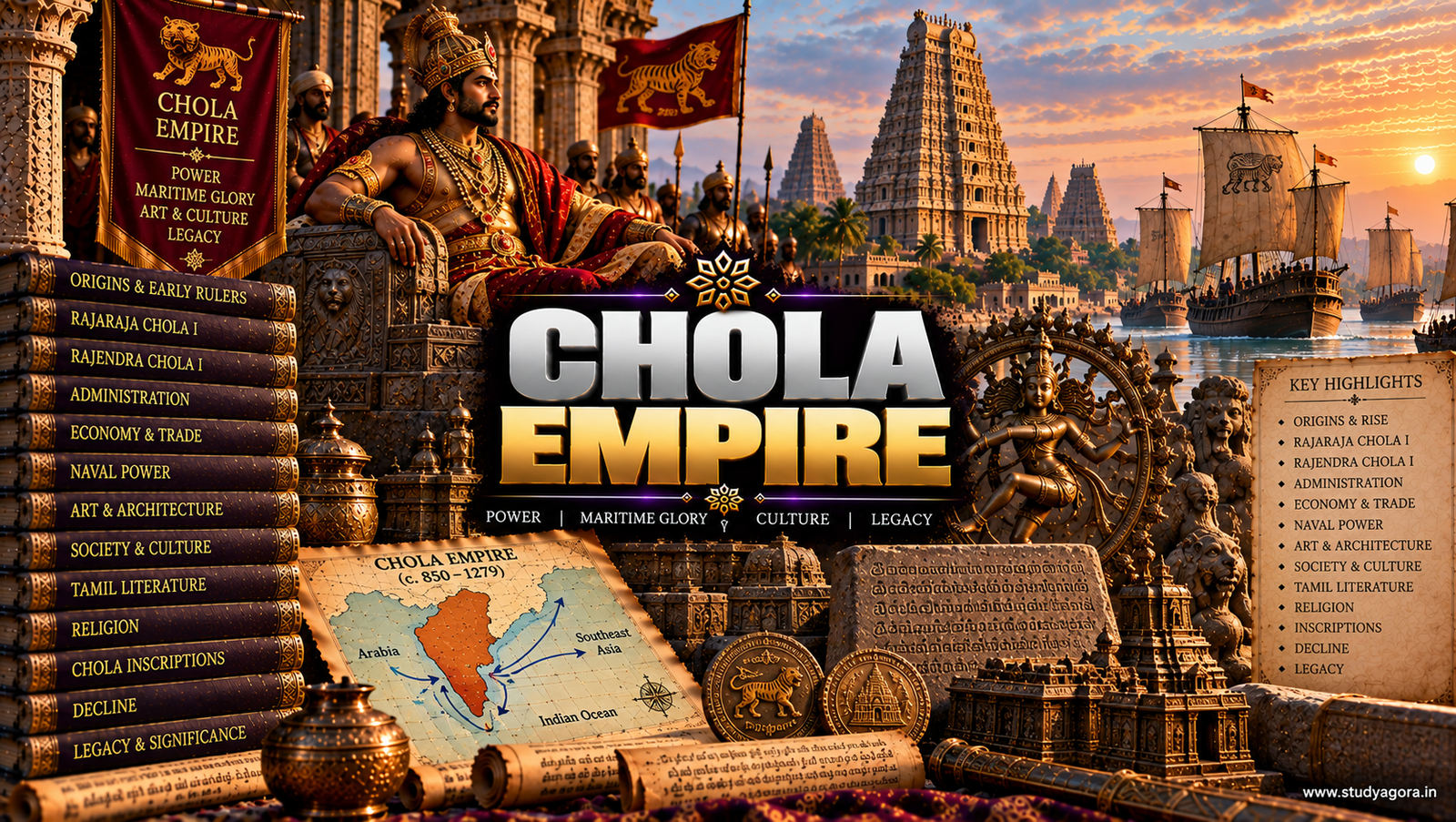
The Imperial Cholas (850–1279 CE) transformed South India from a regional power hub into a dominant trans-oceanic empire. Founded by Vijayalaya in the 9th century upon capturing Tanjore from the Muttaraiyars, the dynasty reached its imperial zenith under Rajaraja I (r. 985–1014 CE) and his son Rajendra I (r. 1012–1044 CE).

The Cholas are distinguished in Indian history for three unique achievements: establishing a formidable blue-water navy that converted the Bay of Bengal into a "Chola Lake," pioneering a highly organized autonomous local self-government system (documented in the *Uttaramerur Inscriptions*), and perfecting Dravidian stone architecture and lost-wax bronze sculptures.

πŸ”₯ Core Analytical Pillars

1. πŸ‘‘ Chronological Survey of Great Chola Monarchs

1.1 Vijayalaya (r. 850–871 CE) & Parantaka I (r. 907–955 CE)

Vijayalaya re-established Chola power by capturing Tanjore from the Muttaraiyar chieftains. Parantaka I expanded the kingdom by defeating the Pandyan king Rajasimha II and capturing Madurai (assuming the title Maduraikonda).

1.2 Rajaraja I (r. 985–1014 CE) β€” The Imperial Architect

Historiographical Status: Rajaraja I laid the structural foundation of the Chola Empire through systematized revenue surveys, naval expansion, and imperial monumentality.

1.3 Rajendra I (r. 1012–1044 CE) β€” The Great Conqueror

2. 🌊 Naval Supremacy & The Srivijaya Campaign (1025 CE)

Economic Motivation: The Chola naval expedition against Srivijaya was driven primarily by commercial imperatives rather than territorial annexation.

πŸ’‘ Strategic Drivers of the Chola Navy

3. πŸ›οΈ Local Self-Government & The Uttaramerur Inscriptions

The hallmark of Chola administration was its highly decentralized, autonomous village governance framework documented vividly in the Uttaramerur Inscriptions (919 and 921 CE) of Parantaka I.

3.1 Three Types of Local Assemblies

Assembly TypeMembership CompositionOperational Jurisdiction
Ur General assembly of non-Brahmin land-owning tax-paying villagers. Managed local agricultural land, tax collection, and village maintenance.
Sabha / Mahasabha Assembly exclusive to Brahmin scholars in tax-free Agrahara / Brahmadeya villages. Exercised full administrative, judicial, and financial autonomy through executive committees.
Nagaram Organization of merchants, traders, and artisans. Managed urban markets, commercial disputes, and trade tax assessments in market towns (Nagarams).

3.2 Committee System (Variyams) & Kudavolai Election Mechanism

The Sabha operated through specialized executive committees called Variyams (e.g., Eri-variyam for tank maintenance, Thotta-variyam for gardens, Gold Committee):

4. βš™οΈ Imperial Administrative Architecture & Land Survey

The Chola Empire was divided into a clear territorial hierarchy to balance central authority with local autonomy.

Administrative UnitModern EquivalentKey Officers & Governance Mechanism
MandalamProvinceGoverned by royal princes (Viceroy / Mandala-mudali). Divided into 8–9 Mandalams.
Valanadu / KottamDivisionSupervised by imperial officers (Perundaram).
NaduDistrictAssembly of local landholders (Nattar) managing land disputes.
Kurram / GramamVillage ClusterAdministered directly by Sabha or Ur.

4.1 Land Revenue Mechanics

5. 🎨 Dravidian Temple Architecture & Lost-Wax Bronzes

Chola art represents the absolute peak of the **Dravidian architectural style** and metallic sculpture perfection.

5.1 Architectural Highlights

5.2 Lost-Wax Bronze Sculptures (Cire Perdue)

Artistic Zenith: Auguste Rodin described Chola bronzes as the finest sculptural achievements in world history.

6. 🎯 UPSC / UPPCS Prelims High-Yield Fact Vault

πŸ“Œ Direct Revision Points for Prelims

7. ✍️ UPSC Mains Analytical Anchor Points

πŸ’‘ Structural Value Additions for GS Paper 1

8. ❓ FREQUENTLY ASKED QUESTIONS (FAQ)

What was the electoral and administrative significance of the Uttaramerur Inscription?

Issued by Parantaka I in 919 and 921 CE, the Uttaramerur Inscriptions detail the democratic functioning of the Brahmin assembly (Sabha). They outline qualifications for committee members (Variyams), disqualifications (such as corruption or failing to submit accounts), and a lottery election system (Kudavolai) for local governance.

Why did Rajendra I invade the Srivijaya Empire in Southeast Asia?

In 1025 CE, Rajendra I launched a naval expedition against the Srivijaya Empire (Malayan Peninsula and Sumatra/Java) to eliminate trade blockades in the Malacca Strait, protect Chola merchant guilds (Ainurruvar and Manigramam), and secure direct sea trade routes with Song Dynasty China.

Continue your systematically ordered Medieval History syllabus coverage:

FINAL REVISION FLOW CHART

Vijayalaya captures Tanjore (850) βž” Parantaka I issues Uttaramerur Inscriptions βž” Rajaraja I builds naval dominance, annexes N. Sri Lanka & builds Tanjore Brihadisvara Temple (1010) βž” Rajendra I annexes entire Sri Lanka, marches to Ganges (Gangaikondachola) & launches Srivijaya Naval Expedition (1025) βž” Local autonomy via Sabha, Ur & Nagaram (Kudavolai lottery) βž” Lost-Wax Bronzes (Nataraja) βž” Decline by 13th century.