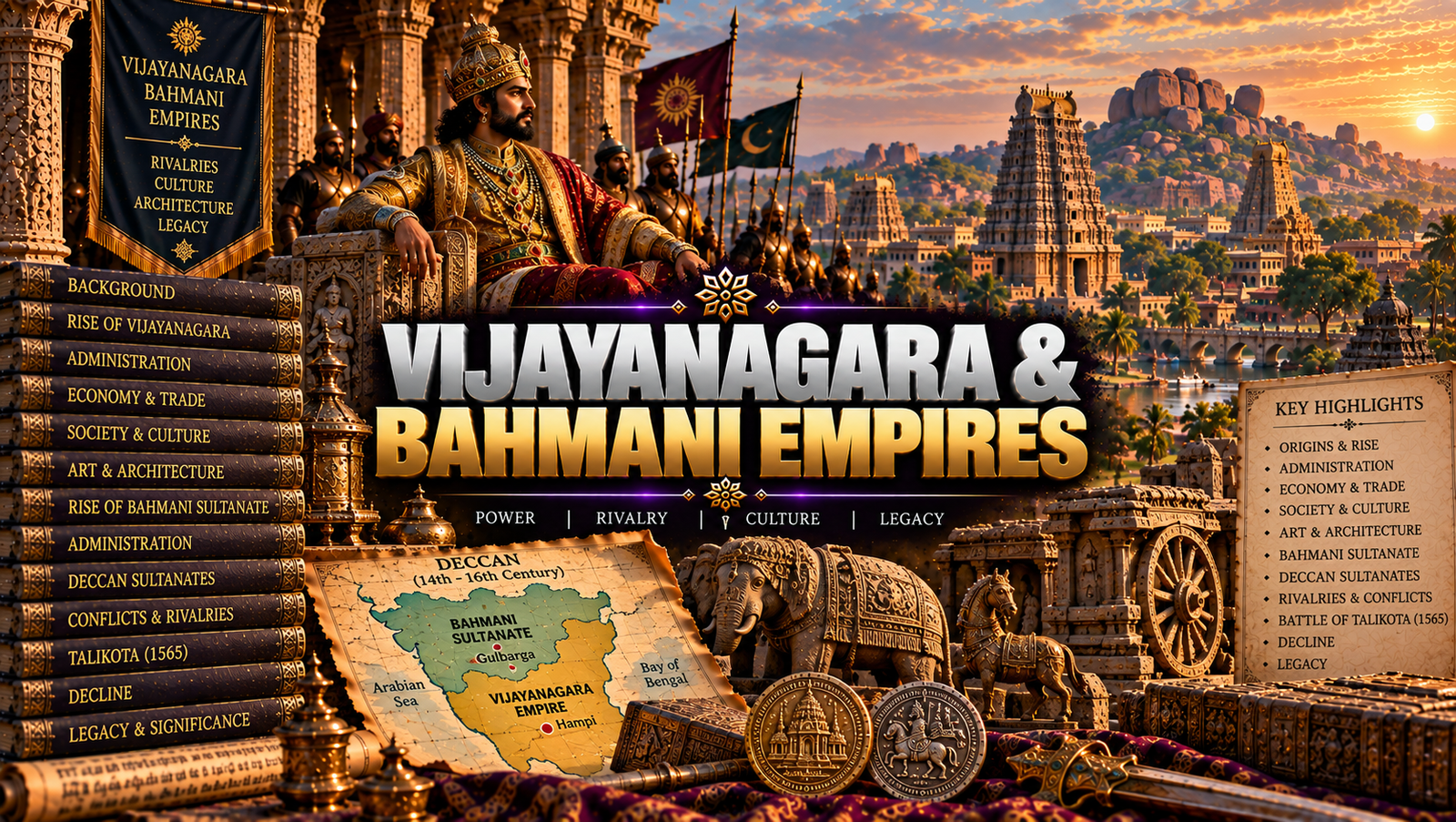
The 14th century saw the simultaneous emergence of two major regional powers south of the Narmada River: the **Vijayanagara Empire (1336–1646 CE)** and the **Bahmani Sultanate (1347–1527 CE)**. Founded during the political turmoil of Muhammad bin Tughlaq's reign, these empires dominated Deccan geopolitics for over two centuries.
While Vijayanagara acted as a bastion of South Indian Hindu culture and institutionalized military-land assignment models (**Nayankara System**), the Bahmani Sultanate synthesized Persian administrative traditions with indigenous Deccan statecraft. Their structural confrontation centered on the strategic and fertile **Raichur Doab**, culminating in the historic **Battle of Talikota (1565 CE)**.
🔥 Core Analytical Pillars
Founders: Vijayanagara (Harihara I & Bukka I, 1336 CE); Bahmani (Alauddin Hasan Bahman Shah / Hasan Gangu, 1347 CE).
Geopolitical Bone of Contention: Control over the fertile Raichur Doab (Krishna-Tungabhadra interfluve) and Goa trade routes.
Institutional Innovation: The *Nayankara* System (Vijayanagara) vs. *Taraf* Provincial System & Mahmud Gawan's reforms (Bahmani).
1. 👑 Vijayanagara Empire: Four Dynasties & Political History
Founded on the southern banks of the Tungabhadra River by brothers **Harihara I** and **Bukka I** of the Sangama dynasty, under the spiritual guidance of Saint **Vidyaranya** (from Sringeri Matha).
Dynasty
Period
Key Monarchs
Major Historical Developments
Sangama Dynasty
1336–1485 CE
Harihara I, Bukka I, Deva Raya I, Deva Raya II
Established empire; Deva Raya II (*Gajabetekara*) inducted Muslim archers into the cavalry and consolidated Southern control.
Saluva Dynasty
1485–1505 CE
Saluva Narasimha
Short-lived usurping dynasty aimed at arresting internal decay and rebel chieftains.
Tuluva Dynasty
1505–1570 CE
Vira Narasimha, **Krishna Deva Raya**, Rama Raya
Golden Age under Krishna Deva Raya (r. 1509–1529 CE). Battle of Talikota (1565) fought during Sadashiva Raya's nominal rule under regent Rama Raya.
Aravidu Dynasty
1570–1646 CE
Tirumala, Venkata II
Shifted capital to Penukonda and later Chandragiri; final fragmented phase of the empire.
1.1 Golden Age of Krishna Deva Raya (r. 1509–1529 CE)
Military Conquests: Defeated the Sultan of Bijapur (Ismail Adil Shah) to capture the Raichur Doab (1520); subjugated Prataparudra Gajapati of Odisha, erecting a victory pillar at Simhachalam.
Titles Assumed:Yavanaraja Sthapanacharya (Restorer of the Yavana Kingdom), Abhinava Bhoja, and Andhra Bhoja.
Literary Patronage: Court adorned by the **Ashtadiggajas** (Eight Literary Giants). Krishna Deva Raya himself composed **Amuktamalyada** (Telugu masterwork on statecraft and divine devotion) and **Jambavati Kalyanam** (Sanskrit drama).
2. ⚙️ Administration, Nayankara System & Ayagar Framework
2.1 Central & Provincial Administration
The King was supported by a Council of Ministers (Pradhani). The empire was divided into **Rajyas** (Provinces), **Vishayas** (Districts), **Sthalas** (Sub-districts), and **Gramas** (Villages).
2.2 The Nayankara System
Structural Legacy: The defining feature of Vijayanagara military feudalism, recorded extensively by Portuguese travelers Domingo Paes and Fernao Nuniz.
Amara-Nayakas: Military commanders who were granted land territories called **Amaram** by the Rayas (King).
Duties: Maintained a fixed contingent of troops and elephants for military service; remitted a portion of land revenue to the central treasury; maintained irrigation works and local law and order.
Non-Hereditary Roots: Initially transferable offices that gradually became hereditary power hubs as central authority weakened.
2.3 The Ayagar System (Village Level)
A body of **12 village functionaries** (including headman/Gaud, accountant/Karnam, watchman/Talari) managed local village affairs. They were granted tax-free land assignments (Manyams) or a share of agricultural produce in perpetuity for their services.
3. 🕌 The Bahmani Sultanate: Administration & Mahmud Gawan
Founded in 1347 CE by **Alauddin Hasan Bahman Shah** (Hasan Gangu), establishing its first capital at **Gulbarga** (later shifted to **Bidar** by Ahmad Shah Wali in 1424 CE).
3.1 Administrative Setup (Tarafs)
The kingdom was organized into four principal provinces called **Tarafs** (Gulbarga, Daulatabad, Berar, Bidar), governed by provincial governors called **Tarafdars** who possessed extensive autonomy.
3.2 Reforms of Mahmud Gawan (Prime Minister, 1463–1481 CE)
💡 Administrative & Fiscal Modernization
Division of Tarafs: Divided the existing 4 large Tarafs into 8 smaller provinces to curtail the growing power of ambitious governors.
Central Fiscal Reservation: Converted significant portions of land in every Taraf directly into royal land (**Khalisa**), bringing local revenue under central control.
Military Salaries & Inspection: Enforced fixed salaries for nobles in cash or land assignments (*Jagir*) and instituted strict inspections of horse contingents.
Educational Legacy: Constructed the magnificent **Madrasa of Mahmud Gawan** at Bidar, attracting scholars across the Islamic world.
Deccan Disintegration: Execution of Mahmud Gawan due to court court factionalism (Afaqis vs. Deccanis) led to the fragmentation of the Bahmani state into 5 Deccan Sultanates by the early 16th century: **Bijapur**, **Golconda**, **Ahmadnagar**, **Bidar**, and **Berar**.
4. 📜 Accounts of Foreign Travelers: Nicolo de Conti to Nuniz
Traveler
Origin / Period
Mughal/Vijayanagara Ruler
Key Historical Observations
Nicolo de Conti
Italian (1420 CE)
Deva Raya I
Described the city fortification walls, festivals of Navaratri and Dipavali, and practice of Sati.
Abdur Razzaq
Persian Ambassador (1443 CE)
Deva Raya II
Wrote in *Matla-us-Sadain*: "The city of Vijayanagara is such that the eye has non seen nor the ear heard of any place resembling it upon the whole earth," describing 7 concentric rings of fortification.
Domingo Paes
Portuguese (1520 CE)
Krishna Deva Raya
Provided detailed accounts of the military strength, bazaar prosperity, irrigation tanks, and personality of Krishna Deva Raya.
Fernao Nuniz
Portuguese Horse Trader (1535 CE)
Achyuta Deva Raya
Left detailed notes on the origins of the kingdom, the Nayankara system, and court administrative practices.
5. 🎨 Vijayanagara Art, Hampi Architecture & Literature
Vijayanagara architecture synthesizes traditional Dravidian style with Islamic structural influences (Indo-Islamic secular architecture).
Architectural Features: High enclosure walls, monolithic pillars with carved leaping horses (*Yali*), intricate carved mandapas, and detached shrines (**Kalyana Mandapa** for divine marriage ceremonies).
Prominent Hampi Monuments:
Virupaksha Temple: Dedicated to Lord Shiva, featuring towering gopurams.
Vittala Temple: Famous for its **Monolithic Stone Chariot** and 56 musical pillars (*Saptaswara pillars*).
Hazara Rama Temple: Royal family temple decorated with detailed relief carvings depicting scenes from the Ramayana.
Lotus Mahal & Elephant Stables: Perfect blend of Islamic arches and Hindu architecture in the Royal Enclosure.
6. ⚔️ The Battle of Talikota (1565 CE) & Decline
Decisive Turning Point: Fought on January 23, 1565 CE (also known as the **Battle of Rakshasi-Tangadi** or **Bannihatti**).
Confederacy of Sultans: Quadruple alliance of four Deccan Sultanates—**Bijapur, Golconda, Ahmadnagar, and Bidar** (Berar stayed neutral)—joined forces against Vijayanagara regent **Rama Raya**.
Catalyst: Rama Raya’s manipulative diplomacy playing neighboring Sultans against each other ultimately united them against Vijayanagara.
Outcome: Complete defeat of the Vijayanagara army; Rama Raya was captured and executed. The imperial capital of Hampi was systematically sacked, looted, and destroyed over six months, ending the imperial status of Vijayanagara.
7. 🎯 UPSC / UPPCS Prelims High-Yield Fact Vault
📌 Direct Revision Points for Prelims
Founders of Vijayanagara: Harihara I and Bukka I of the Sangama Dynasty (1336 CE).
Amuktamalyada: Telugu political commentary composed by King Krishna Deva Raya.
Ashtadiggajas: Eight Telugu poets patronized by Krishna Deva Raya (led by Allasani Peddana, author of *Manucharitam*).
Amara-Nayakas: Military commanders under Vijayanagara given *Amaram* land grants.
Ayagar System: Setup of 12 hereditary village officers paid in tax-free land assignments.
Mahmud Gawan Madrasa: Historic three-story Islamic academy built at Bidar (1472 CE).
Battle of Rakshasi-Tangadi (1565): Alternative name for the Battle of Talikota that ruined Hampi.
8. ✍️ UPSC Mains Analytical Anchor Points
💡 Structural Value Additions for GS Paper 1
Geopolitical Imperial Imperative: The persistent warfare between Vijayanagara and Bahmani states was not fundamentally religious, but driven by agrarian resource control (Raichur Doab) and trade access to western ports for horse imports.
Proto-Feudal Decentralization: While the Nayankara system allowed military mobilization across vast terrains, its eventual conversion into hereditary land holdings weakened central royal authority, causing regional fragmentation.
9. ❓ FREQUENTLY ASKED QUESTIONS (FAQ)
What was the Nayankara system in Vijayanagara administration?
The Nayankara system was a military-land assignment framework where the king assigned territories (Amaram lands) to military chiefs called Amara-Nayakas. In return, Nayakas maintained a stipulated force of infantry, cavalry, and war elephants for state service, remitted annual financial tribute to the royal treasury, and collected local revenue.
Why was the Raichur Doab a major cause of conflict between Vijayanagara and Bahmani rulers?
The Raichur Doab—a fertile tract of land situated between the Krishna and Tungabhadra rivers—was economically valuable for agricultural surplus and contained lucrative diamond mines (Golkonda region). Additionally, control over the western ports (Goa, Dabhol) was critical for importing high-quality Arabian warhorses.
10. 🔗 Next Medieval History Modules in Series
Continue your systematically ordered Medieval History syllabus coverage:
Founding of Vijayanagara (1336) & Bahmani (1347) ➔ Conflict over Raichur Doab & Goa ➔ Vijayanagara Nayankara & Ayagar Systems ➔ Bahmani Taraf system ➔ Golden Age of Krishna Deva Raya (1509–1529) & Ashtadiggajas ➔ Foreign Travelers (Conti, Razzaq, Paes, Nuniz) ➔ Mahmud Gawan reforms in Bidar ➔ Bahmani breakup into 5 Sultanates ➔ Quadruple Alliance ➔ Battle of Talikota (1565) ➔ Destruction of Hampi.